Unit 29 · Grammar · 14 min read
Passive Voice
What the syllabus asks for 6
- The transformation
- The passive of every tense
- Verbs with two objects
- Imperatives, infinitives and impersonal passives
- Questions, prepositional verbs and verbs with no passive
- Choosing the voice
A verb is in the active voice when the subject performs the action — The gardener planted the roses — and in the passive voice when the subject receives it — The roses were planted by the gardener. The passive is not a decoration. English uses it whenever the doer is unknown, obvious, unimportant or deliberately hidden: My bicycle has been stolen. Rice is grown in the Terai. Applications must be submitted by Friday. Notices, rules, reports and scientific writing run on it, which is why Q7 tests it and why every formal letter you write in Q10 will need it.
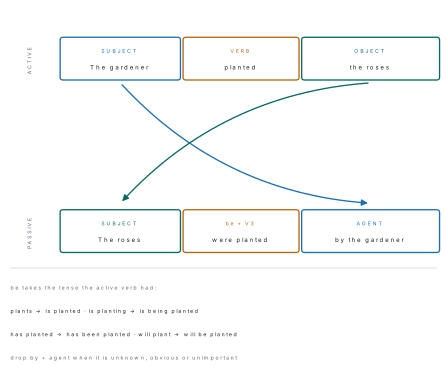
- The object of the active sentence becomes the subject of the passive.
- The verb becomes be + past participle, and be is put into the same tense as the active verb.
- The old subject becomes the agent with by — and is dropped whenever it is unknown, obvious or unimportant.
Only a verb that has an object (a transitive verb) can be made passive.
29.1 The transformation
29.2 The passive of every tense
| Tense | Active | Passive |
|---|---|---|
| Simple present | He writes a letter. | A letter is written by him. |
| Present continuous | He is writing a letter. | A letter is being written by him. |
| Present perfect | He has written a letter. | A letter has been written by him. |
| Simple past | He wrote a letter. | A letter was written by him. |
| Past continuous | He was writing a letter. | A letter was being written by him. |
| Past perfect | He had written a letter. | A letter had been written by him. |
| Simple future | He will write a letter. | A letter will be written by him. |
| Future perfect | He will have written a letter. | A letter will have been written by him. |
| going to | He is going to write a letter. | A letter is going to be written by him. |
| Modal | He must write a letter. | A letter must be written by him. |
| Perfect modal | He must have written a letter. | A letter must have been written by him. |
| Infinitive | He wants to write a letter. | He wants a letter to be written. |
| Gerund | I remember writing it. | I remember its being written. |
Four tenses have no ordinary passive: present perfect continuous, past perfect continuous, future continuous and future perfect continuous. The mechanic has been repairing the car is simply left in the active.
✗ A letter has written by him. → ✓ …has been written… (the be cannot be dropped) ✗ The window was broke. → ✓ The window was broken. (past participle, not past tense) ✗ He was died last year. → ✓ He died last year. (die is intransitive — no passive) ✗ The matter was discussed about in the meeting. → ✓ The matter was discussed in the meeting. ✗ The letter was written by a pen. → ✓ …with a pen. (by = the doer, with = the instrument)
29.3 Verbs with two objects
Give, send, offer, teach, tell, show, lend, pay, promise, hand and award take an indirect object (a person) and a direct object (a thing), so each of them has two possible passives. English prefers the one that begins with the person.
| Active | Passive 1 (person first — preferred) | Passive 2 (thing first) |
|---|---|---|
| They gave me a prize. | I was given a prize. | A prize was given to me. |
| He taught the boys English. | The boys were taught English. | English was taught to the boys. |
| She sent him a card. | He was sent a card. | A card was sent to him. |
With buy, make, get, cook, find, order the second passive takes for: He bought his sister a watch. → A watch was bought for his sister.
29.4 Imperatives, infinitives and impersonal passives
Imperative sentences
| Active | Passive |
|---|---|
| Open the door. | Let* the door be opened. / You are requested to* open the door. |
| Post this letter. | Let* this letter be posted*. |
| Do not touch the wires. | Let not* the wires be touched. / You are warned not to* touch the wires. |
| Please help the poor. | You are requested to help the poor. |
| Work hard. | You are advised to work hard. |
make, let, see, hear, help
In the active these verbs take a bare infinitive; in the passive the to reappears.
| Active | Passive |
|---|---|
| They made him work overtime. | He was made to work overtime. |
| They let him go. | He was allowed to go. |
| I saw him enter the shop. | He was seen to enter the shop. |
| We heard her sing. | She was heard to sing. |
| They helped me carry the box. | I was helped to carry the box. |
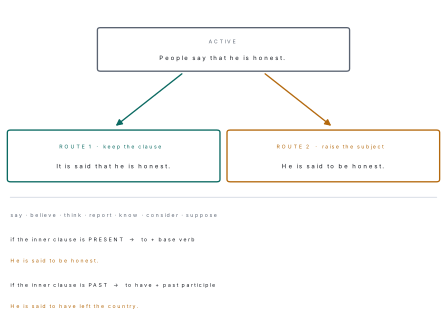
Impersonal passives: It is said that …
| Active | Route 1 | Route 2 |
|---|---|---|
| People believe that she is innocent. | It is believed that she is innocent. | She is believed to be innocent. |
| They report that the bridge collapsed. | It is reported that the bridge collapsed. | The bridge is reported to have collapsed. |
| Everyone knows that he works hard. | It is known that he works hard. | He is known to work hard. |
29.5 Questions, prepositional verbs and verbs with no passive
Questions. Convert the sentence first, then put it back into question form.
| Active | Passive |
|---|---|
| Did he write the letter? | Was* the letter written* by him? |
| Has she paid the bill? | Has* the bill been paid* by her? |
| Who broke the window? | By whom was* the window broken*? |
| What did they discuss? | What was discussed by them? |
| Why did the police arrest him? | Why was* he arrested* by the police? |
Prepositional verbs keep their preposition. It stays attached to the verb even though its object has moved to the front.
| Active | Passive |
|---|---|
| They laughed at him. | He was laughed at. |
| Somebody must look after the baby. | The baby must be looked after. |
| They sent for the doctor. | The doctor was sent for. |
| The surgeon operated on him. | He was operated on. |
| Nobody listened to her. | She was not listened to. |
Verbs that have no passive.
| Group | Examples |
|---|---|
| Intransitive verbs | come, go, die, sleep, arrive, happen, occur, rise, fall, laugh |
| Stative verbs | have (= possess), resemble, lack, suit, fit, become (= suit), hold (= contain), cost, weigh, mean |
| Reflexive and reciprocal objects | He hurt himself. · They know each other. |
✗ The accident was happened at midnight. → ✓ The accident happened at midnight. ✗ This shirt is suited you. → ✓ This shirt suits you.
Prepositions other than by. A few passive participles take a fixed preposition: known to, pleased with, surprised at, filled with, covered with, crowded with, contained in, interested in, tired of, annoyed with. The hall was crowded with students. He is known to everyone here.
29.6 Choosing the voice
Changing voice is an exercise; choosing one is a skill, and the writing questions reward it. Prefer the active as your normal setting — it is shorter and clearer — and switch to the passive for one of these six reasons.
| Reason | Example |
|---|---|
| The doer is unknown | My purse was stolen in the bus. |
| The doer is obvious | The thief was arrested yesterday. (by the police — who else?) |
| The doer is unimportant, as in a process | The tea leaves are plucked, dried and then packed. |
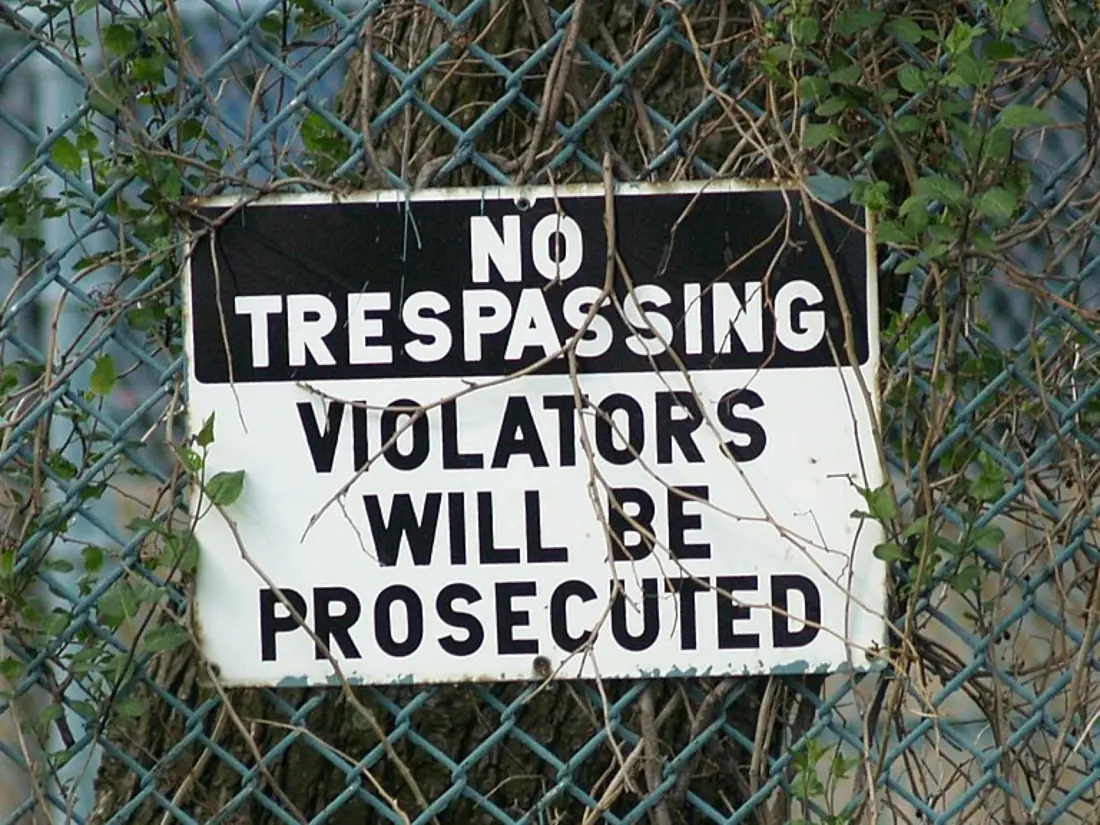
| A rule or notice applies to everybody | Mobile phones must be switched off inside the hall. |
| The receiver is the real topic | The Dharahara was rebuilt after the earthquake. |
| The writer wants to be impersonal | It has been decided that the examination will be postponed. |
Notice the last one. We have decided names a decision-maker; It has been decided does not. That is exactly why official Nepali English — circulars, notices, minutes — is full of passives, and why the same habit makes student essays sound heavy when it is used everywhere. Use the passive because you have a reason, not out of formality.
Keep the agent only when it carries information. Hamlet was written by Shakespeare needs the agent; The road **was repaired by workers does not, because no reader expected anyone else.
Problem. Change into the passive: The principal was giving the students certificates.
Solution — step by step.
- Find the verb and its tense. was giving — past continuous, so the passive frame is was / were being + past participle.
- Find the objects. Indirect object the students (person), direct object certificates (thing).
- Prefer the person as the new subject. The students is plural, so be becomes were.
- Assemble: The students were being given certificates by the principal.
- The alternative starts with the thing and keeps to: Certificates were being given to the students by the principal.
Answer. The students were being given certificates by the principal.
Problem. Change into the passive: (a) Shut all the windows before you leave. (b) They have already dealt with the complaint.
Solution — step by step.
- (a) This is a command. The standard passive of an imperative is Let + object + be + past participle. The subordinate clause before you leave has its own subject and is left untouched. Answer: Let all the windows be shut before you leave. (Also acceptable: You are requested to shut all the windows before you leave.)
- (b) deal with is a prepositional verb; the complaint is its object. The tense is present perfect, so the frame is has / have been + V3. The preposition with stays at the end. Answer: The complaint has already been dealt with.
Problem. Rewrite in two ways: People say that the old temple was built in the twelfth century.
Solution — apply the two routes.
- Route 1 keeps the that-clause and supplies the empty subject it: It is said that the old temple was built in the twelfth century.
- Route 2 raises the inner subject the old temple to the front. Its verb was built is past relative to is said, so the infinitive must be the perfect passive infinitive to have been built.
- Note that the inner verb here is itself passive, which is why the form is to have been built and not to have built.
Answer. (i) It is said that the old temple was built in the twelfth century. (ii) The old temple is said to have been built in the twelfth century.**
Chapter summary
- Passive = be + past participle, with be carrying the tense of the original verb; only transitive verbs have a passive.
- The object becomes the subject; the subject becomes the by-agent, and the agent is dropped when it is unknown, obvious or unimportant.
- Present perfect continuous, past perfect continuous, future continuous and future perfect continuous have no ordinary passive.
- Modals: must be done, can be seen, should have been finished.
- Two-object verbs give two passives; the one beginning with the person is preferred, and the other inserts to (or for with buy, make, cook).
- Imperatives become Let + object + be + V3, or You are requested / advised / warned to …
- make, let, see, hear, help take a bare infinitive in the active but to in the passive: He was made to wait.
- Impersonal actives give It is said that … or He is said to be / to have been …
- A prepositional verb keeps its preposition: The baby was looked after.
- by marks the doer, with the instrument; die, happen, arrive, resemble, suit, lack have no passive at all.
Practice questions
Change into the passive voice (1 mark each)
- The postman delivers the letters every morning. [1]
- They are repairing the road near our school. [1]
- Someone has stolen my bicycle. [1]
- The committee will announce the results tomorrow. [1]
- You must submit the application before Friday. [1]
- The teacher gave Sita a prize. [1]
- Shut the gate at once. [1]
- Who wrote this poem? [1]
- They made him sign the paper. [1]
- The villagers are looking after the orphans. [1]
Answers
1. The letters are delivered (by the postman) every morning. — simple present: are + V3.
2. The road near our school is being repaired. — present continuous: is being + V3; the vague agent they is dropped.
3. My bicycle has been stolen. — present perfect; someone is unknown, so no agent.
4. The results will be announced by the committee tomorrow. — future: will be + V3.
5. The application must be submitted before Friday. — modal: must be + V3.
6. Sita was given a prize by the teacher. (or A prize was given to Sita by the teacher.) — the person-first passive is preferred.
7. Let the gate be shut at once. — imperative passive.
8. By whom was this poem written? — who becomes by whom and the auxiliary follows it.
9. He was made to sign the paper. — make takes to in the passive.
10. The orphans are being looked after by the villagers. — the preposition after stays with the verb.
Change into the active voice (1 mark each)
- The window was broken by the boys. [1]
- A new hospital is going to be built here. [1]
- Let the lights be switched off. [1]
- He is said to be very generous. [1]
Answers
11. The boys broke the window. — the agent becomes the subject.
12. They are going to build a new hospital here. — supply a general subject when no agent is given.
13. Switch off the lights. — Let … be + V3 is the passive of an imperative.
14. People say that he is very generous. — Route 2 reversed.
Correct the errors (1 mark each)
- The letter has written by the secretary. [1]
- He was died in a road accident. [1]
- The problem was discussed about for two hours. [1]
- The glass was broke by the cat. [1]
- The poem was written by a blue pen. [1]
- The hall was crowded by students. [1]
Answers
15. The letter has been written by the secretary. — the passive needs been.
16. He died in a road accident. — die is intransitive and has no passive.
17. The problem was discussed for two hours. — discuss takes no about.
18. The glass was broken by the cat. — past participle, not past tense.
19. The poem was written with a blue pen. — with marks the instrument.
20. The hall was crowded with students. — crowded takes with.
Practise more: English question bank