Unit 11 · Literature - Poems · 44 min read
The Awakening Age
What the syllabus asks for 10
- About the poet
- The poem and its occasion
- The poem, couplet by couplet
- Paraphrase in plain English
- Central idea and themes
- Form, rhyme and structure
- Imagery, figures of speech and sound devices
- Tone
- Critical appreciation
- Glossary
Fourteen lines, seven pairs, one line drawn round the earth. Ben Okri's poem is the shortest text in your literature course and in some ways the easiest to misread, because everything in it is pleasant — hope, vision, light, harvest — and it is tempting to write it off as a greeting card. It is not. The poem has a hard argument inside it: that the poor are routinely described only by what they lack, and that this description is itself part of what keeps them poor. Change the perception, Okri says, and you change what is possible.
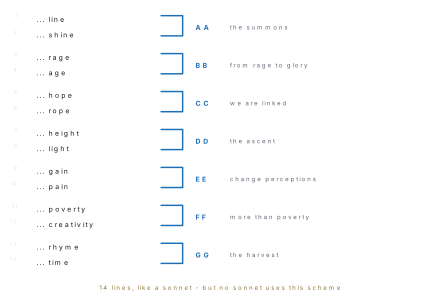
The rhyme scheme, because the textbook asks about it twice: aa bb cc dd ee ff gg — seven rhyming couplets. The fact that it has fourteen lines (which is why the exercises call it a sonnet) but no regular metre and no standard sonnet rhyme scheme. The key phrases: the meridian line, poverty's rage, the awakening age, richly linked in hope, woven in history, like a mountain rope, there's more to a people than their poverty, may our lives rhyme. And the central argument: perception, not charity, is what has to change.
11.1 About the poet
Sir Ben Okri was born on 15 March 1959 in Minna, in central Nigeria, to an Urhobo family.
The CDC textbook gives Okri's date of birth as 1949. This is an error. Okri was born in 1959. If a question asks for the poet's dates, write 1959; if you are anxious about contradicting the book, write "born 1959 (the textbook's 1949 is a misprint)".
When he was a baby his father went to London to study law, and Okri spent his early childhood in Peckham, south London, before the family returned to Nigeria in 1968 — into the middle of the Nigerian Civil War (the Biafran war, 1967–70). That war, seen through a small boy's eyes, runs underneath a great deal of his later work.
He began publishing young. His breakthrough came in 1991, when The Famished Road — narrated by Azaro, an abiku or spirit-child who keeps being born and dying — won the Booker Prize. It made him, at thirty-two, one of the youngest winners in the prize's history. Its sequels are Songs of Enchantment (1993) and Infinite Riches (1998).
His writing is usually placed under the heading of magical realism, and Okri has always resisted the label, arguing that what Europeans call magic is simply the ordinary furniture of a West African world-view. In the interview quoted in your textbook he makes the point exactly: "I grew up in a tradition where there are simply more dimensions to reality: legends and myths and ancestors and spirits and death. You can't use Jane Austen to speak about African reality."
He has lived in Britain since 1978, has been a Fellow of the Royal Society of Literature, received the OBE in 2001, and was knighted (KBE) in 2023 — so he is properly Sir Ben Okri.
11.2 The poem and its occasion
Here is a piece of context that almost no Nepali guide gives you, and it changes how the poem reads.
"The Awakening Age" was commissioned in 1999 for a project called "On The Line", run by Oxfam to mark the millennium. The project followed the Greenwich Meridian — the line of zero longitude — from Britain southwards through France, Spain, Algeria, Mali, Burkina Faso, Togo and Ghana, and on to Antarctica, and it linked schools and communities that happened to lie along that line so that they could learn about one another.
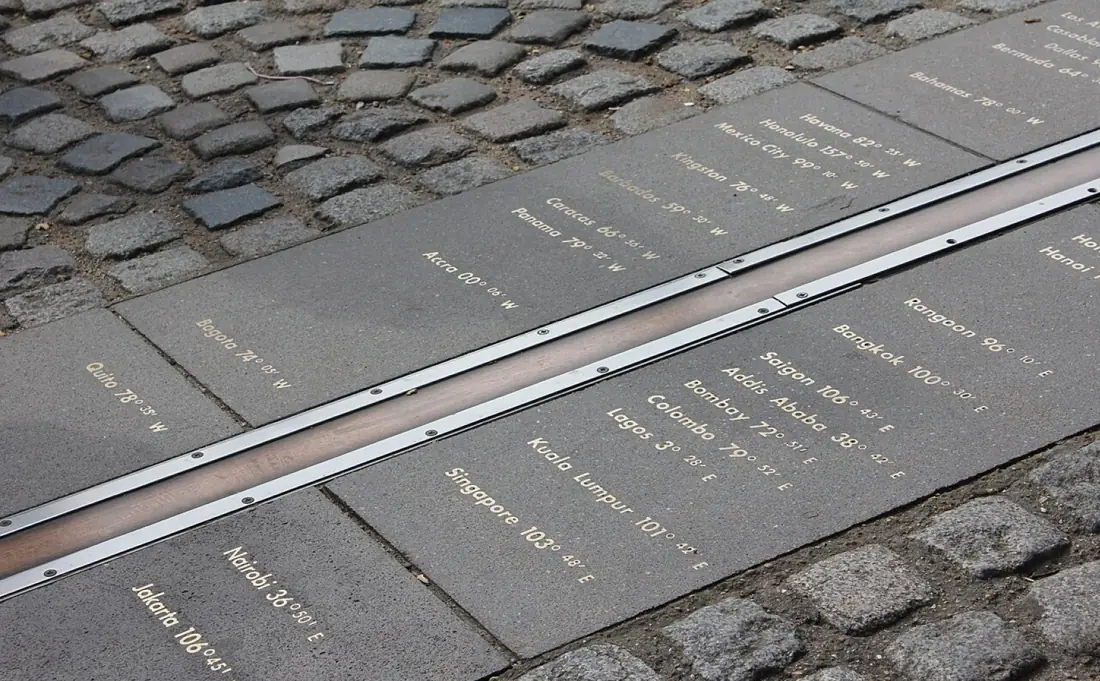
That single fact explains the poem's opening address — "O ye who travel the meridian line" — which otherwise looks like a vague metaphor. The travellers are, first of all, the people of the countries the meridian actually passes through, and the line is a real line, painted on the ground at Greenwich and running across the Sahara.
It follows that two things commonly said about this poem need care:
It is not a poem about the Nigerian civil war. Your textbook's introduction mentions that Okri's writing "treats his family's experience of the Nigerian civil war", which is true of his fiction, and many guides then read the war into this poem. There is no war in it. Its subject is the relationship between rich and poor countries at the end of the twentieth century.
It is not simply a poem about labour migration, although the textbook's "Before reading" questions and the final essay topic push you that way. The travellers on the meridian are people connected across distance, not necessarily people who have emigrated. You can and should answer the migration questions — but do it honestly, saying that the poem can be applied to migration rather than pretending it is about Nepali workers in Qatar.
Do not spend your answer attacking the textbook. Give the poem's real occasion in one sentence — "written in 1999 for Oxfam's 'On The Line' project, which linked communities along the Greenwich Meridian" — and then answer the question asked. Examiners reward the fact; they do not reward a quarrel.
11.3 The poem, couplet by couplet
The poem is in copyright, so only short quotations are given. Keep the textbook open at page 239.
Couplet 1 — the summons
O ye who travel the meridian line, May the vision of a new world within you shine.
The poem opens in the manner of a blessing or an invocation. "O ye" is deliberately archaic — the language of the King James Bible, of hymns, of public prayer — and it lifts the poem at once out of ordinary speech into ceremony. "May…" is the optative: a grammatical form used for wishing. Six of the seven couplets are either a wish or a statement of fact; none of them is an order. Okri never tells anybody what to do.
Two details repay attention. The vision is of a new world within you — the change is internal before it is political. And "shine" begins the poem's chain of light images, which runs through "glory", "clearest light" and "flowering".
Couplet 2 — from rage to glory
May eyes that have lived with poverty's rage, See through to the glory of the awakening age.
"Poverty's rage" is the poem's harshest phrase and it should not be softened. Rage is not sadness or hardship; it is violent anger. Okri is saying that poverty is not a quiet misfortune — it is furious, and it makes the people inside it furious. The eyes have "lived with" it, as one lives with a difficult relative: constantly, at close quarters, without escape.
"See through to" is precise. Not see, but see through — as though poverty were a wall or a fog that the vision has to penetrate. And the thing on the other side is "the glory of the awakening age", a word from religion and from royalty, given here to the poor.
"The awakening age" — the title phrase. An age that is waking up, and an age in which people wake up. Okri does not say the new age or the coming age: he chooses a word that implies the light was always there and the eyes were shut.
Couplet 3 — the argument for solidarity
For we are all richly linked in hope, Woven in history, like a mountain rope.
Note "For" — the only logical connective in the poem. This couplet is the reason the wishes are worth making.
"Richly linked" does work that is easy to miss: "rich" has just been set against "poverty" two lines earlier, and here the wealth is relocated. We are not rich in money; we are rich in connection.
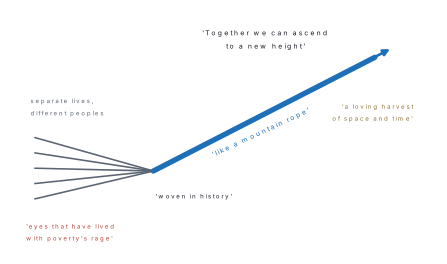
"Woven in history" makes history a fabric rather than a line of dates — and a fabric is made of separate threads that are worthless singly and strong together. The simile then hardens the idea: "like a mountain rope". A climbing rope is the perfect image for Okri's politics, and it is worth spelling out to a Nepali reader who may know real ropes better than most: a rope is many strands twisted into one; it is useless unless it is attached at both ends; it means the climbers share one fate, so that if one falls the others must hold; and it exists for a single purpose — going up.
Couplet 4 — the ascent
Together we can ascend to a new height, Guided by our heart's clearest light.
The rope is now used. "Together" is the first word of the line and the whole poem's condition. "Ascend" is a formal, aspiring verb — one ascends a mountain, a throne, a staircase to heaven; one merely climbs a wall.
The guide is "our heart's clearest light" — not reason, not policy, not economics. Okri is a writer who habitually trusts intuition and vision over analysis, and this half-line is his position in six words. Note "our heart's": singular heart, plural owners. The many have become one climber.
Couplet 5 — the hinge
When perceptions are changed there's much to gain, A flowering of truth instead of pain.
This is the intellectual centre of the poem, and the couplet to quote if you have to defend it as a serious poem rather than a pleasant one.
"When perceptions are changed" — not when aid arrives, not when the economy grows. What has to change first is how people are seen. The passive voice ("are changed") quietly leaves open who does the changing: the poor must stop seeing themselves through others' eyes, and the rich must stop seeing the poor as a problem to be pitied.
"A flowering of truth instead of pain" returns to the organic imagery. Flowering is slow, natural and cannot be forced; it also implies that the truth was already planted. And the opposition is exact: truth replaces pain, which suggests that a good part of the pain was never material at all — it was the pain of being misdescribed.
Couplet 6 — the definition
There's more to a people than their poverty; There's their work, wisdom, and creativity.
The plainest couplet in the poem, and the one to memorise. It is also the only place where Okri argues with an unnamed opponent — the aid poster, the television appeal, the newspaper report that shows a country only as hunger and disaster.
The semicolon is doing real work: it balances a negative statement against a positive one on either side of the same breath. And the three nouns are chosen to cover everything: work (what people do), wisdom (what they know), and creativity (what they make). Notice that "work" comes first. Okri is not offering a sentimental picture of noble poverty; he is pointing at an economy that the poster does not photograph.
The rhyme here is worth remarking: poverty / creativity. It is the poem's only polysyllabic rhyme, and it deliberately chains the two words together in the ear — the very pairing the couplet is arguing about.
Couplet 7 — the harvest
Along the line may our lives rhyme, To make a loving harvest of space and time.
The final couplet turns the poem's own technique into its meaning. "May our lives rhyme" — rhyme is what happens when two different things are found to end in the same sound: not identical, but answering one another. That is Okri's model of human relationship, and he has spent thirteen lines demonstrating it in couplets before naming it here.
"Along the line" returns us to the meridian of line 1, closing the poem in a circle.
"A loving harvest of space and time" is the last and largest image. Harvest implies that something was sown long ago and tended; it implies seasons and therefore patience; and it implies enough for everybody, which is the answer to poverty that the poem has been building towards. And what is harvested is not grain but "space and time" — that is, the whole world and the whole future.
11.4 Paraphrase in plain English
You who travel along the meridian line: I hope the picture of a new and better world lights up inside you. I hope that people whose eyes have looked at nothing but furious poverty can see past it to the splendour of this age that is waking up. Because all of us are connected to one another by hope, and that connection makes us wealthy; history has woven us together the way strands are twisted into a climbing rope. Working together we can climb to a level we have never reached before, with nothing to guide us but the clearest light our hearts can give. Once the way people see one another changes, there is a great deal to be won: truth will open like a flower where there used to be pain. A people is much more than its poverty — it also has its labour, its knowledge and its power to create. So along this line, may our separate lives answer one another the way two rhyming words do, and between us may we gather in a harvest, made with love, out of all the space and all the time we have.
11.5 Central idea and themes
Central idea. Addressing people linked by a line drawn round the earth, Okri prays that they may see past poverty to a world waking up. His argument is that human beings are already connected — woven together like the strands of a climbing rope — and that what must change first is not their wealth but their perception: the poor must be seen, and must see themselves, as people with work, wisdom and creativity rather than as a lack. If lives can be made to rhyme with one another, the result is a shared harvest of space and time.
Solidarity and interconnectedness. The poem's central claim, carried by "we are all richly linked in hope" and the mountain rope, and enacted by the couplet form. Every idea in the poem arrives in a pair.
Perception and dignity. "When perceptions are changed there's much to gain." Okri's target is the international habit of defining whole nations by their poverty. The counter-statement is couplet 6. This is the theme that makes the poem political rather than merely warm.
Hope and awakening. Light imagery from beginning to end — shine, glory, clearest light, flowering — and the title's promise that the age is waking, not being built from nothing.
Unity across difference. The meridian crosses Europe and Africa, rich and poor, north and south. The poem's model of unity is rhyme, not sameness: two words that stay different and still answer each other.
Shared effort and shared risk. The rope and the word "ascend". Nobody in this poem is rescued; everybody climbs, roped to everybody else.
Time, patience and harvest. Flowering and harvest are slow processes. Okri promises a change of age, not a quick fix.
11.6 Form, rhyme and structure
Fourteen lines in seven couplets. Set out in your textbook with a blank line between each pair.
Rhyme scheme: aa bb cc dd ee ff gg. Every couplet rhymes on its own sound and the sound is not used again. The rhyme words are: line/shine, rage/age, hope/rope, height/light, gain/pain, poverty/creativity, rhyme/time. All are full (perfect) rhymes except poverty/creativity, which rhymes on the final two syllables and is the poem's only long, polysyllabic pair.
Is it a sonnet? The exercises call it "this sonnet", and you should answer the questions as set — but you can be accurate at the same time. It has the sonnet's length (fourteen lines) and a sonnet's habit of ending on a couplet. It does not have any recognised sonnet's rhyme scheme: a Shakespearean sonnet runs abab cdcd efef gg and an Italian sonnet abbaabba plus a sestet. Seven consecutive couplets is not a sonnet form. Nor does the poem keep a regular metre. The safe formula for an answer is: "fourteen lines like a sonnet, but built out of seven rhyming couplets rather than any standard sonnet scheme."
Metre: none, strictly. The lines run from about eight to about thirteen syllables ("Guided by our heart's clearest light" is the shortest; "See through to the glory of the awakening age" the longest), and the rhythm is a loose speaking rhythm with a rising, roughly iambic pull. Do not write that the poem is in iambic pentameter; it is not, and the claim is easy to disprove by counting.
Structure of the argument. Couplets 1–2 wish; couplet 3 gives the reason ("For…"); couplet 4 draws the consequence ("Together we can…"); couplets 5–6 state the condition and the truth; couplet 7 returns to the line and closes.
Diction. Deliberately elevated and slightly old-fashioned — "O ye", the repeated "May", "ascend", "glory", "harvest". This is the register of blessing and of public ceremony, appropriate to a poem commissioned for a millennium project.
Why couplets? Because the poem is about partnership. A couplet is two lines that have found a common ending. Seven times over, the form performs the argument before couplet 7 explains it: "may our lives rhyme".
11.7 Imagery, figures of speech and sound devices
| Device | Where it occurs | What it does |
|---|---|---|
| Apostrophe | "O ye who travel the meridian line" | direct address to an absent, plural audience; opens the poem as a blessing |
| Archaism | "O ye" | biblical, ceremonial register suited to a millennium commission |
| Symbol | "the meridian line" | a real line of zero longitude; here, the thread that links distant peoples |
| Light imagery | "shine", "glory", "clearest light" | knowledge, hope and awakening; runs from couplet 1 to couplet 4 |
| Personification | "poverty's rage" | poverty given a violent temper of its own |
| Metonymy | "eyes that have lived with poverty's rage" | eyes stand for the people who have suffered |
| Metaphor | "see through to the glory" | poverty as a barrier the vision penetrates |
| Metaphor | "richly linked in hope" | wealth relocated from money to connection |
| Metaphor | "woven in history" | history as fabric; individuals as threads |
| Simile | "like a mountain rope" | the poem's central image: many strands, one climb, shared fate |
| Metaphor | "ascend to a new height" | moral and social progress as mountaineering |
| Metaphor | "our heart's clearest light" | intuition, not calculation, as the guide |
| Metaphor | "a flowering of truth" | truth as a plant already sown, opening slowly |
| Antithesis | "truth instead of pain"; "more to a people than their poverty" | the poem's argumentative shape: replace one account with another |
| Triad (tricolon) | "work, wisdom, and creativity" | three nouns covering doing, knowing and making |
| Alliteration | "work, wisdom"; "loving … line … lives" | binds the key words of the closing couplets |
| Pun / self-reference | "may our lives rhyme" | the poem's form named inside the poem |
| Metaphor | "a loving harvest of space and time" | sowing, patience and sufficiency; the whole world as the crop |
| Rhyming couplets | throughout | pairing as the formal enactment of solidarity |
| Optative mood | "May the vision…", "May eyes…", "may our lives…" | wishes, never commands: Okri blesses rather than instructs |
Two rhyming words are not the same word. Hope and rope stay different in meaning, in spelling and in everything but the final sound. This is precisely Okri's politics: unity without uniformity. When you answer question (f) in "Reference to the context", this is the connection to make.
11.8 Tone
The tone is hopeful, ceremonial and generous, but it is not soft.
The register is that of a blessing: "O ye", "May…", repeated three times. The speaker stands slightly above the ordinary, like someone speaking at a ceremony, which is exactly what the poem was written for.
Underneath the ceremony there is quiet anger, and it surfaces in two places. "Poverty's rage" is a violent phrase in a gentle poem. And "There's more to a people than their poverty" is a correction — you can only correct somebody who has said something wrong. Okri is answering, politely, a world that has described whole continents as a deficiency.
There is confidence in the flat present-tense statements of couplets 3 and 6 ("For we are all richly linked…", "There's more to a people…"), which are the only lines in the poem not framed as a wish.
And the ending is serene: harvest, love, space and time. Nothing is demanded and nobody is blamed.
11.9 Critical appreciation
The risk this poem runs is obvious. A commissioned poem about global solidarity, written for a charity, full of light and hope and harvest, is very close to the territory of the inspirational poster — and readers who dislike it usually say so on those grounds: that it is abstract, that nobody in it has a name, that "work, wisdom, and creativity" is a slogan.
The defence is that Okri has hidden a genuinely awkward argument inside the pleasant surface, and it is contained in one word: perceptions.
Almost every public statement about world poverty proposes a transfer — of money, of food, of technology — from those who have to those who have not. Okri's poem proposes nothing of the kind. What it asks to be changed is the description. Couplet 6 is the sharpest thing in the poem precisely because it is the flattest: "There's more to a people than their poverty." That sentence is aimed at the charity appeal itself, which must show suffering in order to raise money, and which therefore teaches the world to see an entire people as a photograph of hunger. For a poem paid for by an aid organisation to say this is braver than it looks.
The second success is the mountain rope. Okri could have written "like a chain" or "like a river" and produced nothing. The rope carries four ideas at once — many strands, one purpose, shared fate, upward motion — and it converts the poem's abstraction into something a reader can feel in the hands. It is also, as it happens, the one image in the poem that a Nepali student is better placed to understand than a British one.
The third and cleverest success is the form. A poem arguing that separate lives should answer one another, written entirely in couplets, and ending with the words "may our lives rhyme", is a poem whose shape is its content. Nothing in it is decorative. Even the choice of seven distinct rhyme sounds rather than a repeating scheme matters: each couplet is a separate partnership, not a repetition of the same one, which is a picture of a world of many different bonds rather than one uniform order.
Where the poem is weakest is in the middle of couplet 4. "Guided by our heart's clearest light" is the line that does least work; it is the sort of thing poems say, and Okri, who is capable of the mountain rope, could have found something harder there.
Read beside "The Awakening Age", his better-known lines — "The most authentic thing about us is our capacity to create, to overcome" — show the same conviction. Okri's whole career is an argument that the imagination is a political instrument, and this small poem is that argument at its most compact: change what people can see, and you change what they can do.
11.10 Glossary
| Word or phrase | Meaning as used here |
|---|---|
| O ye | archaic form of "O you" (plural); the language of prayer and public address |
| meridian line (n.) | an imaginary circle round the earth passing through both poles; specifically the Greenwich Meridian, 0° longitude |
| vision (n.) | both the power of sight and an imagined picture of how things could be |
| rage (n.) | violent anger |
| see through to | look past something that blocks the view, to what lies beyond |
| glory (n.) | magnificence, splendour; a word from religion and royalty |
| awakening (adj.) | waking up; coming to consciousness after sleep or ignorance |
| age (n.) | a long historical period with a character of its own |
| richly (adv.) | abundantly, plentifully — here set against "poverty" two lines earlier |
| woven (v., past participle of weave) | made by crossing threads over and under one another |
| mountain rope (n.) | a climbing rope, made of many strands twisted together, roping climbers to each other |
| ascend (v.) | climb, go up (formal) |
| perceptions (n.) | the ways in which people see, understand or interpret something |
| flowering (n.) | the act of coming into flower; a natural, gradual opening out |
| wisdom (n.) | knowledge gained from experience and good judgement |
| creativity (n.) | the ability to make new things and new ideas |
| rhyme (v.) | to end in the same sound; here, of lives, to answer and match one another |
| harvest (n.) | the gathering in of a ripe crop; the reward of long, patient work |
| solidarity (n.) | unity and mutual support among people with a common interest |
| couplet (n.) | two consecutive lines of verse that rhyme with each other |
| optative (adj.) | (of a verb form) expressing a wish, as in "May our lives rhyme" |
Couplets (aa bb cc dd ee ff gg) · rope (many strands, one climb) · perceptions (what must change first) · more ("there's more to a people than their poverty") · rhyme (unity without sameness) · harvest (patient, shared, enough for all).
Chapter summary
Sir Ben Okri (born 1959 in Minna, Nigeria; the textbook's "1949" is a misprint) spent his early childhood in London, returned to Nigeria during the civil war, and won the Booker Prize in 1991 for The Famished Road. "The Awakening Age" was written in 1999 for Oxfam's "On The Line" project, which linked communities along the Greenwich Meridian from Britain through West Africa — which is why the poem addresses "ye who travel the meridian line". Its fourteen lines fall into seven rhyming couplets, aa bb cc dd ee ff gg, with no regular metre; it has a sonnet's length but no sonnet's scheme. The poem wishes that those who have lived with "poverty's rage" may see through to "the glory of the awakening age", argues that we are "richly linked in hope" and "woven in history, like a mountain rope", and promises that together we can "ascend to a new height". Its hinge is couplet 5 — "When perceptions are changed there's much to gain" — and its plainest claim is couplet 6: "There's more to a people than their poverty; / There's their work, wisdom, and creativity." The last couplet turns technique into meaning: "Along the line may our lives rhyme, / To make a loving harvest of space and time." Two rhyming words remain different and still answer each other, and that is Okri's picture of a united world.
Practice questions
Understanding the text
a. Who are the people 'who travel the meridian line'? [2]
Literally, they are the people who live along and move across the Greenwich Meridian — the line of zero longitude that runs from Britain down through France and Spain into Algeria, Mali, Burkina Faso, Togo and Ghana. The poem was written in 1999 for Oxfam's "On The Line" project, which linked communities along exactly that route. More widely, they are all human beings, since the meridian encircles the whole earth: travellers, migrants, and anyone connected to distant others by the line that joins north to south, rich to poor.
b. What does the poet mean by 'a new world'? [2]
Not a new place but a new condition — the "awakening age" the title promises: a world in which people are no longer defined by their poverty, in which work, wisdom and creativity are recognised wherever they exist, and in which nations are linked in hope rather than divided by wealth. The poem insists that this world begins "within you": it is first a change of vision and only afterwards a change of circumstances.
c. How are people connected to each other? [2]
By hope and by history. The poem says "we are all richly linked in hope, / Woven in history, like a mountain rope." The two images are a fabric and a rope: our lives are threads crossing one another in a single cloth, and the strands of a climbing rope twisted into one. The simile adds shared risk and shared purpose — roped climbers rise or fall together.
d. What can we gain after our perceptions are changed? [2]
"There's much to gain": the poem names it as "a flowering of truth instead of pain." Once people stop seeing the poor as nothing but poor, the truth about them opens out naturally, like a flower, and the suffering caused by that false description ends. Practically, what is gained is the recognition of a people's work, wisdom and creativity, and the possibility of ascending together "to a new height".
e. How are we benefited by new people? [2]
Through what they bring rather than what they need. The poem's answer is couplet 6: "There's more to a people than their poverty; / There's their work, wisdom, and creativity." New people bring labour, accumulated knowledge and the power to make new things; contact with them changes our perceptions, and the poem says that changed perceptions are themselves a gain. The benefit is mutual, since "we are all richly linked in hope".
f. Describe the rhyme scheme of this sonnet. [2]
The poem is fourteen lines arranged as seven rhyming couplets, so the scheme is aa bb cc dd ee ff gg: line/shine, rage/age, hope/rope, height/light, gain/pain, poverty/creativity, rhyme/time. Each couplet has its own rhyme sound, used once and not repeated. All are full rhymes; poverty/creativity is the only polysyllabic pair. (Strictly, although the poem has a sonnet's fourteen lines, no standard sonnet uses seven consecutive couplets, and the poem keeps no regular metre.)
Reference to the context
a. What does the poet mean by 'the awakening age'? [5]
The phrase names the historical moment the poem hopes for, and it does so with a word chosen very carefully.
An age that is waking up. Okri wrote the poem in 1999, at the turn of the millennium, for a project about a new century. "Awakening" is a present participle: the waking is happening now, not completed and not merely promised. The age is in the act of opening its eyes.
An age in which people wake up. The grammar runs both ways. In couplet 2 it is "eyes" that must "see through", so the awakening is something that happens inside individual people as much as in history. This is consistent with the poem's opening wish that the new world should "within you shine".
Waking implies the light was always there. This is the crucial point and the one that separates a good answer from an ordinary one. Okri does not call it the building age or the rescuing age. When you wake, nothing outside you has changed; you simply begin to perceive what was already present. Applied to his subject, that means the work, wisdom and creativity of poor nations are not things that have to be created by outside help — they exist already, and what has to change is the eye that failed to see them. Couplet 5 says this directly: "When perceptions are changed there's much to gain."
And it carries the poem's moral temperature. Waking is gentle, natural and inevitable — unlike revolution, which is violent, or development, which is imposed. The poem's associated images are of the same family: a flower opening, light shining, a crop ripening. All of them are processes that cannot be forced and cannot be stopped.
So "the awakening age" means an era in which humanity becomes conscious of its own interconnection, in which the poor are seen and see themselves truly, and in which the "glory" that was always there becomes visible.
b. Why, in your view, have these people 'lived with poverty's rage'? [5]
First, notice the exact phrase. It is not "lived in poverty" but "lived with poverty's rage" — as one lives with an illness or a violent relative: continuously, at close quarters, without the option of leaving. And poverty is given a temper of its own. It is not a quiet absence; it is furious.
Why "rage" rather than "sorrow"? Because Okri wants to destroy the picturesque image of the patient, uncomplaining poor. Poverty makes people angry, and it has every right to. The anger also belongs to poverty itself, which behaves violently: it takes children out of school, it kills people who could have been saved, it destroys families. Calling it rage refuses to be polite about it.
In my view, the causes the poem points to are historical. The word to hold on to is "woven in history". The meridian along which this poem was written runs from Britain, the centre of the largest empire in history, straight down through Mali, Burkina Faso, Togo and Ghana — countries that were governed from Europe and whose wealth flowed north for a century and more. The poverty of the south and the riches of the north are not two separate facts; they are two ends of the same rope. That is why the poem insists we are all "linked": the link explains the inequality as well as the hope.
And the poem adds a cause that most accounts leave out: perception itself. Couplet 6 is a correction — "There's more to a people than their poverty" — and you only correct somebody who has been saying something false. A people continuously described as nothing but hungry is denied credit, investment, respect and self-belief, and that description becomes one of the mechanisms that keeps them poor. In this sense they have lived with poverty's rage partly because the world decided that poverty was all they were.
Finally, my own reason for reading it this way. Nepal makes the argument easy to test. A country routinely presented abroad as one of the poorest in Asia is also a country of extraordinary craft, farming knowledge, languages and endurance — the very "work, wisdom, and creativity" of couplet 6. The poverty is real and it enrages; but it is not the whole description, and Okri's poem exists to say so.
c. Why does the poet appeal for solidarity among the people? [5]
Because, in this poem, solidarity is not a kindness but a fact — and the appeal is only to act on something that is already true.
His first reason is that we are already joined. Couplet 3 is the only one that begins with "For", the poem's single word of logic: "For we are all richly linked in hope, / Woven in history, like a mountain rope." The wishes of the first two couplets are justified by this statement. We do not have to build a connection; history has already woven one, and the poem's job is to make people notice it.
His second reason is that nothing can be achieved alone. The mountain rope makes this concrete. A rope is many strands twisted together, and a single strand would snap; it joins climbers so that a slip by one is held by the others; and it exists for one purpose — going up. The next couplet cashes the image in: "Together we can ascend to a new height." The word together is the condition, not a decoration.
His third reason is the redistribution of the word "rich". He has just used "poverty's rage"; now he says we are "richly linked". The placing is deliberate. It proposes that the real wealth of human beings is their connection to each other, which is a form of riches the poor possess in full.
His fourth reason is that the alternative is a lie. A world without solidarity is a world in which some peoples are seen as problems and others as benefactors. Couplet 6 refuses that arrangement: a people has "work, wisdom, and creativity", which means it has something to give, not only something to receive. Solidarity, unlike charity, is between equals — and that is the relationship the poem is arguing for.
And the form makes the appeal before the words do. Seven couplets, seven pairs, each finding a common sound; then the last line but one says "may our lives rhyme". Okri appeals for solidarity in a shape that has been demonstrating it for thirteen lines.
d. Does the poet present migration in a positive light? Why? Why not? [5]
A careful answer begins by being honest about the question. The poem was written in 1999 for Oxfam's "On The Line" project about communities along the Greenwich Meridian, and its subject is the connection between rich and poor nations rather than migration as such. There is no migrant in it, no departure, no arrival and no border. What the poem gives us is people who "travel the meridian line" — which may mean movement, and certainly means contact across distance. With that said, the poem can be read as presenting movement between peoples very positively, and here is why.
Yes — because travel is where the poem starts. The first line addresses travellers, and the whole poem is a blessing on them. Whoever crosses the line is the person Okri hopes will carry "the vision of a new world".
Yes — because it treats contact as the cure for false perception. The hinge of the poem is "When perceptions are changed there's much to gain", and nothing changes perceptions like meeting people. A world in which Ghanaians and Londoners know one another is a world in which neither can be reduced to a stereotype. Migration, on this reading, is the mechanism of the awakening age.
Yes — because of what the poem says migrants bring. Couplet 6 is the answer to every argument that immigrants are a burden: "There's more to a people than their poverty; / There's their work, wisdom, and creativity." Those three nouns describe exactly what a migrant carries across a border.
Yes — because of the rope. "Together we can ascend to a new height" is the opposite of the idea that one country's gain is another's loss.
But — with two honest reservations. First, the poem says nothing about the cost of migration: the separated families, the exploitation, the loss of young workers by the sending country, the humiliations of the receiving one. Nepal's own experience — the flights to the Gulf and Malaysia, the coffins that come back, the villages of women and old men — is not in this poem. Second, the phrase "poverty's rage" acknowledges that much movement is driven by desperation, not choice, and a poem that celebrated that uncritically would be dishonest.
Conclusion. Okri presents human movement and contact in a strongly positive light, as the means by which perceptions change and solidarity becomes real. He does not examine the hardships of economic migration, because that is not what the poem was written about.
e. Nepal is also known for its economic as well as educational migrants. Have you noticed any change in the perceptions and behaviours of these migrants when they return home from abroad? [5]
This calls for your own observation. Write about people you have actually seen. Below is a model answer of the required length and kind; replace the details with your own.
Yes, and the changes are easy to see in any village or small town where people come and go from the Gulf, Malaysia, Korea, Japan and Australia.
Changes in perception. The first and best change is in the idea of what work is respectable. Men who would not have carried their own luggage before leaving come back and open a tea shop or a poultry farm without embarrassment, because they have spent five years doing jobs abroad that nobody at home would have watched them do. The second is a change in the sense of time — returnees complain about offices that open late and buses that leave when they are full, and they are right to. The third, and the most valuable, is a change in expectations of the state: a man who has seen a hospital in Seoul or a road in Dubai stops accepting that potholes and power cuts are natural. Educational migrants come back with a sharper version of the same thing, along with the habit of questioning a teacher, which our classrooms do not always welcome.
Changes in behaviour. Many returnees are noticeably more careful with money and more interested in saving and investing, though some spend the whole of their earnings on a house and a wedding and have to go abroad again. Most are more willing to eat food from other cultures, to speak a third language, and to treat people of other castes as colleagues — the labour camp is a great leveller. Families change too: husbands who have cooked and washed for themselves for years do it at home, quietly, and daughters-in-law are given a little more room.
And the losses. Not every change is good. Some returnees come back contemptuous of Nepal, comparing everything unfavourably with the country that in fact treated them badly. Some come back ill, injured or in debt. Marriages break under ten years of separation, and children grow up without a father and with money instead.
Reading it through Okri. This is where the poem earns its place on our syllabus. The returning migrant is the person whose "perceptions are changed", and what he or she brings home is exactly the poem's triad — work, wisdom and creativity. But the poem's harder demand is the one we still fail: to see ourselves as "more than our poverty" rather than measuring our country permanently against somebody else's.
f. Relate the rhyme scheme of this sonnet to the kind of life idealized by the poet. [5]
This is the best question on the poem, because form and meaning in "The Awakening Age" are the same thing.
The scheme. Fourteen lines in seven rhyming couplets: aa bb cc dd ee ff gg (line/shine, rage/age, hope/rope, height/light, gain/pain, poverty/creativity, rhyme/time).
A couplet is a partnership. Every idea in this poem arrives in a pair. No line stands alone; each is completed by a partner that answers its sound. That is the poem's picture of human life — "we are all richly linked in hope" — and the form has been demonstrating it since line 2, long before the poem explains itself.
Rhyme is unity without uniformity. This is the subtlest point and the one that lifts an answer. Hope and rope are not the same word: different meanings, different spellings, different origins, joined only at the end. So a rhyme is two things that remain wholly themselves and still correspond. The life Okri idealises is precisely this — not a world where everyone is alike, but one where different peoples, along a line that runs from London to Accra, answer one another. He names it himself in the last couplet: "Along the line may our lives rhyme."
Seven different rhymes, not one repeated sound. The poem never reuses a rhyme. Each couplet is its own bond. This pictures a world of many separate, particular relationships rather than one uniform system imposed on everybody — the difference between solidarity and empire.
The rhymes are full, and that matters. There is no half-rhyme or slant rhyme anywhere in the poem: every pair matches completely. The harmony Okri imagines is confident, not tentative. And the one unusual pair, poverty / creativity, is doing an argument's work — it chains those two words together in the ear at the very moment the couplet is insisting that a people is more than the first and also full of the second.
Finally, the couplets move. Each pair closes its sound and the poem starts again with a new one, seven times, which gives a stepping, ascending motion appropriate to "Together we can ascend to a new height." The last step is the harvest, and the last rhyme — rhyme with time — leaves the poem's technique and the poem's hope holding the same sound.
Reference beyond the text
Write an essay on 'The Impacts of Migration on Nepali Society'. [5]
A plan with the material that earns marks, and two written paragraphs to set the level. Aim for about 450 words and use real figures where you are sure of them; if you are not sure, write "roughly" rather than inventing a number.
Introduction. Open with a scene rather than a definition — a departure gate at Tribhuvan International in the early morning, the queue of young men with new suitcases. Then the thesis: migration has become the central economic fact of modern Nepal, and its effects are neither simply good nor simply bad; they are a trade of money for time, of security for presence.
Paragraph 1 — the economic impact. Remittances are the largest single source of foreign currency in the country and support a very large share of household income; villages that were once food-insecure now have tin roofs, motorcycles, schooling and medical treatment. Note the flip side honestly: much of the money goes to consumption, land and weddings rather than to enterprise, and price inflation follows the money. A model paragraph:
Walk through a hill village today and you can read the remittance economy off the rooftops. The old thatch has gone; there is corrugated sheet, and behind it a dish. Inside, a woman runs a household of children and elders on money that arrives every second month from a construction site in Doha. The house is better than her mother's was. She has not seen her husband in three years.
Paragraph 2 — the social impact. Split families; children raised by grandparents; the rise in the number of households headed by women, which brings both burden and a real increase in women's authority over money and decisions; marital breakdown; the loneliness of the elderly. Also the positive social returns: reduced caste rigidity, wider food habits, new languages, new skills.
Paragraph 3 — the demographic and agricultural impact. The absence of young men from the villages has left land uncultivated and reduced the labour available for collective work; in some districts whole terraces have gone back to scrub while the country imports more food. This is the most serious long-term cost and is worth a full paragraph.
Paragraph 4 — human cost and policy. The deaths and injuries in the Gulf and Malaysia; recruitment debt; the absence of protection abroad. Then what could be done: regulating agents, bilateral labour agreements, skills training before departure, and above all creating conditions in which returnees invest here.
Conclusion — bring Okri in. End with couplet 6: "There's more to a people than their poverty; / There's their work, wisdom, and creativity." Nepal currently exports its work and imports the money; the real question for the next generation is whether the wisdom and creativity that come home with the returning migrant can be used here. Close on an image, not a summary — the same departure gate, and what it would take to make it quieter.
Practise more: English question bank