Unit 10 · Literature - Poems · 47 min read
I Was My Own Route
What the syllabus asks for 10
- About the poet
- The poem in translation
- The poem, stanza by stanza
- Paraphrase in plain English
- Central idea and themes
- Form, structure and technique
- Imagery and figures of speech
- Tone
- Critical appreciation
- Glossary
The poem begins with a confession and ends with an empty chair. In between, a woman walks. She starts by admitting that she once tried to be what men wanted — "an attempt at life", she calls it, a rough draft of a person — and she finishes by simply not turning up to the ceremony where the old order had planned to honour her. Nothing in the poem is smashed. Nobody is shouted at. The rebellion consists entirely of walking forward and declining an invitation, and that is what makes it frightening to the people it is aimed at.
That the poem is translated from Spanish — "Yo misma fui mi ruta", from Poema en veinte surcos (1938) — and that this affects what you may safely say about its sound. Its six stanzas of 9, 3, 10, 6, 1 and 8 lines in free verse. The circular structure: stanza 6 repeats the opening lines and changes the ending. The five phrases that carry the meaning — an attempt at life, a game of hide and seek with my being, made of nows, the old guard, the homage was left waiting for me. And the argument that identity is found within, not conferred by anyone's approval.
10.1 About the poet
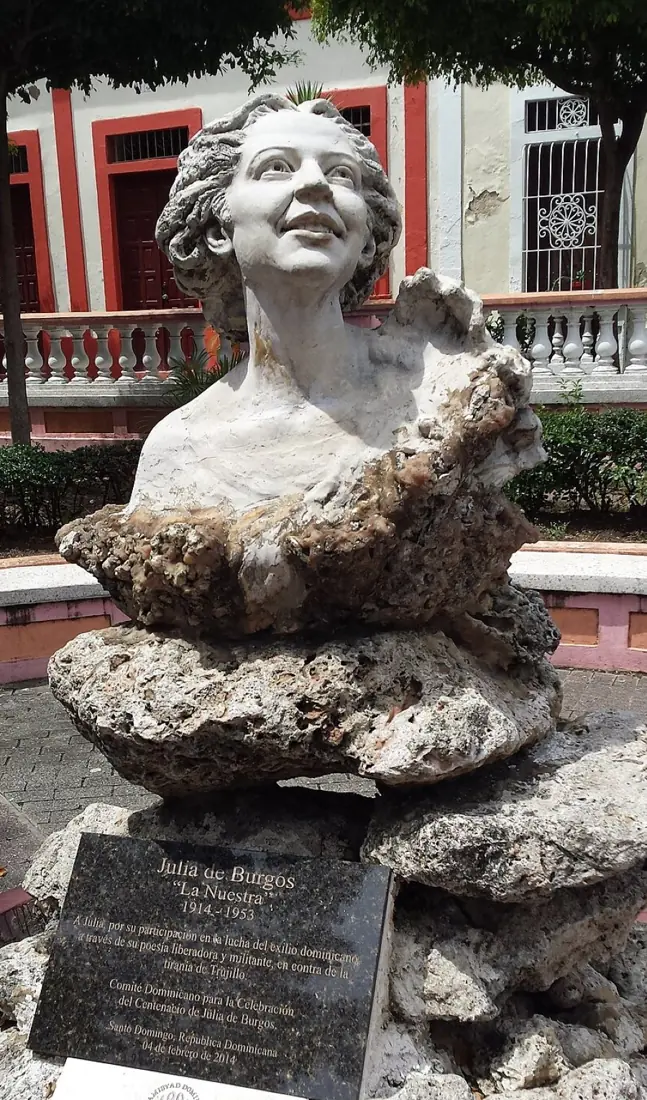
Julia Constanza Burgos García (1914–1953) was born in the Santa Cruz district of Carolina, Puerto Rico, the eldest of thirteen children in a very poor family; six of her brothers and sisters died of malnutrition. She won her way to the University of Puerto Rico and qualified as a teacher in 1935, at twenty-one.
She was a political woman from the start. Puerto Rico had been a possession of the United States since 1898, and de Burgos joined the Puerto Rican Nationalist Party, working in its women's branch, the Daughters of Freedom. Her poetry and her politics were never separate: independence for the island, dignity for the poor, and freedom for women were one cause to her.
Her first collection, Poema en veinte surcos (Poem in Twenty Furrows), appeared in 1938; she is said to have carried copies around herself to sell. "Yo misma fui mi ruta" — "I Was My Own Route" — is from that book. Canción de la verdad sencilla (Song of the Simple Truth) followed in 1939.
In 1940 she left for New York, then spent two years in Cuba, studying at the University of Havana; returning to New York she worked as art and culture editor of the progressive Spanish-language newspaper Pueblos Hispanos. The last years were hard — poverty, illness, alcohol, a broken love affair. On 6 July 1953 she collapsed on a street in Spanish Harlem and died; she was buried at first in an unmarked grave before being identified and brought home to Carolina, where she is now a national figure.
She wrote a generation before the Nuyorican poetry movement of Puerto Rican writers in New York, and is regarded as its precursor — which is what your textbook means by calling her "a precursor to the contemporary Latina/o writers".
10.2 The poem in translation
This is the one thing about this poem that most notes leave out, and it is worth two or three marks in any question about form or sound.
De Burgos wrote in Spanish. The version in your textbook is an English translation by Jack Agüeros, made for Song of the Simple Truth: The Complete Poems of Julia de Burgos (Curbstone Press, 1997), the bilingual edition that introduced her to most English readers. The Spanish title is "Yo misma fui mi ruta" — literally I myself was my route.
What follows from that:
You may discuss imagery, structure and argument with complete confidence. Metaphors survive translation almost intact. The old guard, the branch, the whiplash, the soils of the earth and the regal parade are de Burgos's own inventions and they come through.
You must be careful about sound and rhythm. Any alliteration, assonance or cadence you notice in the English belongs to Agüeros, not necessarily to de Burgos. Never write "the poet uses alliteration in line 7" about a translated poem without the qualification "in the English version".
Something specific is lost that matters here. Spanish marks grammatical gender: adjectives and participles referring to the speaker carry a feminine ending, so a Spanish reader knows in every line that the "I" is a woman. English adjectives do not inflect, so in translation the speaker's womanhood has to be carried entirely by content — by the word "men", by the situation. The poem is therefore, in English, slightly less insistently female than in Spanish.
And the free verse is genuinely de Burgos's. The lines are of very unequal length, there is no rhyme and no metre in either language, so the translator was not forced to break a pattern. What you see on the page — the long sprawling first stanza, the three-line second, the single line of stanza 5 — is the original shape.
One sentence is enough: "Since the poem is a translation from Spanish by Jack Agüeros, its rhythm and sound effects are the translator's; its images and structure are de Burgos's own." Then go on and answer the question. Examiners reward the awareness, not a long digression.
10.3 The poem, stanza by stanza
The poem is in copyright, so short quotations only are given here. Keep the textbook open.
Stanza 1 (nine lines) — the confession and the refusal
I wanted to be like men wanted me to be: an attempt at life; a game of hide and seek with my being.
The poem opens by admitting the failure before describing the escape. The verb is past continuous in feeling — "I wanted to be like men wanted me to be" — and the two appositions that follow are the sharpest definitions of inauthenticity in your syllabus.
"an attempt at life" — not a life, an attempt at one. A trial, a rough draft, a rehearsal. Note the exact preposition: it is "an attempt at life", which is the phrase in the text. A woman shaped by other people's expectations is not living; she is having a go at it.
"a game of hide and seek with my being" — in the game, one child hides and another looks. Here both children are the same person. She is concealing herself from herself, and the tragedy of the image is that it is called a game, as though this permanent self-concealment were a light thing, something children do for fun.
But I was made of nows,
"But" turns the poem, only four lines in. "Nows" is a coined plural — you cannot normally count now — and it is the poem's central invention. She is built out of present moments, one after another, with no past in her composition. Anyone made of nows cannot be governed by what was decided before she was born.
The rest of the stanza is physical. Her feet are "level on the promissory earth" — balanced, standing squarely on ground that promises something (a promissory note is a written promise to pay). Those feet "would not accept walking backwards / and went forward, forward" — the repetition doing the work of a footstep. She goes "mocking the ashes", the ashes being everything already burnt out and finished, "to reach the kiss / of new paths". The kiss is the poem's one tender word, and it recurs.
Stanza 2 (three lines) — the cost
my back was ripped by the desperate flapping wings of the old guard.
Three lines, and the shortest stanza but one. The brevity is the bruise.
The "old guard" — a phrase from Napoleon's Vieille Garde, now meaning the long-established, conservative members of any group who resist change — are given wings, and the wings are desperate and flapping. So they are not a stately procession; they are birds of prey, or scavengers, beating about her and tearing her back as she walks. That the damage is to her back is exact: they can only reach her because she has turned away from them and will not turn round.
The word desperate is a small triumph. The old guard are not calm and powerful; they are frightened. Their violence is a symptom of their weakness.
Stanza 3 (ten lines) — liberation
But the branch was unpinned forever,
The longest stanza is the one about becoming free. It begins with a second "But" and an image of release: a branch that had been pinned is unpinned, and unpinned forever. Pinning holds a growing thing to a shape somebody else has chosen — as a gardener pins a branch flat against a wall. Once unpinned it grows the way it wants.
Then comes the paradox at the heart of the poem: at each new whiplash my look / separated more and more and more from the distant / familiar horizons. Every blow drives her further from what she used to accept. Punishment produces vision. The old guard, by whipping her, are teaching her to see. And notice that the horizons she is leaving are both distant and familiar — the things we are brought up to aim at are always far away and always inherited; we never chose them and we never reach them.
The face changes next. My face took the expansion that came from within — the growth is internal and becomes visible; freedom shows. What it hints at is "a feeling / of intimate liberation", and the adjective is important: intimate, not public. This is not a revolution in the streets. It is a private rearrangement of the self. And it arises "from the balance between my life / and the truth of the kiss of the new paths" — balance, not victory. She is free when what she is matches what she is walking towards.
Stanza 4 (six lines) — belonging to everywhere
I felt myself a blossom of all the soils of the earth,
Having detached from her own inherited ground, she claims all ground. She is a blossom — a flowering, the thing a plant produces when it is fully itself — of "all the soils of the earth": soils "without history", "without a future", "soil always soil without edges", belonging to "all the men and all the epochs".
Read that list carefully, because it is easy to misread as vagueness. Soil without history has no ancestors to obey. Soil without a future has no destiny mapped out. Soil without edges has no borders, no property lines, no nations — which, from a Puerto Rican nationalist living under American rule, is a startling thing to say. Her liberation is not a swap of one identity for another; it is the refusal of boundaries altogether.
Stanza 5 (one line) — the summit
And I was all in me as was life in me .. . .
One line standing alone, and the shortest stanza in the poem. This is the climax, and its form is its meaning: nothing surrounds it, nothing supports it, it needs nothing.
"All in me" — completely present in myself, nothing held back, nothing hidden (the hide-and-seek is over). "As was life in me" — and life was in me in exactly the same way, completely. The self and life have become the same size.
The trailing dots at the end are not a printing error. De Burgos uses a spread ellipsis, and it does what an ellipsis does: it refuses to close. The sentence goes on beyond the page.
Stanza 6 (eight lines) — the same beginning, a different end
I wanted to be like men wanted me to be: an attempt at life; a game of hide and seek with my being. But I was made of nows;
The last stanza repeats the first four lines of the poem word for word. This is the structural masterstroke, and any good answer on form must mention it.
The repetition is not laziness and not a refrain. It is a test. The poem plays the opening again to see whether anything has changed — and what has changed is everything that comes after. In stanza 1, "made of nows" led to feet walking forward. Here it leads to a scene:
when the heralds announced me at the regal parade of the old guard, the desire to follow men warped in me, and the homage was left waiting for me.
The old guard hold a regal parade — royal, ceremonial, a display of legitimate authority — and heralds announce her. She has been given a place of honour. This is the moment every ambitious person is supposed to want: the establishment opening its ranks and calling your name.
And at exactly that moment "the desire to follow men warped in me". Warped means twisted out of its natural shape — the wanting does not die heroically, it simply buckles, the way wood buckles in damp. It stops being usable.
and the homage was left waiting for me.. . . . . . . . . .
The final image is an absence. The tribute is prepared, the parade is assembled, the herald has called — and she does not come. There is no confrontation, no speech, no slammed door. She is elsewhere, on her own route, and the ceremony is left standing there with nobody to honour.
The long trail of dots that closes the poem is the longest ellipsis in your course. It is the homage still waiting. It is also the future, unwritten.
10.4 Paraphrase in plain English
Stanza 1. For a long time I tried to be the woman men expected me to be, and living that way was not a life but only a try at one — a game in which I kept hiding myself from myself. But I am made out of present moments. My feet, planted firmly on ground that held a promise, refused to walk backwards; they kept going forward, laughing at everything that was dead and burnt out, towards the welcome of new roads.
Stanza 2. With every step forward, the defenders of the old order beat their wings at me in panic and tore my back.
Stanza 3. But I had been set loose for good, like a branch released from the wall it was pinned to. Every fresh blow only pushed my gaze further from the faraway, inherited goals I had been taught to aim at. My face grew into the expression of something opening out from inside — a look that suggested a private, personal freedom. That feeling came from the fit between the life I was living and the truth of where I was going.
Stanza 4. Now that my course was fixed in the present, I felt I belonged to every soil on earth — soils with no past, soils with no future, soil that is simply soil with no borders drawn on it, belonging to all people and all ages.
Stanza 5. And I was completely present in myself, just as life was completely present in me.
Stanza 6. I tried to be the woman men expected me to be — an attempt at life, a game of hide and seek with my own self. But I was made of present moments; so when the heralds called out my name at the grand ceremonial procession of the old order, my wish to fall in behind men twisted and gave way, and the honour they had prepared was left waiting for someone who never arrived.
10.5 Central idea and themes
Central idea. A woman who once shaped herself to male expectation describes how she stopped. Her freedom is achieved not by defeating the old order but by walking past it: by being made of the present rather than the past, by taking the punishment without turning round, and finally by declining the honour the old order offers her. Identity, the poem argues, is located inside the self and in the present tense, and it cannot be granted by anyone else's approval.
Patriarchy and the manufactured woman. "Like men wanted me to be" is the poem's premise. Note that the objection is not to men but to being authored by them. The result of such authorship is stated in two images: an attempt at life, and a game of hide and seek with one's own being.
Self-definition and authenticity. The title says it: I was my own route. Not I found my route or I chose my route — she was it. Route and traveller are the same thing. You do not discover your identity somewhere and then go and get it; you are it, in the act of moving.
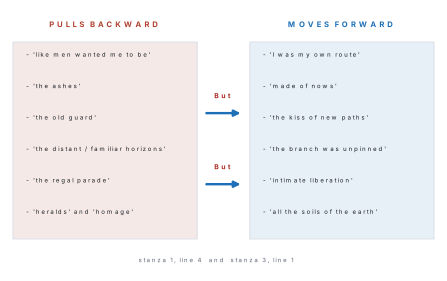
The present against the past. "Made of nows" is set against "the ashes", "walking backwards", "the old guard", "the distant familiar horizons" and the "regal parade". Everything oppressive in the poem is old, and everything free is now. This is why she rejects even the "soils without history".
The price of freedom. The poem is honest about cost. Her back is ripped; the whiplashes are repeated. Liberation here is not comfortable, and it is not applauded. But suffering is also productive: each whiplash separates her look further from the old horizons.
Universality without borders. Stanza 4's soils "without edges", belonging to "all the men and all the epochs", extend a personal liberation into a human one. The woman who refused to be owned refuses also to be located.
The refusal of institutional approval. The last stanza is the subtlest theme and the one most often missed. The old order does not defeat her — it invites her. Heralds, a parade, homage. The final act of freedom is not resistance but non-attendance.
10.6 Form, structure and technique
Free verse. There is no rhyme scheme, no fixed metre and no fixed line length. The line breaks are governed by breath and emphasis, not by counting. This is deliberate and it matches the content: a poem about refusing an imposed shape does not accept an imposed shape.
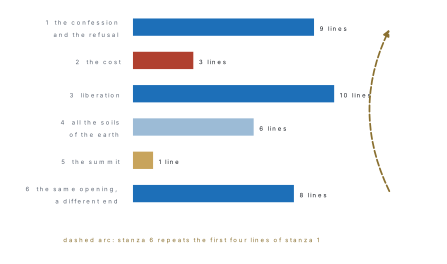
Stanza lengths: 9, 3, 10, 6, 1, 8 — thirty-seven lines in all. Plot those lengths and you can see the poem think. The long stanzas (1, 3) are the ones where she moves and grows; the short ones (2, 5) are the two extremes — the wound and the summit — and both are short because neither needs argument.
Circular structure. Stanza 6 reopens with the identical first four lines of stanza 1 and then diverges. The device is sometimes called a cyclical or framing structure. Its effect is to measure change: the same premise, a different conclusion. It also mimics the way an old expectation keeps coming back at you through life, and has to be refused again each time.
Repetition within lines. "forward, forward"; "more and more and more"; "of the soils … of the soils … of the soil"; "all in me … life in me". The poem pushes by repeating, the way walking is repetition.
Punctuation as gesture. The colon after line 1 opens onto the two definitions. The semicolons separate the two appositions. And the two spread ellipses — after stanza 5 and at the very end — leave the poem unfinished on purpose: the route continues past the last word.
Tense. The entire poem is in the past tense, yet its subject is the present. That is not a contradiction: she is looking back on the moment she became a creature of nows.
10.7 Imagery and figures of speech
| Device | Where it occurs | What it does |
|---|---|---|
| Metaphor | "an attempt at life" | a life lived to order is a rough draft, not the finished thing |
| Metaphor | "a game of hide and seek with my being" | self-concealment, with the same person as hider and seeker |
| Neologism | "made of nows" | a coined plural; the self as a substance composed of present moments |
| Metaphor | "the promissory earth" | ground that carries a written promise; the future as a debt owed to her |
| Symbol | "walking backwards" / "went forward, forward" | regression versus progress; the poem's basic direction of travel |
| Metaphor | "mocking the ashes" | the dead, burnt-out past treated with laughter, not reverence |
| Personification / metaphor | "the kiss of new paths" | the future welcomes her as a lover would; the poem's one tender image |
| Metaphor | "the desperate flapping wings / of the old guard" | tradition as panicking birds, clawing at the back of the woman who leaves |
| Metaphor | "the branch was unpinned forever" | a growing thing released from the shape somebody pinned it into |
| Metaphor | "each new whiplash" | punishment for disobedience — which paradoxically improves her sight |
| Transferred epithet | "the distant / familiar horizons" | goals that are inherited (familiar) and unreachable (distant) at once |
| Metaphor | "my face took the expansion that came from within" | inner growth made visible on the body |
| Oxymoron-like phrase | "intimate liberation" | freedom as a private, interior event rather than a public one |
| Metaphor | "a blossom of all the soils of the earth" | the self as a flower belonging to no single ground |
| Anaphora | "of the soils … of the soils … of the soil" | insistent repetition that widens the claim with each line |
| Symbol | "soil … without edges" | a world without borders, nations or property |
| Metaphor / irony | "the regal parade of the old guard" | the establishment at its most ceremonial, and at its most irrelevant |
| Metaphor | "the desire to follow men warped in me" | ambition buckling out of shape, like damp wood |
| Metonymy | "the homage was left waiting for me" | the honour stands in for the whole institution she refuses |
| Cyclical structure | stanza 6 repeats stanza 1 | the same premise reaching a different conclusion |
| Ellipsis (punctuation) | ".. . ." and ".. . . . . . . . ." | the sentence, and the route, continuing past the poem |
| Repetition | "forward, forward"; "more and more and more" | the rhythm of walking; insistence without argument |
| Antithesis | past / present, backwards / forward, old guard / new paths | the poem is built on a single sustained opposition |
10.8 Tone
The tone is determined, unapologetic and strangely calm.
What it is not is angry. There is no insult in the poem, no accusation aimed at any person, and no demand. De Burgos does not ask to be let out; she reports that she has already left. The verbs are mostly quiet ones — wanted, was, went, took, felt — and the one moment of open contempt, "mocking the ashes", is directed at something already burnt.
There is pain in it — the ripped back, the repeated whiplash — but the pain is reported without self-pity and without complaint, as a traveller reports weather.
And there is exhilaration, concentrated in two places: the "kiss of new paths", and the one-line stanza 5, which is the only moment of pure joy in the poem.
The final tone is the hardest to name. "The homage was left waiting for me" is spoken with something between indifference and quiet amusement. She is not rejoicing at having insulted them. She has simply gone.
10.9 Critical appreciation
"I Was My Own Route" is a feminist manifesto that never raises its voice, and its power comes from three decisions.
The first is the decision to begin in defeat. A lesser poem would open with the declaration of freedom. De Burgos opens with the confession that she tried to be what men wanted, and she states the cost of it so precisely — an attempt at life, hide and seek with my being — that the reader is made complicit before the rebellion begins. Most readers have played that game. The poem earns its later authority by admitting this first.
The second is the decision to make the poem a journey rather than an argument. There is not a single abstract proposition in it about women's rights. There are feet, ground, ashes, wings, a back, a branch, a whip, a face, soil, a parade. The politics arrives entirely through the body and the landscape. This is why the poem has travelled so well — a reader in Kathmandu in 2026 can walk it without knowing anything about Puerto Rico in 1938.
The third, and the boldest, is the decision about how the poem ends. Almost every poem of liberation ends in confrontation, in triumph, or in a vision of the future. This one ends with an empty chair at somebody else's ceremony. That is a much stranger and more modern ending. It says that the old order's real power is its power to confer honour, and that the only way to escape it is to stop wanting what it gives. The last image is not of a woman breaking chains; it is of a room full of dignitaries waiting for somebody who is not coming.
If a criticism can be made, it is that stanza 4 — the soils of the earth without history, without a future, without edges — is the vaguest passage in the poem, and that a freedom defined as belonging nowhere is easier to write than to live. De Burgos's own life bears that out: the woman who claimed all the soils of the earth died at thirty-nine on a New York pavement, unidentified. But the answer is that the poem is not a plan of life; it is a description of a moment of clarity, and clarity is allowed to be larger than circumstances.
Read alongside her better-known poem "To Julia de Burgos", in which the poet addresses the social self she has to appear as in public, this poem completes an argument: there is the self other people have made, and there is the self who walks. The second one is the route.
10.10 Glossary
| Word or phrase | Meaning as used here |
|---|---|
| route (n.) | a way or road taken to get somewhere; in the title, the speaker is her own way |
| an attempt at life | a try at living rather than living itself; a rough draft of a person |
| hide and seek | a children's game in which one hides and another searches — here the speaker does both |
| nows (n.) | de Burgos's coinage: present moments treated as a countable substance |
| promissory (adj.) | containing or conveying a promise (as in a promissory note, a written promise to pay) |
| ashes (n.) | what is left after burning; here, the dead and finished past |
| old guard (n.) | the long-established, conservative people who defend the existing order and resist change |
| whiplash (n.) | a blow with a whip |
| unpinned (adj.) | released from a pin; freed from something that held it flat or in shape |
| horizons (n.) | the limits of what one can see or aim for; here, inherited ambitions |
| intimate (adj.) | private, personal, inward |
| surged (v.) | rose powerfully and suddenly, like a wave |
| blossom (n.) | a flower, especially on a fruit tree; the point at which a plant is fully itself |
| epochs (n.) | long periods of history, especially ones marked by important events or special characteristics |
| edges (n.) | borders or boundaries; "soil without edges" means land with no frontiers |
| heralds (n.) | officials who make formal public announcements, especially at royal ceremonies |
| regal (adj.) | of, like, or fit for a king or queen; royal |
| warped (adj./v.) | twisted out of its natural shape, as wood warps in damp |
| homage (n.) | public respect or honour formally offered to someone |
| free verse (n.) | poetry without regular metre or rhyme |
The five phrases that answer everything
"an attempt at life" · "a game of hide and seek with my being" · "I was made of nows" · "the desperate flapping wings of the old guard" · "the homage was left waiting for me". Learn these five and you can build an answer to any question on this poem.
Chapter summary
Julia de Burgos (1914–1953), born in Carolina, Puerto Rico, teacher, nationalist, journalist for Pueblos Hispanos in New York, and precursor of the Nuyorican poets, published "Yo misma fui mi ruta" in her first collection Poema en veinte surcos (1938); the English text you study is Jack Agüeros's translation. Its thirty-seven lines fall into six free-verse stanzas of 9, 3, 10, 6, 1 and 8 lines. The speaker confesses that she once tried to be what men wanted — "an attempt at life", "a game of hide and seek with my being" — then declares herself "made of nows" and walks forward, mocking the ashes, towards "the kiss of new paths". The old guard tear her back with desperate flapping wings; every whiplash only separates her look further from the distant, familiar horizons. Unpinned forever, her face expands from within into "a feeling of intimate liberation", and she claims all the soils of the earth, soils without history, without a future and without edges. A single line — "And I was all in me as was life in me" — is the summit. The last stanza repeats the opening word for word and ends differently: when the heralds announce her at the regal parade of the old guard, her desire to follow men warps, and the homage is left waiting. The poem's argument is that identity lives in the present and inside the self, and that the final act of freedom is to decline the honour the old order offers.
Practice questions
Understanding the text
a. Why did the speaker try to be the way men wanted her to be? [2]
The poem does not give a reason in so many words, and the honest answer says so before supplying the implied one. She tried because that was the only shape available to a woman in her society: she had been brought up looking at "distant familiar horizons" — ambitions inherited rather than chosen — and behind them stood "the old guard", with its heralds, its parade and its power to grant or withhold honour. Conforming was the route to acceptance and reward. The poem's judgement on that choice is severe: it produced not a life but "an attempt at life", and a permanent "game of hide and seek" with her own self.
b. What do you understand by her feet 'would not accept walking backwards'? [2]
Walking backwards means returning to the past — to tradition, to the role men had assigned her, to the "ashes" of what was already finished. Her feet, planted "level on the promissory earth", refuse it and go "forward, forward" instead. The refusal is put in the feet rather than the mind on purpose: it is not a decision she argues her way to but something her body will not do. It has become instinct.
c. Who are the old guards? Why did they grow desperate? [2]
The "old guard" are the defenders of the established order — the patriarchal society, its customs and its authorities, the people who benefit from things staying as they are. In the poem they appear as birds with "desperate flapping wings" that rip her back, and later as the organisers of a "regal parade". They grow desperate because she is walking away and they cannot stop her. Their violence is a sign of weakness, not of strength: an order that is secure does not need to claw at the back of one woman who is leaving.
d. How did the speaker have 'a feeling of intimate liberation'? [2]
It came from inside her, not from any change in her circumstances. Once "the branch was unpinned forever" her gaze moved further from the inherited horizons with every fresh whiplash, and her face "took the expansion that came from within" — the growth showed outwardly. The poem says precisely where the feeling came from: it "surged / from the balance between my life / and the truth of the kiss of the new paths" — that is, from her life and her direction finally matching each other. It is called intimate because it is private and personal; nobody granted it and nobody witnessed it.
e. Why did the speaker's desire to follow men warp in her? [2]
Because by the time the reward arrived, she no longer wanted it. At the moment the heralds announced her at "the regal parade of the old guard" — the point at which the establishment finally offered her a place of honour — the wish to fall in behind men "warped", that is, twisted out of shape and became unusable, like wood that has buckled. She had become "made of nows", and a woman who lives in the present has no use for an honour conferred by the past. So the homage was left waiting for someone who never came.
Reference to the context
a. What does the speaker mean when she says she was playing 'a game of hide and seek with my being'? [5]
In the children's game, one player hides and the others hunt. De Burgos takes that ordinary image and makes it terrifying by removing the second player: the hider and the seeker are the same person.
What she means is that living according to other people's expectations required her to conceal her real self — her opinions, her ambitions, her sexuality, her politics, whatever did not fit the version of her that men approved of. But concealment of that kind does not stay under your control. Hide your real self long enough and you begin to lose track of where you put it; the search becomes genuine. That is why the phrase is not "hiding my being" but a game of hide and seek with it. She is both the woman doing the hiding and the woman who can no longer find what was hidden.
The choice of the word "game" is the cruellest touch. A game is voluntary, enjoyable, and above all not serious. Calling a lifetime of self-suppression a game exposes how lightly her society treated it — as though a woman rearranging herself to suit her husband, her father and her neighbours were a harmless social pastime rather than the slow disappearance of a person.
The phrase also pairs with the line just above it, "an attempt at life". Both are metaphors for inauthenticity, and together they define the condition the rest of the poem escapes from. The escape is measured by their opposite, which arrives in stanza 5: "And I was all in me as was life in me" — nothing hidden any more, the whole self present and findable. The game is over when there is nothing left concealed.
b. Why, in your view, was her back ripped by the old guards as she was advancing forward? [5]
Because she had turned away from them, and the back is what you present to something you have decided to leave.
Read literally, the image is of birds: the old guard have "desperate flapping wings", and they beat and claw at her as she walks. The injury is therefore inflicted from behind, and that detail carries most of the meaning. She is not fighting them; if she were, the wounds would be on her face and hands. She is walking, and they can only reach the part of her that is no longer facing them. Conservative societies do their real damage to people who have already stopped arguing — through gossip, exclusion, character assassination, the withdrawal of family support. None of it requires the victim's participation. All of it lands on the back.
In my view the wounds represent the social punishment of a woman who steps out of her assigned role in 1930s Puerto Rico: the loss of reputation, the disapproval of family, the hostility of a literary establishment that did not expect a poor girl from Carolina to speak like this, and the sheer exhaustion of being resented. The whip returns in stanza 3 as "each new whiplash", so this is not a single blow but a long, repeated grinding.
Two things save the image from being merely a complaint. First, the attackers are called desperate — the word transfers the panic from her to them, and tells us the old order is frightened of one woman walking. Second, the poem says that every whiplash drove her gaze further from the old horizons. The punishment failed. Worse than failed: it educated her. The old guard, by hurting her, completed the separation they were trying to prevent.
c. What, according to the speaker, did it feel like to be free? [5]
The poem describes freedom four times, and each description adds something.
It felt like release from a shape imposed from outside. "The branch was unpinned forever." A pinned branch is alive but forced flat against somebody else's wall, growing only where it is allowed to. Unpinning does not add anything to the branch; it simply lets it grow in its own direction. Freedom, in this image, is not acquiring something new but ceasing to be held.
It felt like a change visible on the body. "My face took the expansion that came from within." Her freedom is not a private opinion; it alters how she looks, and the direction of the change is outward, from inside to surface. Anyone meeting her would see it, though the poem only says it "hinted at" the feeling — freedom is legible but not loud.
It felt intimate rather than public. The phrase is "a feeling / of intimate liberation". No crowd, no flag, no announcement. And the poem tells us exactly what produced it: it "surged / from the balance between my life / and the truth of the kiss of the new paths" — from her actual life and her actual direction matching. Freedom is integrity in the literal sense: the parts fitting together.
And at its height it felt like being completely present. The one-line stanza — "And I was all in me as was life in me" — is the poem's summit and its simplest statement. To be free is to be entirely inside your own life, with nothing held back, hidden or held in reserve; and to find that life is inside you in the same complete way. It is the exact opposite of the "game of hide and seek" she began with.
There is one more feeling attached, and it is worth mentioning: freedom felt like belonging everywhere — "a blossom of all the soils of the earth … soil always soil without edges". Having lost her assigned place, she gained all places.
d. Why does the speaker prefer the present to the past? [5]
Because in this poem the past is not merely earlier — it is the instrument by which she was controlled, and the present is the only material she is actually made of.
Look at what belongs to the past in the poem. "Like men wanted me to be" is an expectation formed before she was born. The "ashes" are what is burnt out and finished. The "old guard" are, by definition, the guardians of what already exists. The "distant / familiar horizons" are goals inherited rather than chosen. The "regal parade" is ceremony, which is the past performing itself. Every oppressive thing in the poem is old.
Now look at the present. She is "made of nows" — the coined plural is the poem's central claim, and it says that her substance is a series of present moments, not a lineage. Her course is "now set in the present". Her feet stand on "the promissory earth", ground that promises rather than remembers. And what she walks towards is "new paths", twice given a kiss.
The preference is therefore logical, not merely temperamental. A person made of present moments cannot be governed by decisions taken in the past, because there is nothing in her for those decisions to grip. This is why she "would not accept walking backwards": going back is not difficult for her, it is impossible, the way it is impossible to return to yesterday.
Stanza 4 extends the argument to its limit. She claims soils "without history" and even soils "without a future" — refusing not only the past that ruled her but the destiny that might replace it. What is left is the present with no edges at all.
Finally, the preference is strategic. The past is the old guard's only real weapon: their authority is entirely inherited. A woman who lives in the present is the one opponent they cannot reach, which is precisely what happens at the end. They assemble their parade, their heralds, their homage — all of it ceremony, all of it history — and she is not there.
e. John Donne, in his poem "No Man is an Island", says, "No man is an island entire of itself." Would Burgos agree with Donne? Do you agree with Donne or Burgos? [5]
A point of accuracy first, which will impress an examiner: the famous passage is not strictly a poem. It comes from Donne's prose work Devotions upon Emergent Occasions (1624), Meditation XVII, and has been set out in verse lines by later editors. Donne's argument is that every human being is a piece of the continent, that any man's death diminishes him "because I am involved in mankind", and therefore "never send to know for whom the bell tolls; it tolls for thee".
Would de Burgos agree? Partly, and the interesting part is where she would not.
She would agree with Donne's conclusion and even outdo it. Stanza 4 is one of the most sweeping statements of human connection in your syllabus: she feels herself "a blossom of all the soils of the earth", belonging to soils "without edges", to "all the men and all the epochs". Donne says we are all part of one continent; de Burgos says the continent has no borders at all. Her politics support this — she was an anti-colonial nationalist who saw Puerto Rico's struggle as part of a wider human one, and a journalist who wrote for the poor.
She would disagree about the sequence. Donne's islander is warned against withdrawing from the community. De Burgos's speaker has the opposite problem: her community had absorbed her so completely that she had no self left — she was "an attempt at life", playing "hide and seek" with her own being. For her, connection had to be preceded by separation. She had to become "all in me" (stanza 5) before she could belong to all the soils of the earth (stanza 4 — note that the poem places belonging and self-possession side by side, not in opposition). What she refuses is not community but absorption without consent.
And she would reject Donne's institution while keeping his idea. Donne is a Dean of St Paul's writing about the bell of the parish church — connection guaranteed by an established order. De Burgos walks out on exactly that: heralds, parade, homage. She wants human solidarity without hierarchy.
My own view is that the two are not really opponents, and that saying so is the strongest answer. Donne is describing what we are; de Burgos is describing what we must first become. An island is not a person who has chosen solitude; it is a person with no self to bring to anybody. The woman of stanza 6, who declines the parade, is more genuinely connected to "all the men and all the epochs" than the woman of stanza 1, who was applauded by her neighbours and absent from her own life. I agree with Donne that no one is entire of themselves — and with de Burgos that you must first be somebody before you can be part of anything.
Reference beyond the text
a. Write an essay on "My Idea of Freedom". [5]
This must be your essay, in your own voice, about your own life. Below is a working plan with the kind of material that earns marks, and one fully written paragraph to show the level of concreteness expected. Aim for 400–450 words.
Introduction — define your terms by rejecting the easy definition. Most essays on freedom begin "Freedom means doing whatever we want." Begin by disagreeing with that sentence, and you are already better than most of the scripts an examiner will read that day. Doing whatever one wants is not freedom but appetite; a person who cannot stop scrolling at two in the morning is doing exactly what he wants and is not free.
Paragraph 1 — freedom as self-authorship. Take de Burgos's title as your thesis: freedom is being your own route. Distinguish between choosing from options other people have set out (which is choice) and deciding what you are going to be (which is freedom). A model paragraph:
When I finished Grade 10 the question in my house was not what I wanted to study but which of science and management I would study. Nobody was unkind; the two doors were simply the only two doors in the room, and everyone I knew had gone through one of them. It took me a year to notice that the question itself had been decided for me. That noticing is the whole of what I now mean by freedom — not walking through a different door, but seeing the wall.
Paragraph 2 — freedom has a price, and the price is the test. Use the ripped back and the whiplash. Real freedom is unpopular; if a decision of yours has cost you nothing, it was probably not yours. Give one small, true example: disagreeing with a teacher, refusing a family plan, keeping a friendship your relatives disapproved of.
Paragraph 3 — freedom is not the absence of others. Answer the obvious objection. In a family and a society, absolute independence is neither possible nor desirable. What we can demand is that our obligations be accepted rather than assigned. Looking after my grandmother is not a limit on my freedom if I have chosen it; it is one if it was simply announced.
Paragraph 4 — the hardest freedom: refusing the reward. This is the poem's ending and the best thing you can borrow from it. It is relatively easy to refuse a punishment and very hard to refuse an honour. Connect it to something real — a job, a marriage, a scholarship, a position in a party — that would be admired by everyone and wrong for you.
Conclusion. Return to your opening definition and complete it: freedom is not doing what you want; it is wanting what is actually yours to want. End on a concrete image rather than a summary sentence.
b. Not all people, however, seem to agree with the kind of freedom upheld by Burgos in this poem. For example, William Faulkner, in his novel Requiem for a Nun, says, "The past is never dead. It's not even past. All of us labor in webs spun long before we were born, webs of heredity and environment, of desire and consequence, of history and eternity." Do you agree with Faulkner? Why? Why not? [5]
Note for accuracy: the famous six words — "The past is never dead. It's not even past." — are spoken by the lawyer Gavin Stevens in Act I of Requiem for a Nun (1951). The longer sentence about webs is usually printed with it in quotation collections. Faulkner's subject was the American South, a society unable to get free of slavery and the Civil War, which is why the past in his work is a living, hostile presence rather than a memory.
The case for Faulkner. He is describing something true and verifiable. None of us chose our language, our caste, our gender, our country, our religion, our family's money or our first ideas about what a good life looks like — and those things shape most of what we later call our decisions. In Nepal this is not abstract. A Dalit student and a Bahun student in the same classroom, with the same marks, do not face the same set of futures; a daughter and a son in the same family are not asked the same questions about marriage. To tell either of them that they are "made of nows" and may simply walk forward is, at best, incomplete. Faulkner's webs are real, and they were spun before any of us arrived.
The case for de Burgos. But notice what her poem actually claims. She does not claim that the past is gone. The past is the most active force in the poem: it rips her back, it whips her, it assembles a parade for her. She never once says it is weak. What she claims is something narrower and harder — that the past does not have to be obeyed. Being made of nows is not a description of her circumstances; it is a decision about where she will stand. That is why the poem is honest enough to include the wounds. A poem that believed the past was dead would have no old guard in it.
Where I stand. I agree with Faulkner about the facts and with de Burgos about the response, and I do not think the two positions actually collide. Faulkner is a novelist describing how societies work; de Burgos is a poet describing how a person survives one. If you accept only Faulkner, you get fatalism — nothing can change, so nothing need be attempted, which is a very convenient doctrine for whoever currently holds the advantage. If you accept only de Burgos, read carelessly, you get the fantasy that will-power is enough, which blames people for cages they did not build.
The workable position combines them. The web is real and it is strong; but webs are made of threads, and a person who knows exactly which threads hold her can sometimes cut one. De Burgos did not abolish the old guard of Puerto Rico in 1938. She did something smaller and more possible: when they called her name at their parade, she was not there.
Practise more: English question bank