Unit 24 · Grammar · 15 min read
Subject-Verb Agreement and Miscellaneous Agreements
What the syllabus asks for 6
- The basic rule and the words that hide it
- Two or more subjects joined together
- Pronouns and distributives as subjects
- Nouns whose number is not what it looks
- Word order that hides the subject
- Miscellaneous agreements
Agreement (also called concord) means that words which belong together must match in number and person: a singular subject takes a singular verb, a plural antecedent takes a plural pronoun. The rule sounds trivial — He goes, They go — but NEB Q7 never tests the trivial case. It tests the sentence in which a long phrase stands between the subject and the verb, or in which a plural-looking noun is really singular. This unit lists every pattern the board uses, and ends with the other agreements — pronoun, demonstrative and number-compound — that the same question can turn on.
The verb agrees with the head noun of the subject, never with the noun standing closest to it. Cross out every phrase beginning with of, with, along with, as well as, including, besides, in addition to and every relative clause; what is left is the subject. The quality of the mangoes sold in the market was excellent.
24.1 The basic rule and the words that hide it
A singular subject takes the verb form ending in -s in the present tense (he works); a plural subject takes the bare form (they work). In the past tense only be changes (was / were).
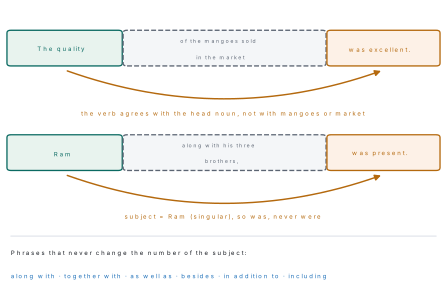
- The list of candidates has been published. (not ~~have~~)
- The causes of this accident are still unknown.
- One of my friends lives in Dhangadhi. (subject = one)
- The boy who won the prizes is from Surkhet.
24.2 Two or more subjects joined together
| Pattern | Verb | Example |
|---|---|---|
| A and B (two different things) | plural | Sita and Gita are cousins. |
| A and B naming one thing or one person | singular | Bread and butter is a cheap breakfast. / The Principal and Manager is on leave. (one person) |
| The A and the B (two people) | plural | The Principal and the Manager are on leave. |
| Each / Every A and each / every B | singular | Every boy and every girl was given a badge. |
| A as well as / along with / together with / besides / in addition to B | agrees with A | The captain, as well as the players, was praised. |
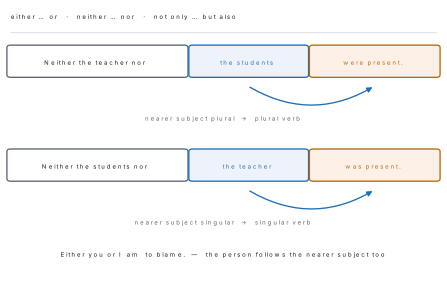
| Either A or B / Neither A nor B | agrees with the nearer subject | Neither the teacher nor the students were present. |
| Not only A but also B | agrees with the nearer subject | Not only the boys but also the girl was late. |
| A or B | agrees with the nearer subject | Two pens or a pencil is enough. |
And makes a plural subject; as well as does not — it only adds extra information. ✗ Hari as well as his friends were absent. → ✓ Hari as well as his friends was absent. ✗ The teacher along with the students have arrived. → ✓ The teacher along with the students has arrived.
24.3 Pronouns and distributives as subjects
Always singular: each, every, either, neither, one, everyone, everybody, everything, someone, somebody, something, anyone, anybody, anything, no one, nobody, nothing, many a, more than one.
- Each of the candidates has been interviewed.
- Neither of the two answers is correct.
- Everybody in the hostel was asleep.
- Many a student has failed in this paper.
- More than one house was damaged. (singular, although the sense is plural)
Always plural: both, few, a few, many, several, others.
- Both of the roads are blocked. Several were missing.
It depends on the noun after of: some, all, most, half, none, a lot, plenty, the rest, and all fractions and percentages.
- Half of the apple is rotten. / Half of the apples are rotten.
- Two-thirds of the land is barren. / Two-thirds of the farmers are landless.
- Most of the water has dried up. / Most of the students have paid.
- None of the boys was selected. (formal writing keeps the singular)
The two number phrases that behave differently:
- A number of + plural noun → plural verb: A number of tourists are waiting.
- The number of + plural noun → singular verb: The number of tourists is rising.
24.4 Nouns whose number is not what it looks
| Group | Verb | Examples |
|---|---|---|
| Subjects and diseases ending in -s | singular | Mathematics is easy. Physics, economics, politics, statistics, civics, ethics, news, measles, mumps, athletics. |
| Tools and clothes in two parts | plural | The scissors are blunt. Trousers, spectacles, binoculars, pliers, jeans. |
| a pair of + those nouns | singular | A pair of scissors is missing. |
| Nouns plural in meaning without -s | plural | The police are investigating. Cattle, people, vermin, poultry, gentry. |
| Titles of books, plays and newspapers | singular | Gulliver's Travels is a satire. The Kathmandu Post is a daily. |
| Names of countries and organisations | singular | The United States is a federal republic. The Philippines, the United Nations. |
| Money, distance, time and weight as one amount | singular | Twenty rupees is not much. Ten kilometres is a long walk. Five years is a long time. |
| Collective nouns acting as one body | singular | The committee has taken a decision. The team, the jury, the family, the government, the audience, the class. |
| The same nouns when the members act separately | plural | The jury were divided in their opinion. |
| The + adjective (a whole class of people) | plural | The rich are not always happy. The poor, the blind, the Nepalese. |
| A gerund, an infinitive or a clause as subject | singular | Swimming is good exercise. To err is human. What she needs is two days' rest. |
Statistics and politics change with the meaning: Statistics is a branch of mathematics (the subject) but These statistics are misleading (the figures).
24.5 Word order that hides the subject
- There is / There are — the verb agrees with the noun that follows it: There is a temple on the hill. / There are two temples on the hill. With a mixed list, it agrees with the nearer noun: There is a pen and two erasers in the box.
- Here comes / Here come — same rule: Here comes the bus.
- Inverted sentences — the subject is after the verb: On the wall hang three old photographs.
- Relative clauses — the verb inside the clause agrees with the antecedent: He is one of the boys who have passed. (the boys passed) but He is the only one of the boys who has passed. (only he passed)
24.6 Miscellaneous agreements
Agreement is not only between subject and verb.
Pronoun and antecedent. A pronoun matches its antecedent in number, person and gender.
- Every student must bring his or her admit card. (formal written English; their is now widely accepted and is common in speech)
- Each of the girls has finished her work.
- The committee announced its decision. (one body) / The committee took their seats. (members)
- Neither Ram nor Hari has brought his book.
Demonstrative and noun. This / that with a singular noun, these / those with a plural one, and the same for kind and sort:
- This kind of book is useful. / These kinds of books are useful. (never ~~these kind of books~~)
Number compounds used as adjectives stay singular and take hyphens:
- a five-year-old boy (but the boy is five years old)
- a ten-rupee note, a two-hour journey, a 500-metre race
- two dozen eggs, three hundred students — no -s after a number, but dozens of eggs, hundreds of students
Sequence of tenses. A past-tense main verb normally pulls the subordinate clause into the past: He said that he was busy. The exception is a universal truth: The teacher told us that the earth moves round the sun.
✗ One of my friend are coming. → ✓ One of my friends is coming. ✗ Each of the students have submitted. → ✓ Each of the students has submitted. ✗ The police is searching for him. → ✓ The police are searching for him. ✗ Mathematics are my favourite subject. → ✓ Mathematics is my favourite subject. ✗ There is many problems in this plan. → ✓ There are many problems … ✗ The number of accidents are increasing. → ✓ The number of accidents is increasing. ✗ Five years are a long time. → ✓ Five years is a long time. ✗ These kind of mistakes are common. → ✓ These kinds of mistakes are common.
Problem. Choose the correct verb: The list of the students who passed the board examination (has / have) been pasted on the notice board.
Solution — step by step.
- Strike out the modifiers. of the students is an of-phrase; who passed the board examination is a relative clause describing students. Neither can be the subject.
- What is left? The list, a singular noun.
- Match the verb. A singular subject needs has.
Answer. The list of the students who passed the board examination has been pasted on the notice board.
Problem. Fill in with the correct form of be in the present tense: (a) Neither the principal nor the teachers _ willing to change the routine. (b) Neither the teachers nor the principal _ willing to change the routine.
Solution — step by step.
- Identify the construction. Both sentences use neither … nor, so the proximity rule applies: the verb agrees with whichever subject stands nearer to it.
- (a) The nearer subject is the teachers, which is plural. Answer: are willing.
- (b) The nearer subject is the principal, which is singular. Answer: is willing.
The two sentences mean the same thing but take different verbs — which is exactly why the examiner sets them.
Problem. Correct: Each of the boy in these kind of classes have their own tablet, and the number of such classes are growing.
Solution — one fault at a time.
- Each of the boy — each of must be followed by a plural noun → each of the boys**.
- these kind of classes — these is plural, so kind must be plural → these kinds of classes.
- have — the subject is each, which is always singular → has.
- their own tablet — the antecedent each is singular, so formal writing uses his or her own tablet.
- the number of such classes are — the number of always takes a singular verb → is growing.
Answer. Each of the boys in these kinds of classes has his or her own tablet, and the number of such classes is growing.
Chapter summary
- The verb agrees with the head noun of the subject; of-phrases, participle phrases and relative clauses in between change nothing.
- And joins two subjects into a plural — unless they name one thing or one person (Bread and butter is …), or are preceded by each / every.
- As well as, along with, together with, besides, in addition to keep the verb agreeing with the first subject.
- Either … or, neither … nor, not only … but also, or follow the proximity rule: the verb matches the nearer subject.
- Singular always: each, every, either, neither, one, everyone, nobody, many a, more than one. Plural always: both, few, many, several.
- Some, all, most, half, none and fractions take their number from the noun after of.
- A number of + plural verb; the number of + singular verb.
- Mathematics, physics, news, politics are singular; scissors, trousers, police, cattle, people are plural.
- Money, distance and time treated as one amount take a singular verb.
- There is / are and Here comes / come agree with what follows them.
- Pronouns match their antecedents; these kinds of books, not these kind of books; and a number compound used as an adjective stays singular (a ten-rupee note).
Practice questions
Fill in the blanks with the correct form of the verb in brackets (1 mark each)
- The quality of these shoes ____ very good. (be — present) [1]
- One of my cousins ____ in Australia. (live) [1]
- Neither of the two candidates ____ the required marks. (have) [1]
- Mathematics ____ always been my favourite subject. (have) [1]
- The police ____ still looking for the missing girl. (be — present) [1]
- Twenty thousand rupees ____ a large sum for a student. (be — present) [1]
- Either the manager or his assistants ____ to attend the meeting. (have) [1]
- A number of houses ____ damaged by the landslide. (be — past) [1]
- The number of road accidents ____ rising every year. (be — present) [1]
- Each of the participants ____ given a certificate. (be — past) [1]
Answers
1. is — the subject is the quality, not shoes.
2. lives — the subject is one, which is singular.
3. has — neither of takes a singular verb.
4. has — mathematics is singular in spite of the -s.
5. are — police is a plural noun.
6. is — a sum of money treated as one amount is singular.
7. have — the proximity rule: his assistants stands nearer.
8. were — a number of + plural noun takes a plural verb.
9. is — the number of takes a singular verb.
10. was — each of is singular.
Correct the errors in the following sentences (1 mark each)
- The list of selected candidates have been published. [1]
- Hari as well as his brothers were invited to the wedding. [1]
- There is many reasons for this failure. [1]
- These kind of questions are asked every year. [1]
- Ten kilometres are not a short distance. [1]
- Every boy and every girl were given a school bag. [1]
- He is one of the students who has topped the district. [1]
- The committee have announced their decision unanimously. [1]
- Each of the girls have brought her own lunch. [1]
- My trousers is too tight for me now. [1]
Answers
11. The list of selected candidates has been published. — the subject is the list.
12. Hari as well as his brothers was invited … — as well as does not make the subject plural.
13. There are many reasons for this failure. — the verb agrees with reasons.
14. These kinds of questions are asked every year. — these needs a plural noun.
15. Ten kilometres is not a short distance. — one distance, so a singular verb.
16. Every boy and every girl was given a school bag. — every … and every … stays singular.
17. He is one of the students who have topped the district. — the clause describes students.
18. The committee has announced its decision unanimously. — acting as one body, and unanimously shows it.
19. Each of the girls has brought her own lunch. — each of is singular.
20. My trousers are too tight for me now. — trousers is a plural noun.
Rewrite as instructed (1 mark each)
- The teachers and the principal were present. — Rewrite beginning Not only the teachers but also … [1]
- All the students have paid the fee. — Rewrite beginning Each … [1]
- There are two temples and a pond in the village. — Rewrite beginning There … a pond and … [1]
- Both the answers are wrong. — Rewrite beginning Neither … [1]
- Politics does not interest him. — Rewrite beginning He … [1]
Answers
21. Not only the teachers but also the principal was present. — the proximity rule makes the verb singular.
22. Each of the students has paid the fee. — each of + plural noun + singular verb.
23. There is a pond and two temples in the village. — with a mixed list the verb follows the nearer noun.
24. Neither of the answers is correct. — neither of + plural noun takes a singular verb.
25. He is not interested in politics. — politics stays singular whichever way the sentence is turned.
Practise more: English question bank