Unit 9 · Literature - Poems · 39 min read
Every Morning I Wake
What the syllabus asks for 10
- About the poet
- Where the poem comes from
- The poem, stanza by stanza
- Paraphrase in plain English
- Central idea and themes
- Form, structure, metre and rhyme
- Imagery, figures of speech and sound devices
- Tone
- Critical appreciation
- Glossary
A village minister stands at his door at the end of the day and says a short prayer out loud. He does not ask for money, or for rain, or for his enemies to be punished. He asks God to keep an eye on "all poor creatures born to die", to notice that the people of his town are "not wholly bad or good", and to let them all have one more day. Then he says good night to the sun — "but just for now". Sixteen lines, eight rhyming couplets, hardly a word above two syllables. It is the gentlest poem in your course, and its gentleness is an argument.
Who is speaking and from where: the Reverend Eli Jenkins in Dylan Thomas's radio play Under Milk Wood, standing outside his house in the invented Welsh village of Llareggub. The four quatrains built of rhyming couplets — aabb ccdd eeff gghh, every rhyme perfect. The two great lines: "all poor creatures born to die" and "We are not wholly bad or good". The idea of a God who is asked to look kindly, not to intervene. And the last line's cheerfulness in the face of death: "good-bye – but just for now!"
9.1 About the poet
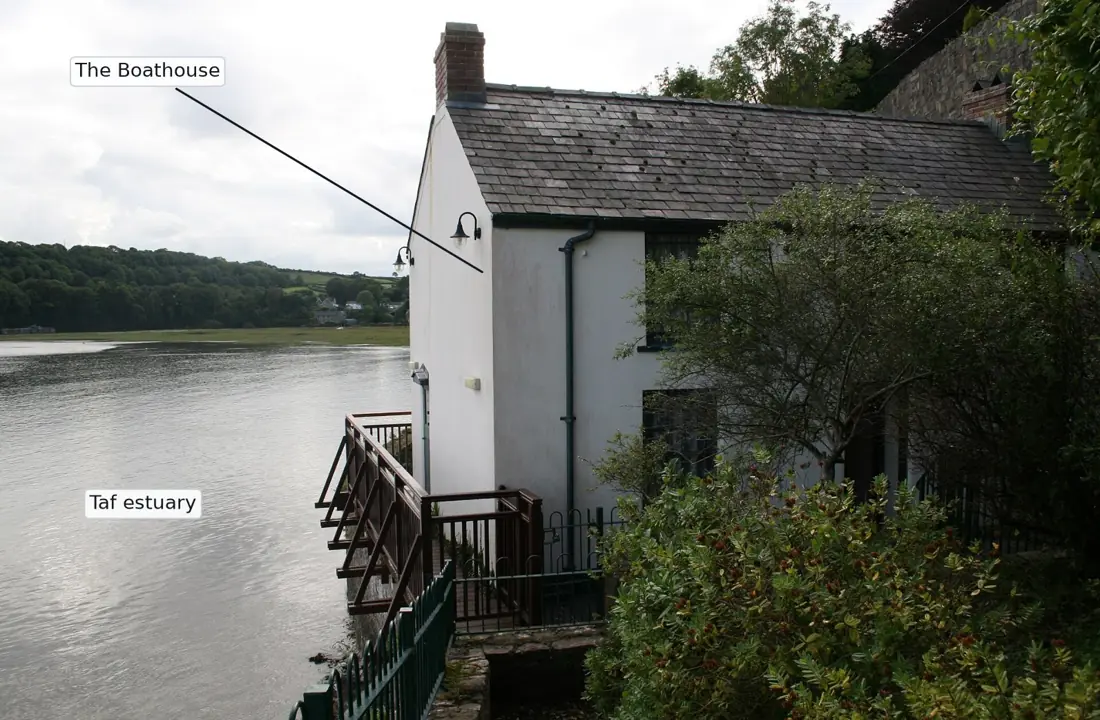
Dylan Marlais Thomas (1914–1953) was born in Swansea, in south Wales, the son of a grammar-school English master. He left school at sixteen, worked briefly as a newspaper reporter, and published 18 Poems at twenty — an astonishing debut that made him famous almost at once. He was a poet of sound before he was a poet of sense: he built his lines out of alliteration, internal rhyme and heavy stress patterns, and he read them aloud in a deep, rolling voice that became as famous as the poems.
Your textbook rightly calls him "an extension into the 20th century of the general movement called Romanticism" — his emphasis falls on imagination, emotion, intuition, spontaneity and organic form rather than on the irony and learning that dominated English poetry in the 1930s while he was writing. His best-known poems are "Do not go gentle into that good night" and "Fern Hill".
He began working for the BBC in 1945, and radio turned out to suit him completely: a voice, no scenery, and a national audience. He drank heavily, was permanently short of money, and died in New York on 9 November 1953, aged thirty-nine, during an American reading tour.
The blurb prints "nineteenth century Englnad" (England), and it says Under Milk Wood is from 1953. Thomas was writing it through 1952–53 and gave its first public reading in New York on 14 May 1953, but the famous BBC radio broadcast was on 25 January 1954, after his death, with Richard Burton reading First Voice. The book was published in 1954. Also note the title is Under Milk Wood, not "Under the Milk Wood", and the village is spelt Llareggub, not "Llaggerub" as the glossary has it.
9.2 Where the poem comes from
Under Milk Wood is a radio play — Thomas subtitled it "A Play for Voices". There is no plot and there are no stage directions in the ordinary sense. Instead, two narrators (First Voice and Second Voice) walk the listener through one spring day in a small Welsh seaside town, from the dark before dawn to the dark after dusk, dipping in and out of the dreams, kitchens, shops and thoughts of some sixty inhabitants.
The town is called Llareggub. Thomas built the name to look like a genuine Welsh place name; read it backwards and it spells a rude English phrase meaning "nothing at all". The joke tells you his attitude: he loves the place and refuses to sentimentalise it. Milk Wood is the wood on the hillside above the town, and the town therefore lives, literally, under Milk Wood.
One of the inhabitants is the Reverend Eli Jenkins, an elderly, unthreatening, poetry-writing minister who steps out of his front door twice a day to recite verses he has composed himself. His morning poem begins "Dear Gwalia! I know there are / Towns lovelier than ours…" — a hymn of praise to Wales. The poem you are studying is his sunset poem, spoken near the end of the play as the light goes.
The poem begins "Every morning when I wake", so it is natural to call it a morning prayer, and your textbook does. But in the play it is Eli Jenkins's evening recitation — his sunset poem. That is not a contradiction. The poem describes what he does every morning and every evening; he speaks it at dusk. If an examiner asks when the speaker prays, the honest answer is: twice a day, morning and at sun-down, and the poem itself is his evening piece.
The poem has no title of its own in the play. "Every Morning I Wake" is simply its first line, used as a title when the passage is anthologised.
9.3 The poem, stanza by stanza
The poem is in copyright, so it is quoted here in short pieces; keep your textbook open beside this page.
Stanza 1 — the morning prayer
Every morning when I wake, Dear Lord, a little prayer I make,
The first thing to notice is the word little. Eli Jenkins does not claim to be a great intercessor. He makes a little prayer — modest in length, modest in ambition, and offered daily rather than in an emergency. The habit matters more than the eloquence.
"Dear Lord" is the second thing. It is how you begin a letter to somebody you know. There is no "Almighty", no "O Thou", no trembling. The relationship is affectionate and everyday.
The request, when it comes, is startlingly small: that God should keep Thy loving eye on "all poor creatures born to die". He is not asking God to do anything. He is asking God to look, and to look lovingly. And the object of that look is not the good, or the faithful, or the people of Llareggub — it is every living thing, on the sole qualification that it is mortal. "Poor" here means pitiable, not penniless; "creatures" means everything that has been created, animals included. In two lines the poem has replaced the idea of a God who rewards and punishes with the idea of a God who watches with pity.
Your textbook prints "O please do keep Thy loving eye". The published text of Under Milk Wood reads "O please to keep Thy lovely eye". Quote your textbook's version in the exam — it is the version being examined — but if you meet the other wording in a library copy, you now know why.
Stanza 2 — the evening blessing
And every evening at sun-down I ask a blessing on the town,
The stanza is built as a deliberate mirror of the first: Every morning becomes And every evening, and the private prayer for all creatures becomes a public blessing on one small place. The poem's shape is therefore the shape of a day, and of the minister's own routine, and — because the play is about one day in one town — of Under Milk Wood itself in miniature.
Then comes the poem's frankest couplet. Whether the townspeople survive the night, he says, is always "touch-and-go". The idiom means highly uncertain, could go either way, and it is a shockingly plain thing for a clergyman to say. He is not promising his congregation protection. He is telling them, and himself, that every night is a risk and that faith does not remove the risk. There is no bargaining in this prayer and no guarantee attached to it.
Stanza 3 — the plea for a fair hearing
We are not wholly bad or good, Who live our lives under Milk Wood,
This is the most quoted line Thomas ever wrote outside "Do not go gentle", and the whole play stands behind it. The people of Llareggub include a man who dreams of poisoning his wife, a woman who scrubs her house all day, a blind sea captain in love with the drowned, and a girl who loves everybody. None of them is a saint; none is a villain. Thomas's judgement on humanity is the one his minister states here: "not wholly bad or good".
The construction is a litotes — an understatement made by denying the opposite. Saying "not wholly bad" is warmer than saying "quite good", because it admits the badness first. And the rhyme is perfect and quiet: good / Wood. The place and the moral verdict chime, as if the town and its imperfection were the same fact.
The second couplet turns to God and, remarkably, tells Him what He will do: And Thou, I know, wilt be the first / To see our best side, not our worst. Three points are worth making here.
The verb is "I know", not "I hope" or "I pray" — the one moment of complete confidence in the poem. What he is confident about is not his own salvation but God's generosity.
"The first" is a small, sharp word. Others will see the worst side first — neighbours, gossips, the town itself. God will be the first to look for the best. The line contains a quiet criticism of human judgement.
And "Thou … wilt" is the archaic second person singular of the old English Bible and the chapel prayer book. In Welsh nonconformist chapels, as in the Book of Common Prayer, God is addressed as Thou — the intimate, singular form, the form you would use to a member of your family. Thomas keeps it because Eli Jenkins would keep it, and because it is affectionate rather than grand.
Stanza 4 — good night, and good morning
O let us see another day! Bless us all this night, I pray,
The last stanza is the only one that asks for something concrete, and what it asks for is simply more time — one more day, for everybody, without distinction. The exclamation mark is the loudest sound in the poem.
Then the ending that makes the poem memorable:
And say, good-bye – but just for now!
The community bows to the setting sun. That is not Christian practice — it is older than Christianity, the instinctive courtesy of people who live by daylight — and Thomas lets the minister do it without embarrassment. Then the dash, then the correction: "but just for now!"
That phrase is doing two jobs at once. On the surface it is a fact of astronomy: the sun will come back in the morning, so the good-bye is temporary. Underneath, it is the poem's answer to "all poor creatures born to die". If saying good night to the sun is only a short parting, then perhaps dying is too. The poem never says so. It lets a cheerful, almost throwaway idiom carry the whole weight of a hope it is too modest to state.
9.4 Paraphrase in plain English
Stanza 1. Every morning when I wake up I say a short prayer: dear God, please keep watching kindly over every living thing, since everything that is born must die.
Stanza 2. And every evening as the sun goes down I ask for a blessing on the village. Whether or not we get through the night is always, I am sure, a very close thing.
Stanza 3. We who live our lives under Milk Wood are neither completely bad nor completely good. And You, I am sure, will be the first to look for the best in us rather than the worst.
Stanza 4. Oh, let us live to see another day! Bless us all tonight, I pray. And all of us will bow to the sun and say goodbye to it — but only for the time being.
9.5 Central idea and themes
Central idea. A village minister's daily prayer asks God not for protection or prosperity but for mercy in judgement: that He should look with love on mortal creatures, notice that ordinary people are mixed rather than wicked, and grant them one more day. The poem argues that humility and kindness are the right religious attitude, and that the proper response to death is courtesy rather than terror.
Prayer as habit rather than emergency. Every morning, every evening. The poem's authority comes from repetition. This is not a cry from a sickbed; it is what this man says on ordinary days when nothing is wrong, which is why it can be trusted.
Human imperfection. "We are not wholly bad or good" is the moral centre of both the poem and the play. Thomas refuses both the sentimental view (village people are innocent) and the puritanical one (people are sinners). Human beings are mixed, and a religion worth having must begin there.
Mortality. "All poor creatures born to die"; "whether we last the night or no"; "let us see another day". Death is mentioned or implied in every stanza, and never with fear. The poem's achievement is to be fully aware of death and still end on an exclamation mark.
A merciful God, imagined humbly. God in this poem has a loving eye, is addressed as Dear Lord and Thou, and is expected to see the best side. There is no hell, no judgement seat, no list of sins. The magnificence of God, which the textbook question asks about, is shown entirely through generosity: He is great because He is kind, and because the whole of creation is small enough to fit under one loving glance.
Community. Almost every pronoun in the second half is plural: we, our, us, us all. The individual speaker dissolves into the town. He asks a blessing "on the town", not on himself, and the final bow is made by everybody together.
Nature and the daily cycle. Sunrise, sun-down, night, another day. The poem is organised by the turning of the earth, and its last gesture is directed at the sun.
9.6 Form, structure, metre and rhyme
Form. Sixteen lines, printed as four quatrains. It is a lyric and, more precisely, a prayer poem in the tradition of the Welsh chapel hymn and the English metrical psalm.
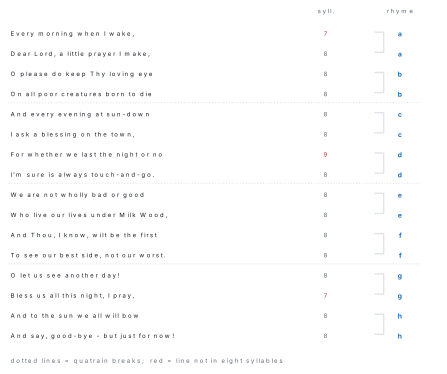
Rhyme scheme: aabb ccdd eeff gghh. Every quatrain is built from two rhyming couplets, and every one of the eight rhymes is perfect:
| Couplet | Rhyme words | Letter |
|---|---|---|
| 1 | wake / make | aa |
| 2 | eye / die | bb |
| 3 | sun-down / town | cc |
| 4 | no / touch-and-go | dd |
| 5 | good / Wood | ee |
| 6 | first / worst | ff |
| 7 | day / pray | gg |
| 8 | bow / now | hh |
No rhyme is carried from one quatrain to the next, and no rhyme is slant or forced. This matters for the meaning: a couplet is the most settled rhyme arrangement in English, because the ear gets what it is waiting for immediately. Nothing is left hanging. In a poem about uncertainty and death, the form is continuously reassuring — the sound keeps promising what the sense cannot.
Metre. Predominantly iambic tetrameter (four beats to the line), the metre of children's rhymes, ballads and hymns. It is not perfectly regular, and the departures are audible:
| Line | Syllables | Note |
|---|---|---|
| 1 | 7 | opens on a stress: EV-ery MORN-ing WHEN I WAKE |
| 2–6 | 8 | steady iambic tetrameter |
| 7 | 9 | "For whether we last the night or no" — the line stretches at exactly the point where the sense becomes least certain |
| 8–13 | 8 | steady |
| 14 | 7 | "Bless us all this night, I pray" — clipped, urgent |
| 15–16 | 8 | steady |
Two of the three irregular lines are the two shortest, and both of them begin on a strong stress, which makes them sound spoken rather than sung.
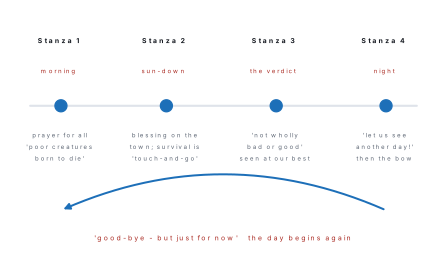
Structure of thought. The four stanzas form a clean progression:
- morning — a prayer for all creatures (the widest circle)
- evening — a blessing on the town (narrower) and an admission of risk
- a plea for fair judgement of "we … under Milk Wood"
- a request for one more day, and a farewell to the sun
The circle narrows from all creation to one village and then to one night, and the last line opens it out again to the sun. The whole poem is one turn of the earth.
9.7 Imagery, figures of speech and sound devices
| Device | Where it occurs | What it does |
|---|---|---|
| Apostrophe / invocation | "Dear Lord", "O please…", "And Thou, I know…" | the poem is spoken to God; it is an address, not a description |
| Archaic diction | "Thy", "Thou", "wilt" | the intimate singular of the old Bible and the chapel prayer book; affectionate, not grand |
| Metonymy / synecdoche | "Thy loving eye" | God reduced to a single kindly glance — no throne, no thunder |
| Periphrasis | "all poor creatures born to die" | a phrase used instead of the word mortals; it makes us pity what it names |
| Parallelism | "Every morning …" / "And every evening …" | the two halves of the day balanced against each other |
| Idiom / colloquialism | "touch-and-go" | ordinary conversational English admitted into a prayer |
| Litotes (understatement) | "We are not wholly bad or good" | denies the extreme instead of asserting the middle; warmer and more honest |
| Antithesis | "bad or good"; "our best side, not our worst"; "last the night or no" | the poem thinks in balanced opposites |
| Personification | "we all will bow / And say, good-bye" to the sun | the sun treated as a departing person owed a courtesy |
| Anticlimax / bathos (used deliberately) | "good-bye – but just for now!" | the grand farewell is immediately made cheerful and small |
| Symbol | Milk Wood; the sun | the wood is the whole community's world; the sun is life and its daily withdrawal |
| Alliteration | "little prayer"; "live our lives"; "bless … born … bow"; "sure … sun" | a soft, sung surface, close to Welsh chapel singing |
| Assonance | "born to die"; "touch-and-go"; "bow … now" | binds the couplets aurally beyond the rhyme |
| Rhyming couplet | throughout | see §9.6: every line is immediately answered — formal reassurance |
| Exclamation | "O let us see another day!"; "but just for now!" | the two moments when feeling breaks through the calm |
| Dash | "good-bye – but just for now" | a pause, then a correction: the poem's hope arrives as an afterthought |
9.8 Tone
The tone is humble, affectionate, conversational and quietly brave.
It is humble because of the scale of the requests: a little prayer, a loving eye, a fair hearing, one more day. It is affectionate because of the diction: Dear Lord, Thou, us all. It is conversational because of "touch-and-go", which no formal liturgy would allow. And it is brave because the poem states twice that everyone in it is going to die and never once flinches.
There is also a thread of gentle humour, which comes from the play. Eli Jenkins is a slightly comic figure — the village poet who recites to nobody in particular — and the last line's bounce keeps him human rather than saintly. Do not mistake the humour for irony: Thomas is not mocking him. The poem asks you to find him funny and to agree with him at the same time.
9.9 Critical appreciation
The strength of "Every Morning I Wake" is that it earns an enormous claim with tiny means.
The claim is that the right relationship between a human being and God is neither fear nor bargaining but mutual kindness — we look at each other generously. The means are sixteen lines of eight-syllable verse, eight nursery rhymes' worth of couplet, and a vocabulary a ten-year-old could read. Thomas, whose own poetry is usually dense with compound words and half-buried images, writes here in a voice that is not his own. It is Eli Jenkins's voice, and it is plainer than anything Thomas wrote under his own name. This is the discipline of dramatic writing: the poem is in character.
The most interesting decision in the poem is what it leaves out. There is no mention of sin, of hell, of the Cross, of church or chapel, of scripture, or of any doctrine whatever. A Welsh minister of the 1950s could have been expected to supply all of these. Instead Thomas gives him an eye, a town, a night and the sun. The result is a prayer that a non-believer can say without dishonesty, which may be why it has outlived the play it came from and is read at funerals and school assemblies by people who have never heard of Llareggub.
Set against that, a critic could object that the poem is too comfortable. "We are not wholly bad or good" is a generous verdict, but it is also a convenient one; it excuses everybody. Under Milk Wood has been accused of exactly this — of turning a real, poor, narrow Welsh town into a charming place where nothing serious is at stake. The counter-argument is line 7: "whether we last the night or no / I'm sure is always touch-and-go". A poem that says that is not comfortable. It has simply decided that the correct response to danger is courtesy.
Finally, the poem's form is its theology. Perfect couplets in a poem about uncertainty say, at the level of sound, what the speaker cannot say at the level of statement: that things come out even, that nothing is left unpaired, that the morning follows the night. He says good-bye; the rhyme says just for now.
9.10 Glossary
| Word or phrase | Meaning as used here |
|---|---|
| Milk Wood | the wood on the hill above the Welsh seaside village of Llareggub in Dylan Thomas's play Under Milk Wood; the village lives "under" it |
| Llareggub | the invented Welsh village of the play; read backwards it spells a rude English phrase meaning "nothing at all" |
| Thy (det.) | archaic form of your, second person singular; used in prayer |
| Thou (pron.) | archaic form of you, second person singular subject; the intimate form, used for God |
| wilt (v.) | archaic form of will used with thou: "Thou wilt" = "you will" |
| creatures (n.) | all created living things, animals as well as people |
| poor (adj.) | here, pitiable, deserving of compassion — not "having no money" |
| sun-down (n.) | sunset; the moment the sun goes below the horizon |
| blessing (n.) | a prayer asking God's favour and protection for someone |
| touch-and-go (idiom) | extremely uncertain; a situation that could end either way |
| wholly (adv.) | completely, entirely |
| our best side | the better part of our character, as opposed to "our worst" |
| bow (v.) | to bend the head or body as a mark of respect or farewell |
| litotes (n.) | a figure of speech that states something by denying its opposite, e.g. "not wholly bad" |
| couplet (n.) | two consecutive lines that rhyme with each other |
"a little prayer I make" (modesty) · "all poor creatures born to die" (mercy and mortality) · "whether we last the night or no … touch-and-go" (honest fear) · "We are not wholly bad or good" (the moral centre). Add the closing "good-bye – but just for now!" and you can answer any question on this poem.
Chapter summary
"Every Morning I Wake" is the sunset poem of the Reverend Eli Jenkins in Dylan Thomas's radio play Under Milk Wood, a play for voices covering one spring day in the invented Welsh village of Llareggub, first read publicly in New York in May 1953 and first broadcast by the BBC in January 1954, after Thomas's death at thirty-nine. Its sixteen lines are four quatrains made of eight perfect rhyming couplets — aabb ccdd eeff gghh — in loose iambic tetrameter. Stanza by stanza it moves through a day: a morning prayer that God should keep a loving eye on "all poor creatures born to die"; an evening blessing on the town, with the frank admission that survival is "touch-and-go"; a plea to be judged fairly, since "We are not wholly bad or good / Who live our lives under Milk Wood"; and a final request for "another day", ending with the whole community bowing to the setting sun and saying "good-bye – but just for now!" The poem asks for mercy rather than miracles, speaks for a community rather than a self, faces death without fear, and lets its unbroken couplets supply the reassurance its words are too honest to promise.
Practice questions
Understanding the text
a. When does the speaker pray to the Lord? [2]
Twice every day, as a settled habit. Every morning when he wakes he makes "a little prayer", and every evening at sun-down he asks a blessing on the town. In the last stanza he also prays at nightfall for the night ahead. The repetition of "every" is the point: this is not an emergency prayer but the ordinary rhythm of his life.
b. What does the speaker pray for? [2]
For remarkably little, and never for himself alone. He asks God to keep a loving eye on all mortal creatures; to bless the town; to judge the people of Milk Wood by their best side rather than their worst; and to let them all live to see another day, and be kept safe tonight. He asks for mercy, attention and time — not for wealth, success, or the punishment of enemies.
c. Who are the 'poor creatures'? Why does the speaker call them 'poor creatures'? [2]
The "poor creatures" are all living things — the people of Llareggub and, since "creatures" means everything created, the animals and birds too. He calls them poor not because they lack money but because they are pitiable: the phrase is completed by "born to die", so their poverty is their mortality. Everything that is alive is under sentence from the moment of its birth, and that shared helplessness is what makes them deserve compassion — the speaker's and God's.
d. What does Milk Wood sound like? A type of wood or a place? Why? [2]
It sounds like both, and Thomas intends the ambiguity. Because it is capitalised and preceded by "under", it works as a place name — the wood on the hill above the village, and by extension the little world the villagers live in ("who live our lives under Milk Wood" means, in effect, "who live here"). But the words themselves, milk and wood, are the names of a substance and a material, so on first hearing it also sounds like a kind of timber, soft, pale and gentle. The milkiness colours the whole poem: it suggests mildness, nourishment, and something childlike about the people being prayed for.
e. Why do the inhabitants of Milk Wood bow to the setting sun 'but just for now'? [2]
Because the parting is temporary. They bow as a mark of respect and farewell at sun-down, but they know the sun will rise again in the morning, so the goodbye is only "for now" rather than forever. The phrase also carries a second, unstated meaning: since the poem has just prayed for "poor creatures born to die", saying that a nightly goodbye is only temporary quietly suggests that death, too, may be a parting rather than an ending. The speaker never claims this outright; he lets a cheerful everyday phrase imply it.
Reference to the context
a. Discuss "Every Morning When I Wake" as a prayer to the God. [5]
The poem is a prayer in the strict formal sense and in a very unusual spirit.
Formally, it has everything a prayer needs. It is addressed: "Dear Lord", "O please", "And Thou". It uses the traditional language of devotion — the archaic Thy, Thou, wilt of the old Bible and the chapel prayer book. It contains petitions: keep Thy loving eye on all creatures; bless the town; bless us all this night; let us see another day. It is spoken at the two canonical hours of private devotion, morning and evening. And it is uttered by a clergyman, the Reverend Eli Jenkins of Under Milk Wood, as part of his daily practice.
In spirit, however, it is unlike most prayers you will have met. Three things mark it out.
It asks for almost nothing. The main request of stanza 1 is not that God should act but that He should look — "keep Thy loving eye". A prayer for attention rather than intervention is a very humble prayer.
It is honest about its own limits. "For whether we last the night or no / I'm sure is always touch-and-go." The speaker prays and simultaneously admits that praying may not save anybody. There is no bargain here, no promise of good behaviour in return for protection.
It speaks for a community, not a self. After the first two lines the pronouns become plural and stay plural: the town, we, our, us all. Eli Jenkins is praying as a representative, and the final bow is made by everyone together.
What the poem finally asks for is mercy in judgement. "We are not wholly bad or good" is a confession and a defence in one line, and the answer to it is the poem's one moment of certainty: "And Thou, I know, wilt be the first / To see our best side, not our worst." The prayer's argument, in short, is that God is kinder than people are — and it ends not with amen but with an entire village bowing to the sunset and saying good night.
b. Why does the speaker make a prayer to the God, but not to a king, a billionaire or a scientist? [5]
Because of what he is asking for. Look carefully at the four requests and ask who could grant them.
He asks that somebody should keep "Thy loving eye" on "all poor creatures born to die". No king rules all creatures, and no king can watch them all at once; the request needs a being who is everywhere and who loves what He sees. A monarch's attention is partial by definition — it falls on his own subjects, and usually on the important ones.
He asks to be seen at his "best side, not our worst". That is a plea for a just and generous judge. A billionaire has no standing to judge anybody's moral worth, and money is precisely the thing this poem never mentions: nothing in the prayer can be bought. Eli Jenkins does not ask for a better harvest, a new chapel roof or relief from poverty, all of which a rich man could supply.
He asks whether "we last the night or no", which he calls touch-and-go, and he asks for "another day". A scientist can lengthen a life but cannot guarantee a night, and cannot do anything at all about the fact that creatures are "born to die". Medicine postpones; it does not answer. The question the poem is really asking — is our mortality watched over by anything that cares? — is not a question science is built to take.
There is a further, human reason. Kings, billionaires and scientists are all powerful people, and the whole temper of this prayer is a rejection of power-relations. The speaker approaches God as "Dear Lord", the way you would open a letter to a relative, and expects kindness rather than patronage. You cannot speak to a king like that. Thomas's minister wants a listener who is great enough to see everything and intimate enough to be addressed as Thou — and only God, as this poem imagines Him, is both.
c. How does the poet highlight the magnificence of the God? [5]
Not by describing Him. There is no throne in this poem, no light, no angels, no thunder and no judgement seat. Thomas's method is the opposite of the usual one: he makes God magnificent by making Him generous, attentive and near.
By scale of attention. "All poor creatures born to die" is the largest phrase in the poem — it takes in every living thing that has ever existed — and it is governed by a single organ, "Thy loving eye". One glance covers the whole of mortal creation. The magnificence lies in the ratio between the enormous object and the effortless means.
By moral generosity. "Thou … wilt be the first / To see our best side, not our worst." God is great because He is the most charitable reader of human beings in existence — better than neighbours, better than the villagers are to each other, better than they are to themselves. Notice that this is the only statement in the poem the speaker introduces with "I know". Of everything in heaven and earth, God's kindness is the one thing he is sure of.
By the reverence of the language. The archaic Thy, Thou, wilt and the capitalised pronoun place God in the register of the Bible; "O please" and "Dear Lord" place Him within speaking distance. Holding both at once is itself a way of saying that He is both above us and beside us.
By what is left for Him to do. Every other authority in the poem is absent. There is no mention of church, doctrine, sin or hell — only a man at a door, a town, a night and the sun. Into that emptiness God is invited simply to look kindly, and that turns out to be the largest thing anyone in the poem can imagine.
By contrast with human smallness. "A little prayer", "poor creatures", "we are not wholly bad or good", "just for now" — everything on the human side of the poem is diminutive and provisional. Against that steady smallness, a being who can hold the whole of it in one loving eye is made to seem immense without a single grand adjective being used.
d. How does the rhyme scheme of the poem reinforce its message? [5]
The poem is written in rhyming couplets — aabb ccdd eeff gghh — arranged in four quatrains, and every one of the eight rhymes is perfect: wake / make, eye / die, sun-down / town, no / touch-and-go, good / Wood, first / worst, day / pray, bow / now. Four features of that scheme do real work.
Nothing is left unpaired. In a couplet the ear gets its answer at once, in the very next line. The poem's subject is a community — "we", "our", "us all" — and its central anxiety is being left alone in the dark. A form in which every line immediately finds its partner enacts the togetherness the prayer asks for.
The form is reassuring where the sense is not. The content is frankly frightening: creatures are "born to die" and survival is "touch-and-go". But the sound never falters. There are no half rhymes, no failed expectations, no line left hanging. The rhyme keeps promising order underneath a statement of disorder, which is exactly what faith does. The scheme is the speaker's confidence.
It is the sound of a hymn, and of a nursery rhyme. Couplets in eight syllables are the metre of the chapel, of children's verse and of folk song — the poetry of ordinary people rather than of scholars. That is the right music for a village minister speaking on behalf of shopkeepers and fishermen, and it keeps the prayer from sounding superior to the people it is about.
Each quatrain closes cleanly, and so does each idea. Because the rhymes do not run on between stanzas, every four lines form a complete, self-contained thought — morning, evening, judgement, night. The poem advances in four calm steps, like the four stages of a day, and comes to rest at the end of each. When the very last couplet closes on bow / now, the sound of finality arrives on the word "now", which means not final at all. The scheme has one last joke in it, and it is a consoling one.
Reference beyond the text
a. Does the God exist? Give your opinion. [5]
This question asks for your own view. What earns marks is not which side you take but whether you take one clearly, support it with reasons, and treat the other side fairly. Below is one fully worked answer; write yours in your own voice.
I do not think the question can be settled by evidence, and I think that is the most honest place to begin. Nothing we can measure would count decisively for or against the existence of a being who is, by definition, outside the system we measure. So the real question becomes a different one: is belief in God reasonable, and is it good?
The strongest argument for God's existence is the one from order and existence itself — that the universe is here at all, that it is intelligible, and that human beings possess a moral sense that is difficult to reduce entirely to self-interest. The strongest argument against is the problem of suffering: if God is both all-powerful and all-loving, the earthquake that killed nine thousand people in Nepal in 2015 is very hard to account for. Neither argument defeats the other. Believers answer the second with free will and with the limits of human understanding; unbelievers answer the first by pointing out that a universe which produced us would look designed to us whether it was or not.
What Eli Jenkins's prayer suggests to me is that this may be the wrong argument to spend a life on. His God is not a hypothesis about the origin of matter; He is a way of holding two facts together — that we are "born to die", and that we still deserve to be looked at with love. Whether or not such a being exists, a person who prays that prayer every morning will treat his neighbours better than a person who does not.
My own position is that I cannot know, and that I choose to live as though the loving eye is there. It costs me nothing I value, it makes me less willing to see the worst side of people, and it makes death easier to look at. If I am wrong, I will have been kind for no reason, which is not a serious loss.
b. In his Epistle to the author of the book The Three Impostors (1768), Voltaire says, "Even if the God didn't exist, it would be necessary to invent him." Write an essay highlighting the importance of the God in the society. [5]
Plan first. This essay needs an introduction that explains Voltaire's sentence, three or four body paragraphs each with one function of religion in society and a concrete example, a paragraph acknowledging the other side, and a conclusion that takes a position. Aim for 400–450 words. The model below is compressed; expand each paragraph with examples from Nepal.
Introduction. Voltaire was not a believer in any conventional sense — he attacked the Church all his life — which is what makes his famous line so interesting. Si Dieu n'existait pas, il faudrait l'inventer. He is not arguing that God is real. He is arguing that the idea of God performs work in a society that nothing else has yet performed as well, and that a society which abolished it would have to build a replacement.
God as the guarantee of morality when nobody is watching. Laws restrain people who fear being caught. The idea of a being who sees everything restrains people who know they will not be caught. Voltaire's own version of the argument was blunt: he wanted his lawyers and his servants to believe in God. In Eli Jenkins's poem the same idea appears in its gentle form — the assumption that we are being watched, lovingly, and will one day be judged by our best side.
God as the source of social solidarity. Religion assembles people who otherwise have no reason to meet. A temple, a mosque, a gumba or a chapel is a place where the rich and the poor of a locality stand in the same room. In Nepal, festivals such as Dashain and Tihar, or the community feasts attached to a guthi, do more to hold a neighbourhood together than any civic institution. Sociologists from Émile Durkheim onward have argued that what such rituals worship is partly the community itself.
God as consolation in the face of death and injustice. This is the function the poem is most interested in. Human beings are "poor creatures born to die", and every society must give its members some way of bearing that. The belief that suffering is seen, and that the accounts are settled somewhere, is what allows grief to be survivable and allows the powerless to keep their dignity.
God as the source of meaning and of art. Much of the world's greatest architecture, music, painting and poetry exists because somebody was trying to praise God — the Pashupatinath temple and the Boudhanath stupa as much as the cathedrals of Europe. The idea has been extraordinarily productive.
The other side, stated fairly. Religion has also justified caste, the subjugation of women, the burning of heretics and, in our own region, communal violence. Voltaire knew this better than anyone; he spent his life fighting religious persecution. And modern secular societies such as Denmark and Japan manage high levels of honesty and social trust with very low levels of belief, which suggests the "necessary invention" can be replaced by education, law and prosperity.
Conclusion. The honest conclusion is the one Voltaire's sentence itself implies: what societies need is not necessarily God, but the things belief in God supplies — a shared morality, a reason to be good unobserved, a way of meeting our neighbours, and a bearable answer to death. Where religion supplies those things kindly, as it does in Eli Jenkins's prayer, it remains one of the most valuable institutions we have. Where it supplies them cruelly, the invention has failed, and Voltaire would have been the first to say so.
Practise more: English question bank