Unit 33 · Writing and Skills · 19 min read
Free Writing: Essays and Memoirs
What the syllabus asks for 8
- What Question 6 asks, and how the ten marks fall
- The five kinds of essay
- The thesis statement
- The shape of the whole essay
- Openings and endings that are not clichés
- The expository essay
- The memoir
- Marking checklist for Question 6
Question 6 gives you ten marks and a choice of topics, and then leaves you alone. That freedom is exactly what makes it the question most often wasted. A candidate who begins writing the moment the topic is chosen produces four paragraphs that say the same thing four times; a candidate who spends four minutes on a plan produces four paragraphs that each move the argument one step further. The planning is the essay.
An essay answers a question; a memoir answers a memory
If the topic is a question or a statement — Do you agree?, Discuss — you owe the examiner a position and reasons for it. If the topic is An unforgettable day, The person who shaped me, you owe him a scene and what you now understand about it. Deciding which of the two you have been given is the first minute's work.
33.1 What Question 6 asks, and how the ten marks fall
| What is credited | Marks | What that means |
|---|---|---|
| Content | 4 | A clear position or a clear centre; ideas developed, not merely listed; specific detail |
| Organisation | 3 | Introduction, three or four body paragraphs, conclusion; each paragraph on one idea; visible links |
| Language | 3 | Range of sentence types and vocabulary; accurate tenses, articles, punctuation |
Length 300–400 words. Time about thirty minutes: four to plan, twenty-two to write, four to check. Four hundred careful words beat six hundred careless ones, because the language mark is a mark for accuracy, not for quantity.
33.2 The five kinds of essay
| Kind | The topic sounds like | What the examiner wants | Dominant tense |
|---|---|---|---|
| Argumentative | Do you agree? · Should Nepal …? | a stated position, reasons, and one honest counter-argument answered | present simple |
| Expository | Explain why … · Discuss the causes of … | causes or stages set out in order, no opinion | present simple |
| Descriptive | A monsoon morning in my village | one place, one hour, and the five senses | past or present |
| Narrative | An incident that changed me | one event, told in scenes, with a turning point | past simple |
| Reflective | What failure taught me | an experience plus the thought it produced | past for the event, present for the thought |
A memoir is a narrative essay with the reflection built in. Grade 12 asks for it often, and Section 33.7 treats it separately.
33.3 The thesis statement
A thesis is one sentence, usually the last of the introduction, that states your position and signposts your reasons. It is what an examiner looks for before anything else.
| Not a thesis | A thesis |
|---|---|
| In this essay I will discuss examinations. (announcement) | Examinations measure memory rather than understanding, and the fear they create does more damage to learning than the discipline they impose is worth. |
| Examinations are a very important topic. (no position) | |
| Examinations are good and bad. (no position) |
Build it with a template until you no longer need one:
- Position + because: Nepal should make cycle lanes compulsory in every municipality, because the cost is small, the health gain is large and the alternative is another decade of unbreathable air.
- Although + main clause: Although foreign employment has kept many families fed, it has emptied our villages of exactly the people who could have rebuilt them.
Can a reasonable person disagree with it? If not, it is a fact, not a thesis, and the essay has nothing to prove. Water is necessary for life cannot be argued with; bottled water should be taxed can.
33.4 The shape of the whole essay
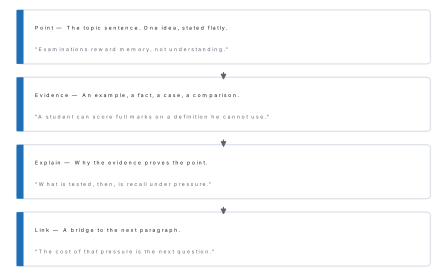
Each body paragraph is built the same way. Learn the four moves as a habit and you will never again write a paragraph that wanders.
Cohesion is what turns four paragraphs into one essay. Vary the connectives; the same moreover three times is itself an error of style.
| Job | Choose from |
|---|---|
| adding | furthermore, what is more, in addition, equally important |
| contrasting | however, by contrast, on the other hand, and yet, admittedly |
| causing | consequently, as a result, which is why, hence |
| giving an example | for instance, take the case of, consider |
| conceding then turning | granted that …, it is true that … but |
| concluding | in short, on balance, the upshot is |
33.5 Openings and endings that are not clichés
Since time immemorial… · Man is a social animal… · In today's modern world of science and technology… · The dictionary defines education as… · Every coin has two sides. · In this essay I am going to discuss… Each of them wastes the first sentence, which is the only sentence guaranteed to be read with full attention.
Replace them with one of these four:
| Opening | Example |
|---|---|
| A concrete scene | At six in the morning the corridor outside the examination hall smells of fear and hair oil. |
| A number or a fact | A Grade 12 student sits roughly thirty formal tests in two years. |
| A contradiction | We say we value understanding, and then we measure it with a stopwatch. |
| A question you will answer | What exactly is an examination for? |
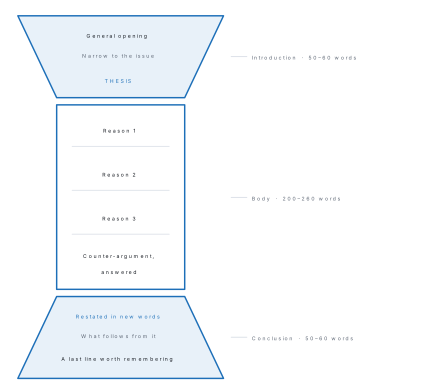
Conclusions fail in the opposite way: they either repeat the introduction word for word or introduce a brand-new idea. A good conclusion does three small things — restates the position in different words, says what should follow from it, and ends on a short sentence. Never begin one with Last but not the least; never end one with So, this is my essay.
Model answer 33.1 — an argumentative essay
Question. Examinations do more harm than good. Do you agree? Write an essay in about 350 words. [10]
Model answer — Thirty Tests and One Question
We say that we value understanding, and then we measure it with a stopwatch. For three hours in Chaitra, a student's two years are converted into a grade, and everything he has learnt that cannot be written down in that time is treated as though it did not happen. Examinations are not useless — a country of thirty million needs some fair way of deciding who enters which college — but as they are set at present they measure memory rather than understanding, and the fear they produce costs more learning than their discipline is worth.
The first charge against them is that they test recall, not thought. A student can score full marks on the definition of photosynthesis and still be unable to explain why a plant on a dark window sill turns yellow. Our question papers reward the sentence that has been memorised in the exact words of the textbook, and our answer keys frequently punish the student who puts the same idea in his own. What is being measured, then, is speed of recall under pressure — a real skill, but a narrow one, and not the one the syllabus claims to teach.
The second charge is heavier. Fear is a poor teacher. In the six months before the board examination, learning in most classrooms stops and revision begins: past papers, guess papers, model sets. Curiosity is postponed because curiosity is not on the marking scheme. A student who might have spent an evening taking a radio apart spends it instead copying the ten most probable questions, and the habit of asking why quietly dies.
It must be granted that examinations do some good. They impose a deadline, and most of us work only to deadlines. They are also, for all their faults, blind: the examiner in Kathmandu does not know whose son is writing. That fairness is worth defending, and nobody who argues against examinations should pretend otherwise.
But fairness is an argument for examinations of some kind, not for these. A paper that asked students to apply an idea to a situation they had never seen would be just as blind, just as fair, and would test something worth testing. Until we set that paper, we shall go on grading memory and calling it education.
Why it scores. The thesis is in the last sentence of the introduction and concedes something before it argues; each body paragraph opens with a flat topic sentence and then earns it with a concrete case; the fourth paragraph gives the other side properly before answering it; the conclusion proposes a remedy instead of repeating paragraph one; and the sentence lengths vary from three words to thirty.
33.6 The expository essay
An expository essay explains rather than argues. It is not permitted an opinion, and its organisation must therefore come from the material itself: causes and effects, stages in order, kinds and sub-kinds, or problem and solution. Announce that organisation in the introduction — three things drive this — and then keep to it.
Model answer 33.2 — an expository essay
Question. Explain why so many young people leave the hill villages of Nepal, and what a village loses when they go. Write about 350 words. [10]
Model answer — What the Hills Send Away
Walk through a hill village in Gandaki at midday and you will meet children, mothers and the very old, and almost nobody between eighteen and forty-five. The absence is not an accident. Three forces pull the young out of these villages — work, schooling and the shape of the land itself — and what is left behind loses more than a pair of hands.
Work is the first and the plainest. A terraced field of eight ropanis will feed a family for part of the year and pay for almost nothing else: no fees, no medicines, no roof of corrugated sheet. Wages in the Gulf, in Malaysia or simply in Pokhara are earned in cash, every month, and cash is what a household needs the moment it wants anything the village cannot grow. A young man does not leave because he dislikes farming; he leaves because farming has no salary.
Schooling is the second. Primary classes exist in nearly every ward, but the campus that offers Grade 11 is often three hours away on foot. Once a student boards in the district headquarters at sixteen, the village becomes a place he visits in Dashain. Education, which the village paid for, has taught him a way of living the village cannot supply.
The third force is the land. Hill soil is thin, the plots are small and divided again at every inheritance, and a single monsoon landslide can remove a year's work in an afternoon. Where the road has not come, the cost of carrying anything to market eats the profit of selling it.
What a village loses is not only labour. It loses the age group that repairs trails, carries the sick to the health post and argues in the ward assembly. Fields fall out of cultivation and the forest creeps back over them; festivals thin; a school with eleven pupils closes and the next family leaves because the school has closed. The money sent home builds better houses, but the houses stand empty most of the year.
The hills, in short, are exporting exactly the people who could have rebuilt them, and each departure makes the next one easier.
Why it scores. The introduction names the three causes and so promises a shape; each body paragraph takes one cause and supports it with a concrete detail (eight ropanis, three hours on foot, eleven pupils); the fourth paragraph turns from causes to consequences as the question required; there is no opinion anywhere; and the closing sentence states a pattern rather than a preference.
33.7 The memoir
A memoir is not an autobiography. An autobiography covers a life; a memoir takes one remembered episode and tells it so that the reader understands why it is still remembered. Five features are expected at Grade 12:
- First person, past tense — I, and events that are over.
- A single, narrow slice of time — a morning, a journey, one afternoon.
- Sensory detail: what could be seen, heard, smelt, touched. This is where a memoir earns its content marks.
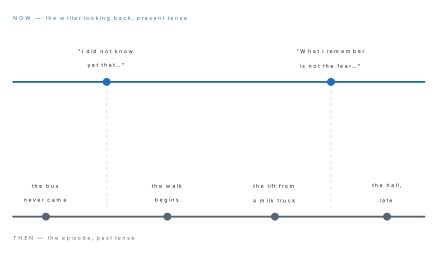
- The double voice — the person it happened to, and the older person telling it. The second voice is what makes it a memoir and not a story.
- A turning point and a reflection: something changed, and you now know what.
Model answer 33.3 — a memoir
Question. Write a memoir of an incident from your school days that you still think about. Write in about 350 words. [10]
Model answer — The Morning the Bus Did Not Come
I was fifteen, and the bus that took us from Bhanu to the examination centre at Damauli left the chautari at half past five. On the morning of the compulsory mathematics paper I was there at twenty past, with my admit card in a polythene bag inside my shirt because the sky had that low grey look that means rain before nine. At six o'clock the bus had not come. At half past six the tea-shop man said, without looking up from his kettle, that the drivers were on strike.
I remember exactly three things about the hour that followed: the smell of wet dust as the first drops came down, the sound of my own breathing, and a boy from the year below me crying quietly by the milestone. I remember no fear at all, which surprises me now. There was simply a distance — nineteen kilometres — and three hours in which to cover it, and it did not occur to me that the two might not fit together.
So I walked. For the first hour I walked fast and alone; then two other boys caught up and we walked together without saying much. At Byas a milk truck stopped of its own accord, and the driver, who asked nothing and was told nothing, moved four steel cans to make room for us on the tray. We sat among them with the rain coming sideways, and I held the polythene bag against my chest with both hands the whole way.
I reached the hall at twenty-five past nine, twenty-five minutes late, soaked to the knee. The invigilator looked at my admit card, looked at my trousers, and said nothing. He gave me the paper. I scored 71.
What I think about now is not the walk, and not the mark. It is the milk-truck driver, whose name I never asked and whose face I could not describe. He lost twenty minutes of his morning for three boys he would never see again, and he did it without the smallest suggestion that he was doing anything. I have been trying, ever since, to be somebody's milk truck.
Why it scores. One morning, not a whole school career; the detail is physical (the polythene bag, the steel cans, the rain sideways) rather than emotional; the older voice appears twice — which surprises me now, What I think about now — and the last line turns a private memory into something a reader can use.
33.8 Marking checklist for Question 6
| Check | Mark at risk | |
|---|---|---|
| 1 | Is my position or centre in one sentence at the end of paragraph one? | Content |
| 2 | Have I given the other side once, and answered it? | Content |
| 3 | Does every body paragraph begin with a topic sentence? | Organisation |
| 4 | Does every body paragraph contain one concrete example, number or case? | Content |
| 5 | Is the conclusion in different words from the introduction? | Organisation |
| 6 | Have I introduced a new idea in the conclusion? Remove it. | Organisation |
| 7 | Any since time immemorial, last but not the least, every coin has two sides? | Language |
| 8 | Have I used the same connective twice? Change one. | Language |
| 9 | For a memoir: is it one episode, in the past, with sensory detail? | Content |
| 10 | For a memoir: does the older voice appear at least twice? | Content |
| 11 | One tense per stretch; subject and verb agreeing; articles in place? | Language |
| 12 | Between 300 and 400 words, with a title? | Organisation |
Chapter summary
- Question 6 is 10 marks: content 4, organisation 3, language 3. Write 300–400 words in about thirty minutes, four of them on a plan.
- Decide first whether the topic wants an argument or a memory.
- The thesis is one sentence at the end of the introduction; it must be something a reasonable person could disagree with.
- The essay is an hourglass: general opening narrowing to the thesis, a straight body, a conclusion widening back out.
- Every body paragraph: point, evidence, explanation, link. The explanation is where the content marks are.
- An argumentative essay must concede one point to the other side and then answer it.
- An expository essay takes its shape from the material — causes, stages, kinds — and allows no opinion.
- A memoir is one episode, first person, past tense, heavy in sensory detail, told in two voices: the person it happened to and the person remembering.
- Open with a scene, a fact, a contradiction or a question. Never with since time immemorial.
Practice questions
Free writing — essays (10 marks each)
- Social media has made us better informed and worse at listening. Do you agree? [10]
- Explain the causes of air pollution in the Kathmandu Valley and suggest what a student can realistically do about it. [10]
- Write a descriptive essay on a market place on the first morning of a festival. [10]
- The best thing my school ever did was something that was not on the timetable. Write a reflective essay. [10]
Free writing — memoir (10 marks)
- Write a memoir of a day on which you were trusted with something you did not feel ready for. [10]
Position: agree with the first half, agree with the second, and argue that the second is caused by the first. Thesis: Social media has given us more information than any generation has ever had and, in the same movement, has taught us to reply before we have finished reading. Para 2 — better informed: a landslide in Sindhupalchok is known in Butwal in nine minutes; the flood of 2078 was mapped by ordinary people with phones. Para 3 — worse at listening: the reply button sits under the post, so answering costs less effort than understanding; a comment written in four seconds gets the same weight on the screen as an argument written in four hours. Para 4 — counter-argument: it is said that the fault is ours, not the platform's; answer that a tool which rewards speed will produce speed. Conclusion: the remedy is small and personal — read to the end before typing. Opening line: I know what happened in Sindhupalchok this morning. I could not tell you what my neighbour thinks about it.
Short free-writing skills (1 mark each)
- Turn into a thesis: This essay is about the importance of trees. [1]
- Name the fault: Firstly, secondly, thirdly, and last but not the least… [1]
- Which kind of essay is Discuss the stages by which a bill becomes law? [1]
- Rewrite as a topic sentence: Now I will talk about the second reason. [1]
- Give a connective that concedes and then turns. [1]
- What makes a memoir different from a short story? [1]
- Improve: In conclusion, I conclude that examinations are bad as I said above. [1]
Answers
6. A town that plants trees along its highways is buying shade, quieter air and lower repair bills, and it is buying them cheaply. — a position, not a subject.
7. Last but not the least is a cliché, and numbering every paragraph replaces real linking.
8. Expository — it explains a process and takes no position.
9. The second cost of the examination system is paid by teachers. — a topic sentence states the idea, it does not announce it.
10. Granted that… / It is true that… but / Admittedly…
11. A memoir is true and is told by the person it happened to, and it includes that person's later understanding of it.
12. We shall go on grading memory, then, until we are willing to set a harder kind of paper. — restate in new words and end on something forward-looking.
Practise more: English question bank