Unit 13 · Literature - Essays · 39 min read
On Libraries
What the syllabus asks for 7
- About the author
- The essay: source, shape and message
- The essay, paragraph by paragraph
- Arguments and themes
- Style and devices
- Glossary
- Textbook exercises
Most people meet a library as a place where you must be quiet. Oliver Sacks met it as the place where he became himself. His essay "On Libraries" is a short memoir of the rooms in which he read — the oak-panelled library at home, the public library five minutes from his door, the school and museum libraries where he hunted for chemistry, the vaults under an Oxford college — and it ends, unexpectedly, in grief: the shelves he loved are being emptied because students now find everything on a screen. It is one of the easiest essays in your book to read and one of the hardest to answer badly, because every paragraph is a memory and every memory carries a small argument.
The two-sided shape of the essay: eleven paragraphs of gratitude, then two of loss. The places (home library, Willesden Public Library, Walker Library, Science Museum library, Radcliffe Science Library, the Bodleian, the Queen's College library, the Albert Einstein College of Medicine library) and what each gave him. The contrast between a pupil and a learner. The community that grew between strangers in the stacks. And Sacks's attitude to the digital library: not anger at technology, but sorrow for the physical book — "its look, its smell, its heft". Short questions are almost always one fact from one paragraph; the long question is almost always "traditional versus digital" or "what libraries gave the writer".
13.1 About the author
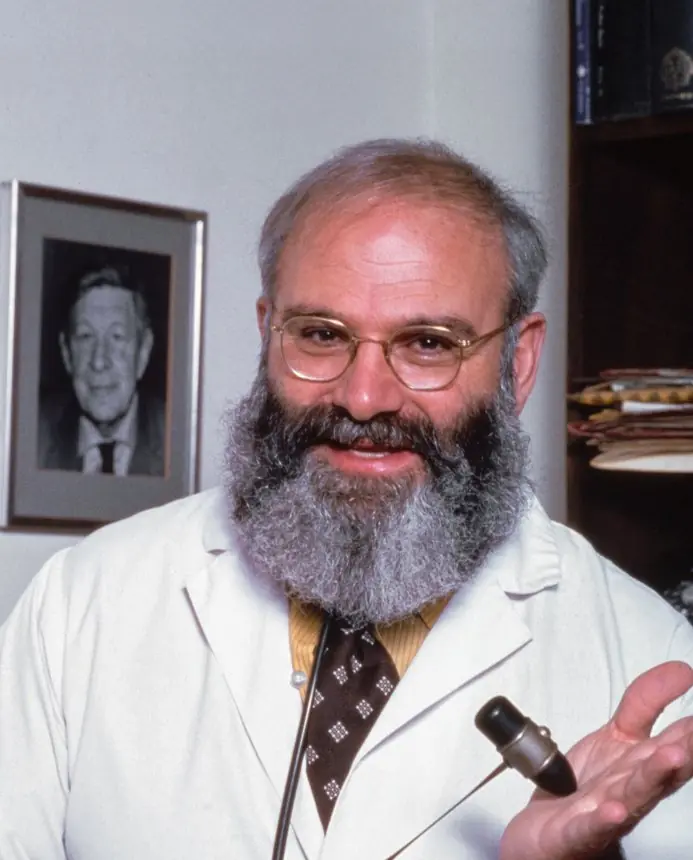
Oliver Wolf Sacks was born in London on 9 July 1933, the youngest of four sons of two doctors — a physician father and a surgeon mother. His parents met, as the essay tells us, in a medical students' society devoted to the plays of Ibsen. He was educated at St Paul's School in London and then at The Queen's College, Oxford, where he qualified in medicine. In the early 1960s he crossed the Atlantic: he interned at Mount Zion Hospital in San Francisco and trained in neurology at UCLA, and in 1965 he settled in New York, the city that appears in the middle of the essay. He worked there for nearly fifty years as a neurologist and died on 30 August 2015, aged 82.
What made Sacks famous was not only his medicine but his prose. In the hospital he met patients that other doctors had given up on — the survivors of the 1920s sleeping-sickness epidemic whom he woke with a new drug, people who could not recognise faces, people who heard music that was not there — and he wrote about them as human beings rather than as cases. The books that came out of this work are the ones your textbook names:
| Book | Year | What it is about |
|---|---|---|
| Migraine | 1970 | his first book, on the headache and its visual aura |
| Awakenings | 1973 | patients revived from sleeping sickness; filmed in 1990 with Robin Williams and Robert De Niro |
| The Man Who Mistook His Wife for a Hat | 1985 | case histories of unusual disorders of perception and memory |
| Musicophilia | 2007 | music and the brain |
| Hallucinations | 2012 | why healthy and sick minds see and hear what is not there |
| On the Move | 2015 | his memoir, published shortly before his death |
The New York Times called him "the poet laureate of medicine", and the textbook adds that he won honours from the Guggenheim Foundation, the National Science Foundation, the American Academy of Arts and Letters and the Royal College of Physicians. After his death a further book of essays, Everything in Its Place: First Loves and Last Tales (2019), was put together from the pieces he left. "On Libraries" was printed in the American literary magazine The Threepenny Review, and it appears in that posthumous collection under the shorter title "Libraries".
Sacks describes himself as a boy who was "biased towards the sciences, especially astronomy and chemistry". He did not become a literary man who happened to study medicine; he became a doctor who never stopped reading. That is why the essay moves so easily between Mellor's Treatise on Inorganic Chemistry, the diaries of a witty nineteenth-century entertainer and the seventeenth-century prose of Sir Thomas Browne. For him there was no wall between the sciences and the humanities — the library was where they met.
Several popular guides to this essay contain errors that will cost you marks if you copy them. Dickens is Charles Dickens, the English novelist — not "Emily" Dickens and not an American poet. Kipling was English, born in Bombay, not an Irish playwright. Willesden Public Library was the library of Sacks's growing-up years, not of his "adult life". And the essay says he was a good learner, not a good listener (see §13.7). Always check a fact against the essay itself.
13.2 The essay: source, shape and message
"On Libraries" is a personal (reflective) essay: the writer speaks in the first person, draws on his own memories and moves towards an opinion without proving it like a lawyer. Your textbook's headnote calls it "a praise of intellectual freedom, community work, and the ecstasy of serendipitous discovery". The three phrases are worth learning, because each names a strand of the essay:
- intellectual freedom — the freedom to choose your own books and follow your own curiosity (paragraph on Willesden);
- community — the quiet friendship of strangers in the stacks (paragraphs on New York);
- serendipity — the joy of finding a valuable thing by lucky accident, which only browsing among real shelves allows (the "unexpected treasures, lucky finds").
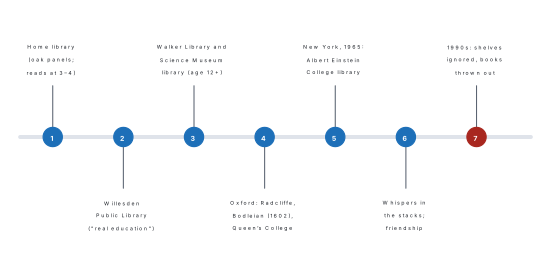
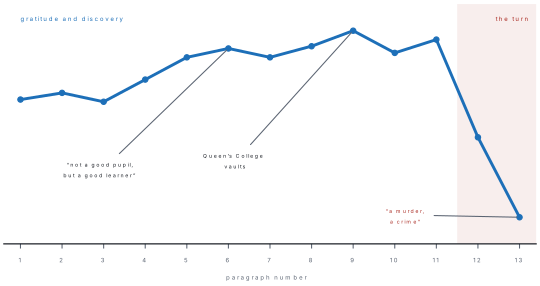
The essay is built in three movements. First comes childhood and youth (paragraphs 1–9): the home library, Willesden, school, the science books, Oxford. Second comes adult life in New York (paragraphs 10–11): the crowded flat, the spacious library, the whispered conversations. Third comes the turn (paragraphs 12–13): the 1990s, the students who ignore the shelves, the discarded books, the librarian's reassurance and the writer's refusal to be reassured. Nothing in the first eleven paragraphs tells you that the last two are coming — which is why they hit so hard.
13.3 The essay, paragraph by paragraph
The essay has thirteen short paragraphs. This section retells them in order, in plain words, with only the shortest quotations, so that you can find any detail the examiner asks for.
Paragraphs 1–4 — the library at home
Sacks's favourite room as a child was the family library: a large oak-panelled room, every wall lined with bookcases, a solid table in the middle for writing and study. It held his father's special collection as a Hebrew scholar; all of Ibsen's plays; a shelf of the young poets of his father's generation, "many killed in the Great War"; and, on the lowest shelves where a small boy could reach them, the adventure and history books of his three older brothers. Among these he found Kipling's The Jungle Book, identified with the wolf-boy Mowgli, and used his adventures as a launching-pad for his own fantasies.
His mother kept her own books in a separate bookcase in the lounge: Dickens, Trollope and Thackeray; Bernard Shaw's plays in pale green bindings; a complete Kipling in soft morocco leather; a three-volume Shakespeare; a gilt-edged Milton; and poetry she had won as school prizes. Medical books lived in a locked cabinet in the parents' surgery — but the key was in the door, which tells you how easily a curious child could get at anything.
The fourth paragraph sums up. The library was the quietest and most beautiful room in the house; it "vied with" his little chemistry lab as his favourite place. He would curl up in a chair and lose all sense of time, and when he was late for lunch or dinner the family knew where to look. He learned to read at three or four, and "books, and our library, are among my first memories".
Paragraphs 5–6 — Willesden: the "Ur-library"
The library that mattered most, he says, was not the one at home but Willesden Public Library, a five-minute walk from his house. He calls it his "Ur-library" — Ur- is a German prefix for "original, archetypal", so this was the first of all libraries, the one against which every later library was measured. "It was there I received my real education."
The next paragraph explains why. He disliked school: sitting in class receiving instruction, information went "in one ear and out by the other". He could not be passive; he had to learn actively, what he wanted and in the way that suited him. He puts it in one balanced sentence: he was "not a good pupil, but … a good learner". In Willesden and in every library afterwards he roamed the shelves, chose freely and followed paths that fascinated him — "to become myself". The paragraph closes with the feeling that runs through the whole essay: at the library he felt free — free to look at tens of thousands of books, and to enjoy the "quiet companionship of other readers, all, like myself, on quests of their own".
Paragraphs 7–8 — science, and the search for books that were not there
As he grew older his reading leaned towards astronomy and chemistry. At St Paul's School, which he entered at twelve, the Walker Library was excellent but strong in history and politics; it could not feed his hunger for science, and above all for chemistry. A master wrote him a special testimonial, which got him a ticket to the library of the Science Museum in London, where he "devoured" the many volumes of Mellor's Comprehensive Treatise on Inorganic and Theoretical Chemistry and the even longer Gmelin's Handbook of Inorganic Chemistry. Note what this shows: a school library, however good, cannot hold everything; a boy who wants more must go looking, and a great library will let him in.
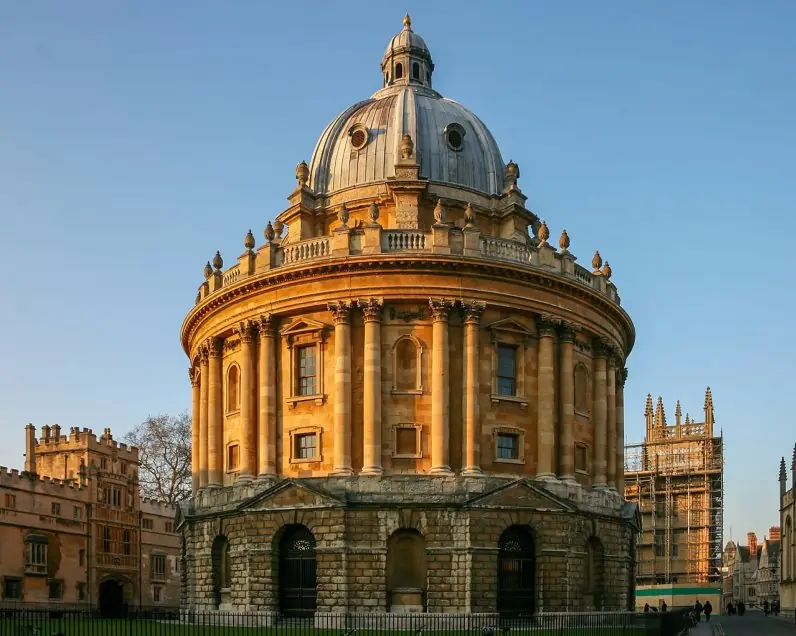
At Oxford he could use the two great university libraries, the Radcliffe Science Library and the Bodleian — "a wonderful general library that could trace itself back to 1602". In the Bodleian he stumbled on the forgotten works of Theodore Hook, an early-nineteenth-century wit admired for his brilliance at improvising in theatre and music (he was said to have composed more than five hundred operas on the spot). Sacks became so fascinated that he decided to write a kind of biography, a "case-history", of Hook. For that he needed materials that only the Bodleian and the British Museum Library could supply, and the "tranquil atmosphere" of the Bodleian was ideal for writing.
Paragraph 9 — the library he loved most: the Queen's College
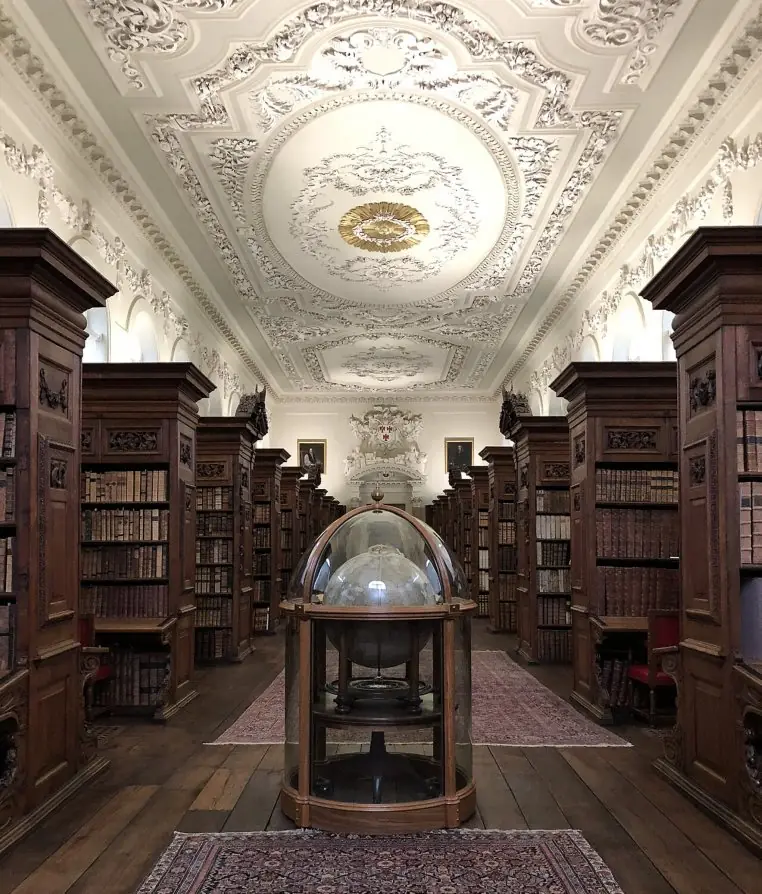
The Oxford library he loved best was not the grand university one but the library of his own college, the Queen's College. The magnificent library building itself, he says, was designed by Christopher Wren; beneath it, "in an underground maze of heating pipes and shelves", lay the vast holdings — the catacombs of the library. Here he held incunabula (books printed before 1501) for the first time and adored Gesner's Historiae Animalium (1551), illustrated with Dürer's rhinoceros, and Agassiz's four-volume work on fossil fishes. He saw all of Darwin's works in their original editions, and found and fell in love with Sir Thomas Browne — Religio Medici, Hydrotaphia, The Garden of Cyrus: "How absurd some of these were, but how magnificent the language!" When Browne's grand style (his magniloquence) became too much, he could switch to the sharp, chiselled prose of Swift.
He had grown up on the nineteenth-century books his parents loved; the Queen's vaults introduced him to the seventeenth and eighteenth centuries — Johnson, Hume, Pope and Dryden. And the great thing was that these books were "freely available, not in some special, locked-away rare books enclave, but just sitting on the shelves". In those vaults he "really gained a sense of history, and of my own language".
Paragraphs 10–11 — New York: space, treasures and friendship
In 1965 Sacks arrived in New York and found himself in "a horrid, pokey little apartment" with almost no surface to read or write on. He wrote part of Migraine (the book named in the essay) balancing at the top of the refrigerator, one elbow held awkwardly aloft. He longed for spaciousness, and found it at the library of the Albert Einstein College of Medicine, where he worked. There he could sit at a large table to read or write, then wander among the stacks with no idea what his eye might fall on — "unexpected treasures, lucky finds", which he carried back to his seat. This is the serendipity of the headnote.
The next paragraph adds people. Though the library was quiet, "whispered conversations might start in the stacks" — two readers hunting for the same old book, the same bound volumes of the journal Brain from 1890 — and such conversations "could lead to friendships". Everyone was absorbed in a private world, and yet there was "a sense of community, even intimacy". Part of this camaraderie came from the physicality of books: handling them, sharing them, passing them between readers, even seeing the names of earlier borrowers and the dates they took the books out.
Paragraphs 12–13 — the turn: the 1990s and the empty shelves
"But a shift was occurring by the 1990s." Sacks still sat at a table with a mountain of books, but students increasingly ignored the bookshelves and got what they needed on their computers. The books, so far as they were concerned, were unnecessary — and because most users no longer used the books, the college decided in the end to dispose of them. He had no idea this was happening, "not only in the AECOM library but in college and public libraries all over the country".
When he visited "a couple of months ago" he was horrified: the once-overflowing shelves were sparsely occupied, most books thrown out "with remarkably little objection from anyone". He felt "that a murder, a crime had been committed — the destruction of centuries of knowledge". A librarian, seeing his distress, reassured him that everything "of worth" had been digitised. But he does not use a computer, and he mourns the loss of books — even bound periodicals — because "there is something irreplaceable about a physical book: its look, its smell, its heft". He remembers how libraries once cherished old books and kept a special room for old and rare ones, and how in 1967, rummaging in the stacks, he found an 1873 book, Edward Liveing's Megrim, which inspired him to write his own first book. That last detail closes the circle: an old book on a shelf, found by accident, produced a new book. Digitise the shelf and you may keep the text — but you lose the accident.
When a short question begins with Where, When, Why did he …, the answer is nearly always in one of these anchors. Late for meals; first memories → ¶4. Willesden → ¶5. Dislike of school; freedom → ¶6. Science bias; Science Museum → ¶7. Hook; the Bodleian → ¶8. Queen's library → ¶9. New York; Einstein College → ¶10. Friendship → ¶11. The 1990s → ¶12. Horror, librarian, smell and heft → ¶13.
13.4 Arguments and themes
1. The library is a place of freedom. The word appears in the Willesden paragraph three times in three lines. Sacks contrasts two kinds of education. School is instruction: someone else chooses what you learn, how fast, and in what order. The library is self-education: you choose, you wander, you follow the odd book that catches your eye. He was, by his own account, a poor pupil and a good learner — and the library is where the learner, rather than the pupil, is allowed to flourish.
2. Books and libraries are the seedbed of a writer and thinker. The essay is really a map of how a mind was fed. Home shelves gave him fantasy (The Jungle Book) and the habit of absorption; Willesden gave him independence; the Science Museum gave him chemistry; the Bodleian gave him a subject (Hook); Queen's gave him "a sense of history, and of my own language"; the Einstein College library gave him space to write Migraine; and a stray 1873 book gave him the idea of his first book. A library is not a warehouse but a workshop.
3. Serendipity — discovery by lucky accident. Sacks never knew what his eyes "might alight upon" in the stacks. Shelves arrange knowledge by neighbourhood, so that what you find beside the book you wanted is often better than the book you wanted. A search box returns exactly what you asked for and nothing else.
4. Community without conversation. A library is one of the few places where strangers share a room in silence and still feel connected — "all of us … reading our own books, absorbed in our own worlds, and yet there was a sense of community, even intimacy". The friendships that started from two people looking for the same old volume are Sacks's proof that a quiet place can still be a social one.
5. The physical book and its irreplaceable qualities. Sacks does not say digitisation is useless. He says it does not replace everything. A physical book has a look, a smell, a heft — and, in a library copy, the traces of earlier readers, the names and dates that make a shelf a shared memory. Old books are also artefacts: an original edition of Darwin or a Gesner from 1551 tells you something a scan cannot.
6. The danger of forgetting: technology, progress and loss. The ending is an alarm. Libraries were emptied "with remarkably little objection from anyone". Sacks's word for it is murder, and the target is "centuries of knowledge". The essay asks a hard modern question: when we make something more convenient, what do we quietly stop valuing? Note that he offers no plan; he ends with a memory, not a slogan.
13.5 Style and devices
Personal voice and plain diction. Sacks writes in the first person and in short, unforced sentences. The essay contains very few difficult words; the difficulty (as the glossary shows) is in the names — Mellor, Gmelin, Gesner, Agassiz, Browne — and these are there for a reason, described below.
Catalogues. Long lists of authors and titles recur (the mother's shelf; the Queen's vaults). They work like the shelves themselves: the reader is made to walk along them. The lists also show Sacks's range — Kipling to Gmelin, Dryden to Darwin.
Contrast (antithesis). Not a good pupil, but a good learner. Instruction versus freedom. Quiet library versus whispered friendships. Above all, the essay's two halves — then and now, shelf and screen.
Allusion and the "Ur-library". Naming real books and real places makes the essay credible and lets the reader see the shelves. Ur- (German for "original") gives Willesden a mythic importance: the first library, the source of all others.
Metaphors of space and journey. The library is a maze, catacombs, vaults, stacks to be "roamed"; the readers are on quests. These images make reading an adventure and the reader an explorer.
Verbs of hunger. He hungered for science books and devoured Mellor's volumes. Reading is presented as appetite — which is why the modern preference for a quick search feels, to him, like a diet of crumbs.
Tone. Warm and grateful for ten paragraphs; sober and then indignant in the last two. The single most forceful word, "murder", is saved for the end and applied to books, which is a deliberate hyperbole — an exaggeration that shows the depth of feeling.
Symbol of the physical book. "Its look, its smell, its heft" — three senses, three words — stands for everything a screen cannot carry: memory, place, continuity.
13.6 Glossary
| Word | Meaning |
|---|---|
| fantasies | imaginary adventures; things one dreams up |
| morocco | fine, soft goat-skin leather used for binding books |
| curl up | to sit or lie with the legs drawn up in a comfortable position |
| absorbed | so deeply interested that nothing else is noticed (an adjective; the textbook wrongly marks it as an adverb) |
| vied with | competed with |
| Ur-library | (Ur- is German) the original, first and archetypal library |
| astronomy | the scientific study of the sun, moon, stars and planets |
| hungered for | wanted very strongly |
| testimonial | a written statement recommending someone |
| devoured | read greedily and quickly, as if eating |
| Comprehensive Treatise | a very complete, formal, multi-volume work on a subject |
| stumbled upon | found by chance |
| improvisation | composing or performing on the spot without preparation |
| case-history | a detailed record of one person's life and condition, as doctors keep |
| tranquil | calm and quiet |
| incunabula | books printed in the earliest years of printing, before 1501 |
| magniloquence | grand, high-flown language |
| lapidary | (of writing) elegant, exact and concise, as if cut in stone |
| catacombs | underground passages or chambers |
| stacks | the rows of shelving in which library books are stored |
| enclave | a small area with a special character, enclosed within a larger one |
| pokey | small, cramped and unpleasant |
| aloft | high up; in the air |
| camaraderie | friendship and trust among people who spend time together |
| rummaging | searching by turning things over |
| heft | weight; the feel of something heavy in the hand (the textbook glossary misprints this as "helt") |
| digitised | converted into computer-readable form |
| irreplaceable | impossible to replace once lost |
Library (a collection of books, or the room that holds it) and librarian (the person who looks after it). Serendipity (finding something good by chance) and synchronicity (a meaningful coincidence). Digital (stored and read on a computer) and physical (held in the hand).
13.7 Textbook exercises
Before you read
a. Why do people visit the libraries?
People go to libraries for many reasons. Students go to study quietly and to find books they cannot afford to buy; researchers go for reference works and old records that are found nowhere else; ordinary readers go for pleasure and relaxation; and many go simply for the company of other readers. Libraries also lend newspapers, magazines and, today, computers and internet access, so that people without them at home are not left behind.
b. Have you ever borrowed books from the library? If yes, what kinds of books do you like to read?
A personal answer is expected. Model: Yes, I borrow from my school library and from the community library in our ward. I like short stories and biographies because they show how real people overcame difficulties, and I borrow science magazines when I want explanations that are simpler than my textbook's. I avoid books that are only summaries of exam answers, because they teach me nothing that I can use outside the examination hall.
Understanding the text
a. Where could the author be found when he was late for lunch or dinner?
He could be found in the oak-panelled library at home, curled up in a chair and so completely absorbed in a book that he had lost all sense of time.
b. What are his first memories?
His first memories are of books and the family library. He learned to read early, at three or four, and the library where his father, mother and brothers kept their books was already his favourite room.
c. Why did he dislike school?
He disliked sitting in class passively receiving instruction: information seemed to go in one ear and out of the other. He wanted to learn actively — what he chose, in the way that suited him — and school did not allow that. He calls himself "not a good pupil, but … a good learner".
d. What did he feel about the library?
He felt free. In the library he could look at thousands of books, choose whatever he liked, follow whatever paths fascinated him and "become myself". He also enjoyed its special atmosphere and the quiet companionship of other readers, each on a quest of his or her own.
e. Why was he so biased towards the sciences, especially astronomy and chemistry?
As he grew older his interests turned towards science, and the essay gives no reason beyond that growing interest. What it does show is how strong the interest was: he "hungered" for chemistry books, which the excellent but history-heavy Walker Library at St Paul's could not supply, so he got a ticket to the Science Museum library and read Mellor and Gmelin. His little chemistry "lab" at home, which he says rivalled the library as his favourite place, points the same way.
f. Why did he become so fascinated by Hook?
Theodore Hook was a man greatly admired in the early nineteenth century for his wit and for his genius at improvising in theatre and music; he was even said to have composed more than five hundred operas on the spot. Sacks found his forgotten works by chance in the Bodleian and was so struck by such a gifted, neglected man that he decided to write a biography or "case-history" of him.
g. Describe the library at the Queen's College.
The library building was designed by Christopher Wren and was magnificent. Beneath it, in an underground maze of heating pipes and shelves, lay the huge holdings, like catacombs. There Sacks handled incunabula, saw Gesner's Historiae Animalium (1551) with Dürer's rhinoceros, Agassiz's volumes on fossil fishes and all of Darwin's works in their original editions, and discovered Sir Thomas Browne, Swift, Johnson, Hume, Pope and Dryden. The books were freely available on open shelves, not locked away. He says it was there that he gained "a sense of history, and of my own language".
h. Why did the students ignore the bookshelves in the 1990s?
Because they could get what they needed through their computers. Few of them went to the shelves any more; as far as they were concerned the books were unnecessary.
i. Why was he horrified when he visited the library a couple of months ago?
He found the shelves, once overflowing, sparsely occupied: most books had been thrown out, with almost no objection from anyone. He felt it was like "a murder, a crime" — the destruction of centuries of knowledge.
Reference to the context
a. The author says, "I was not a good pupil, but I was a good listener." Justify it with textual evidence.
Note first that the textbook has misquoted the essay: Sacks writes "a good learner", not "listener". Answer the question as it is set, but if you can, use the right word. Sacks disliked school because passive instruction bored him: "information seemed to go in one ear and out by the other." A good pupil accepts what the teacher offers; Sacks could not. But he was an excellent learner, because he learned actively for himself. In the library he "roamed the shelves and stacks", chose "whatever I wanted", and followed "paths which fascinated me". As a boy he devoured Mellor's and Gmelin's chemistry volumes after a school library could not supply them, and at Oxford he taught himself seventeenth-century literature in the Queen's vaults and researched Theodore Hook. A pupil waits to be taught; a learner goes and finds out — and Sacks was the second kind.
b. A proverb says, "Nothing is pleasanter than exploring a library." Does this proverb apply in the essay? Explain.
Yes, it applies completely. Exploring is exactly what Sacks describes: he "roamed the shelves and stacks" at Willesden, discovered Hook by chance in the Bodleian, "stumbled upon" old treasures in the Queen's catacombs and, in New York, would "wander around the shelves and stacks" without knowing what he might find. Each search ends in delight — the "unexpected treasures, lucky finds". The pleasure of exploring is also social, because whispered conversations in the stacks turned into friendships. The proverb even explains his sorrow at the end: when the shelves are emptied there is nothing left to explore.
c. Are there any other services that you would like to see added to the library?
An opinion answer. Model: I would like libraries to add audio books and large-print and Braille editions so that visually impaired readers can use them; a digital section with internet and e-books, provided that the printed books stay on the shelves; quiet study rooms for group work; evening and holiday opening hours; reading clubs and author talks to bring young readers in; and a mobile library to serve villages far from any town. New services should be added to the shelves, not put in their place — which is the lesson of Sacks's essay.
Reference beyond the text
a. Write an essay on Libraries and its uses for students.
Model essay (about 250 words).
Libraries and Their Uses for Students. A library is an organised collection of books, journals, newspapers and other resources kept for public use. For a student it is a second classroom, and in many ways a better one, because the student chooses the lesson.
The first use of a library is reference and study. A textbook gives one writer's account; a library gives many, so that a student can compare, check facts and understand a topic more deeply. Books that are too expensive to buy — dictionaries, encyclopaedias, atlases, past question papers — are available free of charge. The second use is self-education. Like Oliver Sacks, a curious student can follow a subject as far as his interest takes him, beyond the syllabus. Reading widely also improves vocabulary, writing and concentration, which help in every examination. Third, a library gives a quiet place to work, especially to students whose homes are crowded or noisy. It also teaches discipline and respect — silence, careful handling of books, and return on time.
Today most libraries also provide computers, e-books and internet access, which open further sources of knowledge. But the printed shelves still matter, for browsing among them often leads to discoveries that a search cannot. A student who uses the library regularly learns not only facts but how to find them, and that is the beginning of independent thought.
b. Do you have any public library in your locality? If so, do the people in your community use it? Give a couple of examples.
A personal answer, drawn from the student's own community, is expected. Model: Yes, there is a community library in our tole, opened by a youth club with donated books. Students use it most, especially in the weeks before the board examinations, when they borrow past papers and reference books and study in its small reading room. Older residents come in the morning to read the newspapers and magazines, and on Saturdays a local teacher runs a story hour for young children. Use is less than it could be, because many families do not know the library exists and because it has few new books. A regular reading campaign and a computer with internet would bring more readers.
Chapter summary
- "On Libraries" is a personal essay by the neurologist and writer Oliver Sacks (1933–2015); it praises libraries as places of intellectual freedom, community and serendipitous discovery, and was published in The Threepenny Review and, as "Libraries", in Everything in Its Place (2019).
- Childhood: the oak-panelled home library (father's Hebrew scholarship, Ibsen, war poets, brothers' adventure books, The Jungle Book; mother's Dickens, Trollope, Thackeray, Shaw, Kipling, Shakespeare, Milton); he read at three or four and was found in the library when late for meals.
- Willesden Public Library was his "Ur-library" and his "real education". He disliked school but was "not a good pupil, but … a good learner": in libraries he was free to choose and "become myself".
- Science: the Walker Library at St Paul's lacked chemistry, so a testimonial got him into the Science Museum library (Mellor's Treatise, Gmelin's Handbook).
- Oxford: the Radcliffe Science Library and the Bodleian (traced to 1602; Theodore Hook, over 500 improvised operas; British Museum Library); above all the Queen's College library (Wren; catacombs; incunabula, Gesner 1551, Agassiz, Darwin, Browne, Swift, Johnson, Hume, Pope, Dryden) — "a sense of history, and of my own language".
- New York, 1965: Migraine begun on top of a refrigerator; the Albert Einstein College of Medicine library gave space, lucky finds and friendships (Brain from 1890).
- The turn: by the 1990s students ignored the shelves, books were disposed of; Sacks was horrified ("a murder, a crime"), was told everything "of worth" had been digitised, and answered that a physical book has "its look, its smell, its heft".
- Devices: first-person memoir, catalogues, contrast, metaphors of maze and quest, hyperbole ("murder"), the symbol of the physical book.
Practice questions
Short answer questions (2 marks each)
- Why did Sacks call Willesden Public Library his "Ur-library"? [2]
- How did Sacks get into the library of the Science Museum? [2]
- Why does the author appreciate the Queen's College library? (NEB 2080, GIE Set A) [2]
- Why do you think the modern students ignore the bookshelves? (NEB 2081, Set A) [2]
- What made the essayist unhappy when he visited the library a couple of months ago? (NEB 2081, Set B) [2]
- How does the writer's family background inspire him to learn from the library? (NEB 2081, Set B) [2]
- What impression did the author have about the library at the Albert Einstein College of Medicine? (NEB 2081, Set C) [2]
- What did the librarian assure the author? (NEB 2079, GIE) [2]
- Why does the digital library not interest the author? (NEB 2082) [2]
- Why was the author biased towards science? (NEB 2080, Set D) [2]
Model answers — short questions
1. Ur- is a German prefix meaning "original". Willesden, the public library a five-minute walk from his home, was the first great library of his life and the standard for every library after it: there, he says, he "received my real education".
2. The Walker Library at his school, St Paul's, had few science books, so a schoolmaster wrote him a special testimonial. With that recommendation he obtained a ticket to the Science Museum library and read the huge chemistry works of Mellor and Gmelin.
3. He appreciates it for its magnificent building (designed by Wren), its underground "maze of heating pipes and shelves", and above all its holdings: ancient books, Gesner's Historiae Animalium, Agassiz, Darwin's works in original editions, Browne, Swift, and the seventeenth- and eighteenth-century writers. The books were freely available on the shelves, and there he "really gained a sense of history, and of my own language".
4. Because by the 1990s they could find whatever they needed through computers, so the shelves seemed unnecessary. To them the printed books were no longer the first place to look, and few visited the stacks at all.
5. He found the shelves, once overflowing, sparsely occupied; most of the books had been thrown out over a few years, with hardly any objection. He felt that a crime had been committed against centuries of knowledge.
6. His father's Hebrew scholarship, his parents' Ibsen society, his mother's books and his brothers' adventure books meant that shelves of books surrounded him from birth. He could pick up a book at any time, learned to read at three or four and made the oak-panelled library his favourite place — the beginning of a lifelong habit of learning in libraries.
7. He found it spacious, which he had longed for after his cramped flat. It had a large table where he could read and write and shelves and stacks where he could wander and find "unexpected treasures, lucky finds". It was quiet, but whispered conversations led to friendships, and it gave him a sense of community, even intimacy.
8. The librarian, seeing his distress, assured him that everything "of worth" had already been digitised, so nothing valuable was lost.
9. He values what only a physical book can offer — "its look, its smell, its heft" — and the freedom of browsing among shelves. He does not use a computer himself, and he feels a digital copy cannot replace the book, the shelf and the reader's community.
10. As he grew older his interest turned to astronomy and chemistry. The essay says his reading became "increasingly biased towards the sciences", and his hunger for chemistry books that the school library lacked led him to the Science Museum library.
Long answer questions (5 marks each)
- In the essay "On Libraries", Oliver Sacks talks about two kinds of library — the traditional library and the modern, digital one. Which do you find more impressive, and why? (NEB 2082, adapted) [5]
- "On Libraries" is written in praise of intellectual freedom, community and serendipitous discovery. Discuss. [5]
- What did libraries give Oliver Sacks at each stage of his life? Trace the development of his relationship with libraries. [5]
- Do you agree with Sacks that the loss of physical books is a great loss? Give reasons from the essay and from your own experience. [5]
Model answers — long questions
1. Sacks describes the traditional library in loving detail: oak-panelled rooms, open shelves and stacks, quiet tables, whispered talk that turns to friendship, old books in original editions — and, at the end, a digital library in which books are scanned and the paper copies thrown away. I find the traditional library more impressive, and Sacks gives me the reasons. First, it gives freedom to browse: he "roamed the shelves" and found "unexpected treasures, lucky finds", such as Hook in the Bodleian and Liveing's Megrim in the stacks. A search returns only what you ask for; a shelf shows you what you did not know to ask. Second, it builds community: readers looking for the same volume of Brain became friends, and handling books and seeing earlier borrowers' names created "camaraderie". Third, the physical book has a sensory and historical value — "its look, its smell, its heft" — which a scan cannot carry. That said, a digital library has real advantages: it reaches distant readers, it saves space and it can protect fragile texts. The wisest answer is that we should add the digital library to the traditional one, not use it to destroy the shelves; Sacks's grief is at the destruction, not at the technology itself.
2. The headnote's three phrases each name a strand of the essay. Intellectual freedom is the freedom to choose what to read, which he found at Willesden, where he was "free to look at the thousands, tens of thousands, of books" and "to become myself", in contrast with school where he was passive. Community is the intimacy of strangers in a quiet room: two readers whispering over the same old book, sharing volumes and seeing each other's names on the library slips. Serendipity is the joy of lucky finds — discovering Hook, or Sir Thomas Browne in the stacks, or the 1873 book that inspired his first book. All three depend on physical shelves and open access, which is why the essay ends in sorrow when students ignore them and colleges dispose of the books. The praise of libraries is therefore also a defence of a certain kind of education: self-directed, sociable and full of surprise.
3. Home library: books and reading became his first memories; he read at three or four and found fantasy in The Jungle Book. Willesden: his "real education"; freedom to choose; independence from the school that bored him. Walker Library and Science Museum library: his first serious training in chemistry, when his school could not supply the books. Oxford: the Bodleian gave him a subject in Theodore Hook and a quiet place to write; the Queen's College library gave him "a sense of history, and of my own language" through original editions of Darwin, Browne, Swift and others. New York: the Einstein College library gave him space to read and write after his cramped flat, lucky finds and friendships. The 1990s: the library as he had known it began to disappear, and he was left grieving. The relationship therefore grows from shelter to freedom to training to scholarship to community, and ends as a loss he cannot prevent.
4. I agree with Sacks that it is a great loss, though not one to be blamed on technology alone. His argument is that digitisation saves the text but destroys the book: its "look, its smell, its heft", its neighbours on the shelf and the names of earlier readers. It also destroys serendipity: he found Hook and Megrim only by wandering among real shelves. And a library that disposes of its old books cannot rediscover them later; once a book is thrown out and the scan is lost or unreadable, knowledge vanishes. In my own experience, a book on a school shelf beside the one I wanted has often taught me something I did not plan to learn. On the other hand, I know that digital libraries help students in remote parts of Nepal who have no shelves at all. So the loss is real but avoidable: keep the books and add the screens.
Take any sentence from the essay and ask four things of it: (a) who says it and where; (b) what comes immediately before or after; (c) what it means in plain words; (d) why it matters to the whole essay. For "But a shift was occurring by the 1990s": (a) Sacks, at the turn from memories to the loss of libraries; (b) after the New York friendships, before the students who ignore the shelves; (c) the way people used libraries was changing; (d) it is the hinge of the essay, from praise to grief.
Practise more: English question bank