Unit 26 · Grammar · 15 min read
Adjectives, Adverbs and Adjective Order
What the syllabus asks for 7
- Kinds of adjective and where they can stand
- The order of adjectives
- Participial adjectives: -ing and -ed
- Degrees of comparison
- Adverbs: kinds, forms and false friends
- Where an adverb stands
- Errors Nepali speakers make most often
An adjective describes a noun or pronoun; an adverb describes a verb, an adjective, another adverb or a whole sentence. That much is familiar from earlier grades. What Grade 12 adds is the fussy detail the examiner actually tests: the fixed order in which several adjectives must stand before a noun, the difference between bored and boring, the comparatives that take to instead of than, and the position an adverb is allowed to occupy in a clause. These are places where a sentence can be perfectly understandable and still be marked wrong.
- Several adjectives before a noun follow the order opinion – size – age – shape – colour – origin – material – purpose.
- -ing describes the thing that causes the feeling; -ed describes the person who has it. The lesson was boring; the students were bored.
- A linking verb (be, seem, look, feel, taste, sound, smell, become, get) is followed by an adjective, not an adverb: The soup tastes good, not tastes well.
- An adverb never comes between a verb and its object: She speaks English fluently, not speaks fluently English.
26.1 Kinds of adjective and where they can stand
| Kind | Examples |
|---|---|
| Quality (descriptive) | honest, red, Nepali, wooden |
| Quantity | much, little, some, enough, whole |
| Number | five, many, few, first, several |
| Demonstrative | this, that, these, those |
| Possessive | my, our, your, his, their |
| Distributive | each, every, either, neither |
| Interrogative | which, what, whose |
Most adjectives can stand before the noun (attributive: a tall boy) or after a linking verb (predicative: the boy is tall**). A few are fixed in one position only.
| Predicative only | Attributive only |
|---|---|
| afraid, alive, asleep, alone, ashamed, aware, awake, alike, content, glad, unable | main, only, mere, sheer, chief, former, latter, elder, eldest, inner, outer, utter |
✓ The child was asleep. ✗ the asleep child → ✓ the sleeping child ✓ my elder brother ✗ He is elder than me → ✓ He is older than me
26.2 The order of adjectives
When two or more adjectives of different kinds come before a noun, English fixes their order. Native speakers do not learn it as a rule, but they never break it, and the examiner marks it.
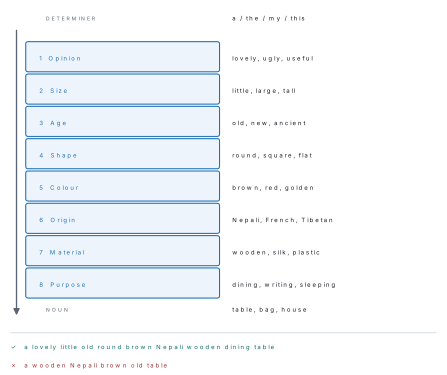
Two points of detail:
- Commas. Adjectives of the same kind are separated by commas or and: a cold, wet, miserable morning. Adjectives of different kinds take no comma: a small black bag.
- Numbers come first. the first three chapters, not the three first chapters.
✗ the three first questions → ✓ the first three questions ✗ a red big ball → ✓ a big red ball (size before colour) ✗ an Italian old leather jacket → ✓ an old Italian leather jacket ✗ a most unique opportunity → ✓ a unique opportunity (unique, perfect, round, empty, full, ideal are absolute — they have no degrees)
26.3 Participial adjectives: -ing and -ed
| -ing — what causes the feeling | -ed — what feels it |
|---|---|
| The journey was tiring. | The passengers were tired. |
| The film was boring. | We were bored. |
| The news is surprising. | I am surprised at the news. |
| The result was disappointing. | Her parents were disappointed. |
| a frightening noise | a frightened child |
| an interesting lecture | an interested listener |
| a confusing map | a confused tourist |
| an exciting match | the excited crowd |
✗ I am very interesting in music. → ✓ I am very interested in music. ✗ The students were boring with the lesson. → ✓ The students were bored with the lesson.
26.4 Degrees of comparison
| Formation | Positive | Comparative | Superlative |
|---|---|---|---|
| one syllable: + er / est | tall | taller | tallest |
| one syllable ending consonant–vowel–consonant: double the consonant | big | bigger | biggest |
| ending in -y: y → i | happy | happier | happiest |
| two syllables or more: more / most | beautiful | more beautiful | most beautiful |
| irregular | good / well | better | best |
| irregular | bad / ill | worse | worst |
| irregular | little | less | least |
| irregular | much / many | more | most |
| irregular | far | farther / further | farthest / furthest |
| irregular | late | later / latter | latest / last |
| irregular | old | older / elder | oldest / eldest |
Comparatives that take to, not than. These come from Latin and already contain the comparison: superior, inferior, senior, junior, prior, anterior, posterior, preferable. ✓ He is senior to me. ✗ He is senior than me. ✓ Health is preferable to wealth. ✓ I prefer tea to coffee.
Patterns worth memorising.
- He is taller than any other boy in the class. (not any boy — that would include himself)
- Kathmandu is one of the busiest cities in Nepal. (superlative + plural noun)
- The more* you practise, the better* you become.
- This bag is twice as heavy as that one.
- He is not so / as tall as his brother.
- a most interesting book = a very interesting book (formal use of most)
✗ more better, most best, more easier → never combine more / most with -er / -est. ✗ Nepal is larger than any country in South Asia. → ✓ …than any other country… ✗ The climate of Pokhara is better than Kathmandu. → ✓ …better than that of Kathmandu. (compare like with like) ✗ He is the taller of the three. → ✓ the tallest of the three (comparative for two, superlative for three or more) ✗ sufficient enough, return back, repeat again → say it once: sufficient, return, repeat.
26.5 Adverbs: kinds, forms and false friends
| Kind | Question answered | Examples |
|---|---|---|
| Manner | how? | carefully, fast, well, hard |
| Place | where? | here, outside, upstairs, everywhere |
| Time | when? | now, yesterday, soon, already |
| Frequency | how often? | always, often, seldom, never, twice |
| Degree | how much? | very, quite, almost, too, enough |
| Sentence (comment) | the speaker's view | fortunately, certainly, obviously |
Most adverbs of manner are formed with -ly, but three groups break the pattern.
| Group | Examples |
|---|---|
| Same form as the adjective | fast, hard, late, early, straight, high, deep, near, well (from good) |
| -ly form with a different meaning | hardly = almost not · lately = recently · nearly = almost · highly = very much · deeply = profoundly · shortly = soon |
| Adjectives ending in -ly (never adverbs) | friendly, lovely, lonely, silly, cowardly, likely, ugly |
✓ He works hard. (with effort) ✓ He hardly works. (almost not at all) ✓ She came late. ✓ I have not seen him lately. ✓ The bird flew high. ✓ She is highly respected. For friendly and its group, use a phrase: He spoke in a friendly way.
26.6 Where an adverb stands
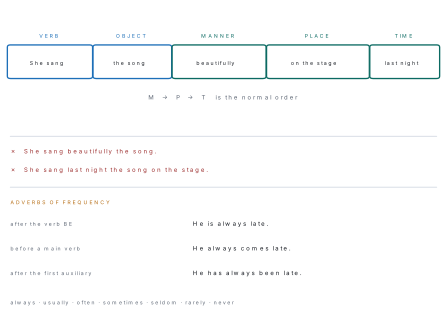
Three further rules of position:
- Adverbs of degree stand immediately before the word they modify: She is quite sure, He drives too fast. But enough follows the adjective or adverb: old enough, clearly **enough.
- Only attaches to whatever follows it, and moving it moves the meaning. Only I solved two sums. (nobody else did) · I only solved two sums. (I did nothing more with them) · I solved only two sums. (no more than two)
- Negative adverbials at the front cause inversion — the auxiliary jumps in front of the subject.
| Front position | Sentence |
|---|---|
| Never | Never have I seen such a crowd. |
| Seldom / Rarely | Rarely does he miss a class. |
| Hardly … when | Hardly had she* spoken when* the bell rang. |
| No sooner … than | No sooner had we* sat down than* it rained. |
| Not only … but also | Not only did he* apologise, but he also* paid for the damage. |
| Little | Little did they know the truth. |
| Under no circumstances | Under no circumstances should you open this door. |
26.7 Errors Nepali speakers make most often
| ✗ Wrong | ✓ Correct | Why |
|---|---|---|
| It was very much interesting. | It was very interesting. | very + adjective; very much goes with verbs and comparatives |
| I am much happy. | I am very happy. | much modifies comparatives (much happier), not the positive |
| He is more taller than me. | He is taller than me. | no double comparative |
| She is senior than me. | She is senior to me. | Latin comparatives take to |
| She sings very nice. | She sings very nicely. | a verb needs an adverb |
| The food tastes well. | The food tastes good. | linking verb + adjective |
| He drives very fastly. | He drives very fast. | fast has no -ly form |
| He works hardly. | He works hard. | hardly means "almost not" |
| This is more preferable. | This is preferable. | preferable is already comparative |
| He is elder than his sister. | He is older than his sister. | elder is attributive only |
| We have sufficient enough time. | We have enough time. | one word is enough |
| It is the most unique design. | It is a unique design. | absolute adjectives take no degree |
| He speaks English good. | He speaks English well. | good is an adjective, well the adverb |
| I am feeling very badly. | I am feeling very bad. | feel here is a linking verb |
| She read carefully the letter. | She read the letter carefully. | nothing between verb and object |
Problem. Rearrange: (a) a / Nepali / beautiful / woollen / old / shawl.
Solution — step by step.
- Sort each word into its slot. beautiful = opinion (1), old = age (3), Nepali = origin (6), woollen = material (7).
- Put the determiner first: a.
- Arrange by slot number: 1 → 3 → 6 → 7.
- End with the noun: shawl.
Answer. a beautiful old Nepali woollen shawl
No commas are needed, because every adjective belongs to a different class.
Problem. Choose: The three-hour speech was so (bored / boring) that even the (interested / interesting) listeners looked (tired / tiring).
Solution — ask who feels and what causes.
- The speech causes the feeling, so it takes the -ing form: boring.
- The listeners experience the feeling, so they take the -ed form: interested.
- The listeners again feel it: tired. (tiring would mean the listeners made other people tired.)
Answer. The three-hour speech was so boring that even the interested listeners looked tired.
Problem. Rewrite beginning with the word given: (a) I have never tasted such sweet mangoes. (Never …) (b) He had hardly reached home when the storm broke. (Hardly …)
Solution — step by step.
- (a) Move Never to the front. Inversion now applies: the auxiliary have moves before the subject I, and the rest of the verb phrase follows unchanged. Answer: Never have I tasted such sweet mangoes.
- (b) Move Hardly to the front. The auxiliary is had, so it comes before he. The when clause stays where it is. Answer: Hardly had he reached home when the storm broke.
Note that inversion uses the auxiliary only. If the sentence has no auxiliary, supply do / does / did: He rarely complains. → Rarely does he complain.
Chapter summary
- Adjective order: opinion – size – age – shape – colour – origin – material – purpose, after the determiner and before the noun; numbers come before descriptive adjectives.
- afraid, alive, asleep, alone, aware, ashamed stand only after a verb; main, only, mere, former, elder only before a noun.
- -ing = the cause of a feeling, -ed = the person who has it.
- Comparatives: -er/-est for short words, more/most for long ones; never both. superior, inferior, senior, junior, prior, preferable take to.
- Use than any other in comparisons within a group; use that of when comparing qualities of two things.
- hard / hardly, late / lately, near / nearly, high / highly are different words, not variants.
- A linking verb takes an adjective; an action verb takes an adverb.
- Order of adverbs after the object: manner – place – time; never put an adverb between the verb and its object.
- Frequency adverbs go after be, before a main verb, and after the first auxiliary.
- Negative adverbials at the front (Never, Rarely, Hardly, No sooner, Little, Not only, Under no circumstances) force inversion of the auxiliary.
Practice questions
Choose or supply the correct form (1 mark each)
- The lecture was so ____ (bore) that half the class fell asleep. [1]
- She speaks English more ____ (fluent) than her brother. [1]
- Everest is ____ (high) mountain in the world. [1]
- He is two years ____ (senior) me in service. [1]
- The porter carried the load quite ____ (easy). [1]
- This year's result is ____ (bad) than last year's. [1]
- I have not met him ____ (late). [1]
- The children were ____ (excite) about the picnic. [1]
- She is one of the ____ (talented) singers of her generation. [1]
- The ____ (much) you read, the more you learn. [1]
Answers
1. boring — the lecture causes the feeling.
2. fluently — an adverb modifies speaks; fluently is three syllables, so more fluently.
3. the highest — superlative with the.
4. senior to — the Latin comparative takes to.
5. easily — an adverb of manner after the object the load.
6. worse — irregular comparative of bad.
7. lately — "recently", used with the present perfect.
8. excited — the children have the feeling.
9. most talented — one of the + superlative + plural noun.
10. more — the fixed pattern the more … the more ….
Correct the errors (1 mark each)
- He is more stronger than his elder brother. [1]
- She read carefully the notice before signing it. [1]
- The mangoes of Nepal are sweeter than India. [1]
- I am very much interesting in classical music. [1]
- He drives very fastly on the highway. [1]
- This soup tastes very well. [1]
- She bought a Nepali beautiful woollen cap. [1]
- Kathmandu is bigger than any city in Nepal. [1]
- We have sufficient enough chairs for the guests. [1]
- He works hardly from morning till night. [1]
Answers
11. He is stronger than his elder brother. — never more with -er.
12. She read the notice carefully before signing it. — no adverb between verb and object.
13. The mangoes of Nepal are sweeter than those of India. — compare mangoes with mangoes.
14. I am very much interested in classical music. — the person feels it. (very interested is equally correct.)
15. He drives very fast on the highway. — fast is both adjective and adverb.
16. This soup tastes very good. — taste is a linking verb here.
17. She bought a beautiful Nepali woollen cap. — opinion, then origin, then material.
18. Kathmandu is bigger than any other city in Nepal. — Kathmandu cannot be bigger than itself.
19. We have enough chairs for the guests. — sufficient enough is a double expression.
20. He works hard from morning till night. — hardly would mean "almost not".
Rewrite as instructed (1 mark each)
- I have never heard such a foolish excuse. — Begin: Never … [1]
- He had no sooner entered the hall than the lights failed. — Begin: No sooner … [1]
- He rarely visits his village. — Begin: Rarely … [1]
- No other student in the class is as sincere as Sita. — Rewrite using the superlative. [1]
- Ram is not as tall as Hari. — Rewrite using taller. [1]
Answers
21. Never have I heard such a foolish excuse. — the auxiliary have moves before I.
22. No sooner had he entered the hall than the lights failed. — inversion of had.
23. Rarely does he visit his village. — there is no auxiliary, so does is supplied and the main verb returns to its base form.
24. Sita is the most sincere student in the class. — the negative comparison becomes a superlative.
25. Hari is taller than Ram. — reverse the subjects and use the comparative.
Practise more: English question bank