Unit 25 · Grammar · 16 min read
Connectives and Discourse Markers
What the syllabus asks for 6
- The three grammatical types
- Connectives grouped by meaning
- Paired (correlative) connectives
- Punctuation the examiner checks
- Choosing between look-alikes
- Joining sentences — the patterns NEB sets
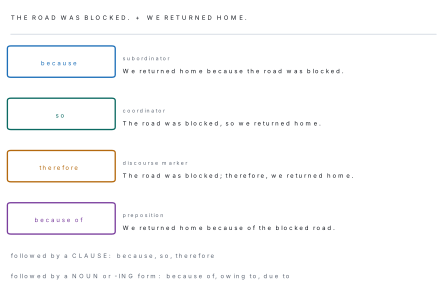
A connective is any word or phrase that shows how one idea is related to another — and, but, because, although, however, therefore, in spite of. When the connective joins clauses inside a sentence we call it a conjunction; when it opens a sentence and points back to the one before, it is a discourse marker (also called a linking or transitional word). Q7 sets them as gap-fills and as joining exercises, and the writing questions are marked partly on them. The trick is that connectives of the same meaning need different grammar: because takes a clause, because of takes a noun, and therefore needs a full stop or a semicolon in front of it.
Before you write a connective, ask what comes after it. Subordinating conjunction (because, although, when, if) + a clause: because the road was blocked. Coordinating conjunction (and, but, so, or) + a clause, with a comma before it: , so we returned. Discourse marker (however, therefore, moreover) — a new sentence or a semicolon before it, a comma after: ; therefore, we returned. Preposition (because of, in spite of, despite) + a noun or -ing form: in spite of the rain.
25.1 The three grammatical types
| Type | Members | Position | Punctuation |
|---|---|---|---|
| Coordinating conjunctions (FANBOYS) | for, and, nor, but, or, yet, so | between two equal clauses | comma before the conjunction: It rained, but we played. |
| Subordinating conjunctions | because, since, as, although, though, even though, while, whereas, when, before, after, until, unless, if, so that, in case, as soon as, provided that, as long as | at the front of the dependent clause, which may come first or second | comma only when the dependent clause comes first: Although it rained, we played. |
| Conjunctive adverbs / discourse markers | however, therefore, moreover, furthermore, nevertheless, consequently, hence, thus, otherwise, meanwhile, instead, besides, in fact, for example, on the other hand, in short | at the front of a new sentence, or after a semicolon | It rained. However, we played. / It rained; however, we played. |
25.2 Connectives grouped by meaning
| Relation | Subordinators (+ clause) | Coordinators | Discourse markers | Prepositions (+ noun / -ing) |
|---|---|---|---|---|
| Addition | — | and, nor | moreover, furthermore, besides, in addition, what is more | in addition to, besides |
| Contrast / concession | although, though, even though, while, whereas | but, yet | however, nevertheless, nonetheless, on the other hand, on the contrary, instead | in spite of, despite, notwithstanding |
| Cause / reason | because, since, as, seeing that | for | — | because of, owing to, due to, on account of, thanks to |
| Result / effect | so … that, such … that | so | therefore, consequently, hence, thus, as a result, accordingly | — |
| Purpose | so that, in order that, lest | — | — | to, in order to, so as to, for |
| Condition | if, unless, provided (that), as long as, in case, on condition that | or (else) | otherwise | without, but for |
| Time / sequence | when, while, before, after, until, as soon as, no sooner … than, hardly … when | — | then, meanwhile, afterwards, later, finally, at last, first of all | during, prior to, after |
| Example | — | — | for example, for instance, namely, that is | such as, like |
| Comparison | as … as, than, just as | — | similarly, likewise, in the same way | like, unlike |
| Emphasis | — | — | indeed, in fact, as a matter of fact, above all | — |
| Summary | — | — | in short, to sum up, in conclusion, on the whole, all in all | — |
25.3 Paired (correlative) connectives
These come in two halves, and both halves must be present and in the right place.
| Pair | Example | Point to watch |
|---|---|---|
| both … and | She is both intelligent and hard-working. | plural verb |
| either … or | Either* Ram or* Shyam has taken it. | verb follows the nearer subject |
| neither … nor | Neither* the pen nor the book is* mine. | never use or after neither |
| not only … but also | He not only sings but also plays the sarangi. | the two halves must have the same grammatical shape |
| whether … or | I do not know whether he will come or not. | if cannot be used before or not in this pattern |
| no sooner … than | No sooner had* the bell rung than* the children ran out. | inversion after no sooner; than, never then |
| hardly / scarcely … when (or before) | Hardly had* I sat down when* the phone rang. | inversion; when, not than |
| so … that | He was so tired that he fell asleep at once. | so + adjective / adverb |
| such … that | It was such a cold night that the pipes froze. | such + (a) + adjective + noun |
| too … to | The box is too heavy to lift. | already negative — never add not |
| as … as | Pokhara is as beautiful as Bandipur. | base form of the adjective |
| lest … should | Work hard lest you should fail. | lest is already negative — never add not |
25.4 Punctuation the examiner checks
- Comma before a coordinating conjunction that joins two full clauses: The power went off, and the fans stopped. No comma when there is no second subject: He opened the gate and went in.
- Comma after a fronted subordinate clause: When the bell rang, the children rushed out. No comma the other way round: The children rushed out when the bell rang.
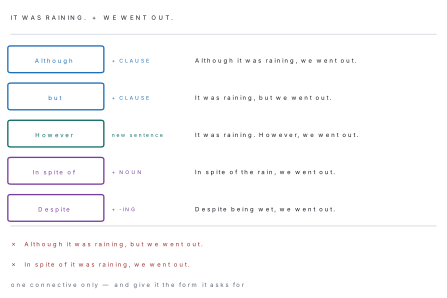
- A discourse marker cannot join two clauses by itself. Use a full stop or a semicolon before it and a comma after it. ✗ It was late, however we continued the meeting. ✓ It was late. However, we continued the meeting. ✓ It was late; however, we continued the meeting.
- Never double the connective. English uses one, Nepali-influenced English often uses two.
✗ Although he was ill, but he attended the class. → ✓ Although he was ill, he attended the class. / ✓ He was ill, but he attended the class. ✗ Because* it was raining, so we stayed at home. → ✓ Because it was raining, we stayed at home. / ✓ It was raining, so we stayed at home. ✗ Though he is rich, yet he is unhappy. → ✓ Though he is rich, he is unhappy. (yet alone is acceptable in formal writing, but never write though … but) ✗ No sooner had he left then it rained. → ✓ No sooner had he left than it rained. ✗ Unless you don't work hard, you will fail. → ✓ Unless you work hard, you will fail. (unless already means if not) ✗ Work hard lest you should not fail. → ✓ Work hard lest you should fail. ✗ Despite of the rain, the match went on. → ✓ Despite the rain / ✓ In spite of* the rain.
25.5 Choosing between look-alikes
| Pair | Difference | Example |
|---|---|---|
| because / because of | because + clause; because of + noun | because he was ill / because of **his illness |
| although / in spite of | although + clause; in spite of + noun or -ing | although he was poor / in spite of **his poverty |
| beside / besides | beside = next to; besides = in addition to | Sit beside me. / Besides Nepali, he speaks Maithili. |
| however / but | however needs a sentence break; but joins with a comma | …rained. However, … / …rained, but … |
| so / such | so + adjective; such + (a) + adjective + noun | so cold / such a cold night |
| too / very | too = more than is acceptable | too hot to drink / very hot |
| on the other hand / on the contrary | two sides of an issue / correcting a wrong idea | He is strict; on the other hand, he is fair. / He is not lazy; on the contrary, he works all night. |
| while / whereas | while = at the same time, or contrast; whereas = contrast only | Kathmandu is crowded, whereas Jumla is empty. |
| since / for | since + point of time or reason; for + length of time | Since you are here, help me. |
25.6 Joining sentences — the patterns NEB sets
| Instruction | Example pair | Joined |
|---|---|---|
| Use although | He was tired. He finished the work. | Although he was tired, he finished the work. |
| Use so … that | The tea was very hot. I could not drink it. | The tea was so hot that I could not drink it. |
| Use too … to | The tea was very hot. I could not drink it. | The tea was too hot to drink. |
| Use no sooner … than | He reached the stop. The bus left. | No sooner had he reached the stop than the bus left. |
| Use as soon as | same pair | As soon as he reached the stop, the bus left. |
| Use so that (purpose) | She got up early. She wanted to catch the first bus. | She got up early so that she could catch the first bus. |
| Use unless | Work hard. Otherwise you will fail. | Unless you work hard, you will fail. |
| Use in spite of | He was ill. He attended the class. | In spite of his illness, he attended the class. |
Problem. Fill in the blanks: (a) The flight was cancelled _ the bad weather. (b) _ the weather was bad, the flight was cancelled. (c) The weather was bad; ____, the flight was cancelled.
Solution — step by step.
- (a) What follows is the bad weather, a noun phrase. A noun phrase needs a preposition, not a conjunction. Answer: because of (also owing to / due to / on account of).
- (b) What follows is the weather was bad, a clause with its own subject and verb, and the gap is at the front of the sentence. That calls for a subordinating conjunction. Answer: Because (also As / Since).
- (c) There is a semicolon in front of the gap and a comma after it, so the word must be a discourse marker of result. Answer: therefore (also consequently / hence / as a result).
Problem. Join into one sentence using no sooner … than: The teacher entered the class. The students stood up.
Solution — step by step.
- Put the earlier event after no sooner. The entering came first.
- Invert the auxiliary. A sentence beginning with no sooner must be inverted: the auxiliary comes before the subject. The tense is past, and no sooner takes the past perfect for the earlier event: No sooner had the teacher entered** …
- Join the second clause with than — not then, and not when.
- Keep the later event in the simple past.
Answer. No sooner had the teacher entered the class than the students stood up.
With hardly / scarcely the second half takes when: Hardly had the teacher entered the class when the students stood up.
Problem. Correct: Although he had little money, but he helped the flood victims, because of he is generous, and despite of his own losses.
Solution — one fault at a time.
- Although … but doubles the connective. Keep although and delete but.
- because of he is generous — he is generous is a clause, so the preposition because of must become the conjunction because.
- despite of — despite never takes of.
- his own losses is a noun phrase, which despite correctly governs, so only the of is removed.
Answer. Although he had little money, he helped the flood victims, because he is generous, despite his own losses.
Chapter summary
- Connectives fall into four grammatical types, each with its own requirement: subordinator + clause, coordinator + clause (comma before), discourse marker + new sentence or semicolon, preposition + noun or -ing.
- FANBOYS = for, and, nor, but, or, yet, so — the seven coordinating conjunctions.
- A fronted subordinate clause takes a comma; the same clause at the end does not.
- However, therefore, moreover, nevertheless, consequently cannot join two clauses with a comma — that is a comma splice.
- Never double a connective: although … but, because … so, though … yet are all wrong.
- No sooner … than (with inversion), hardly / scarcely … when, so … that, such a … that, too … to, lest … should.
- Unless already means if not; lest and too … to are already negative — do not add another not.
- Despite takes no of; in spite of does.
- Because / although / while take clauses; because of / in spite of / despite take nouns or -ing forms.
- Beside = next to; besides = in addition to.
Practice questions
Fill in the blanks with a suitable connective (1 mark each)
- ____ he worked hard, he could not pass the examination. [1]
- The match was postponed ____ the heavy rain. [1]
- She is very busy today; ____, she has agreed to meet us. [1]
- Hurry up, ____ you will miss the last bus. [1]
- _ had the programme started _ the power went off. [1]
- He saved money ____ he could buy a laptop. [1]
- ____ Nepali, she can speak Maithili and Hindi fluently. [1]
- The soup was ____ salty that nobody could eat it. [1]
- Kathmandu is crowded, ____ Jumla is almost empty. [1]
- ____ you apologise, he will not talk to you. [1]
Answers
1. Although (or Though / Even though) — a clause of concession follows.
2. because of (or owing to / due to) — a noun phrase follows, so a preposition is needed.
3. however (or nevertheless) — a discourse marker after a semicolon.
4. or (or otherwise) — a warning about the alternative result.
5. No sooner … than — the fixed pair, with inversion after no sooner.
6. so that — purpose, followed by could.
7. Besides (or In addition to) — "in addition to Nepali".
8. so — so + adjective + that.
9. whereas (or while) — direct contrast between two places.
10. Unless — unless means "if … not", so no extra negative is used.
Correct the errors in the following sentences (1 mark each)
- Although he was ill, but he came to college. [1]
- Because the shop was closed, so we returned empty-handed. [1]
- Despite of his age, he walks five kilometres every day. [1]
- No sooner had the bell rung then the students rushed out. [1]
- Unless you don't hurry, you will be late. [1]
- He ran fast lest he should not miss the train. [1]
- It was raining heavily, however the programme continued. [1]
- She was too tired that she could not walk further. [1]
- Beside tea, they also served biscuits. [1]
- He failed because of he did not revise the lessons. [1]
Answers
11. Although he was ill, he came to college. — one connective only.
12. Because the shop was closed, we returned empty-handed. — delete so.
13. Despite his age, he walks five kilometres every day. — despite takes no of.
14. No sooner had the bell rung than the students rushed out. — the pair is no sooner … than.
15. Unless you hurry, you will be late. — unless already contains the negative.
16. He ran fast lest he should miss the train. — lest is already negative.
17. It was raining heavily; however, the programme continued. — a discourse marker needs a semicolon or a full stop.
18. She was so tired that she could not walk further. (or too tired to walk further) — too pairs with to, not that.
19. Besides tea, they also served biscuits. — besides means "in addition to".
20. He failed because he did not revise the lessons. — a clause needs because, not because of.
Join the following pairs as instructed (1 mark each)
- He was very weak. He could not stand. — Use so … that. [1]
- He was very weak. He could not stand. — Use too … to. [1]
- She switched on the fan. The room was hot. — Use because. [1]
- He started early. He wanted to avoid the traffic. — Use so that. [1]
- I reached the counter. The last ticket was sold. — Use hardly … when. [1]
- It was a very interesting film. We watched it twice. — Use such … that. [1]
Answers
21. He was so weak that he could not stand. — so + adjective + that + clause.
22. He was too weak to stand. — too … to carries the negative sense by itself.
23. She switched on the fan because the room was hot. — reason clause after the main clause, so no comma.
24. He started early so that he could avoid the traffic. — purpose clause with could.
25. Hardly had I reached the counter when the last ticket was sold. — inversion, past perfect, then when.
26. It was such an interesting film that we watched it twice. — such + a/an + adjective + noun + that.
Practise more: English question bank