Unit 4 · Literature - Short Stories · 42 min read
The Treasure in the Forest
What the syllabus asks for 8
- About the author
- The story
- Characters
- Themes
- Setting, structure and point of view
- Style and literary devices
- Glossary
- Textbook exercises
"The Treasure in the Forest" is one of H. G. Wells's earliest short stories and one of his most compact. Two men paddle a canoe towards a tropical island with a stolen map. In the first pages they are thirsty and eager; by the last page they are dying in a silent forest beside a heap of gold. Nothing in the story is wasted: every small detail — the map's "little dashes", a "little prick" on the thumb, the grin on a dead man's face — turns out to be a clue. It is a story about greed, but it is also a lesson in how a storyteller plants a secret in plain sight and then lets the reader discover it a moment before the characters do.
Greed makes people careless, and treasure that looks like a prize may be a trap. Evans and Hooker take their gold from a dead man and a map from another — and pay for it with their lives, killed by the same hidden thorns that killed the man they found. The story is a moral tale dressed as a thriller: the wages of greed are death, and a clever victim can win even after he is dead.
4.1 About the author
Herbert George Wells (1866–1946) was born in Bromley, Kent, England, the fourth and last child of Joseph Wells, who kept a failing shop and was a professional cricketer, and Sarah Neal, a former domestic servant who later returned to work as a lady's maid. The family was poor, and "Bertie", as he was called, was sent at thirteen to learn the drapery trade. He loathed it — a thirteen-hour day, sleeping in a dormitory — and the experience later fed his comic novels Kipps and The History of Mr Polly. He became a pupil-teacher, and won a scholarship to the Normal School of Science (now part of Imperial College) in London, where he studied biology under T. H. Huxley, Darwin's great defender. That scientific training marks all his fiction.
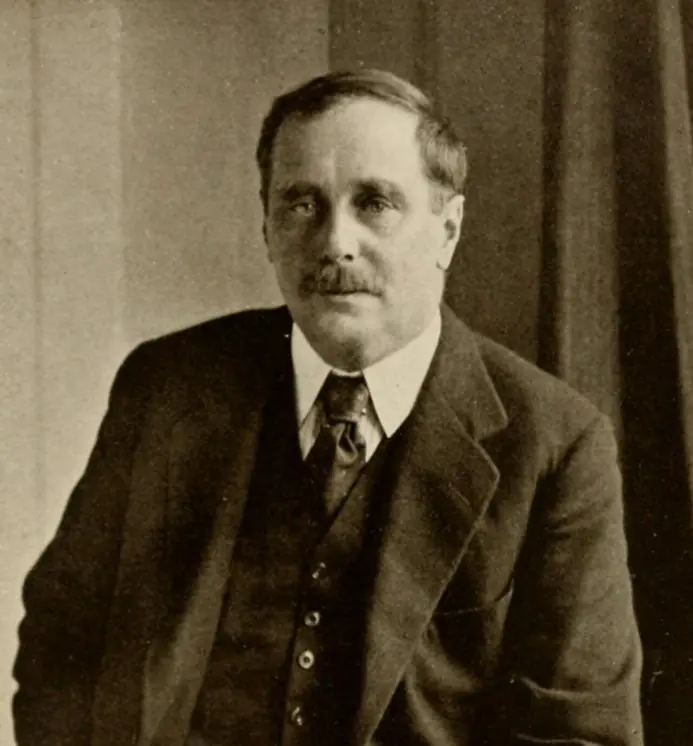
Wells began publishing stories in the 1890s and had an immediate success with The Time Machine (1895). Over the next few years came The Island of Doctor Moreau (1896), The Invisible Man (1897) and The War of the Worlds (1898), which made him, with Jules Verne, a father of science fiction. He also wrote social novels (Tono-Bungay, 1909), a huge popular history (The Outline of History, 1920) and many essays as a socialist and member of the Fabian Society. He was nominated for the Nobel Prize in Literature four times and died in London in 1946.
"The Treasure in the Forest" first appeared in the magazine Pall Mall Budget on 23 August 1894, when Wells was twenty-seven and still earning his living by writing short pieces for London newspapers. It was collected in his first book of stories, The Stolen Bacillus and Other Incidents (1895). It is a good example of his early manner: a short, tight, "what happens next?" tale with a sting in the tail.
- The story is not science fiction and has no invention in it. Wells wrote many kinds of story; this is an adventure-mystery-horror tale.
- The two treasure hunters are Evans and Hooker. The Chinese man who owned the map is Chang-hi. Some study guides write "Evan" for "Evans".
- Chang-hi is not the dead man in the forest. The dead body they find is that of another Chinese man (probably one of Chang-hi's companions). Chang-hi himself is remembered only in Evans's dream and in Hooker's last thoughts.
- The story never says outright that Evans and Hooker killed Chang-hi. It implies it: the "struggle for the plan", Chang-hi's pigtail in Evans's hand in the dream, and Hooker's shudder — "It's so like——" — at the corpse.
4.2 The story
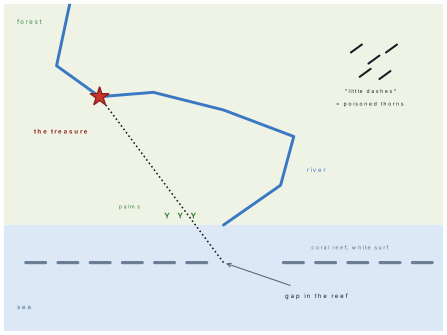
The canoe and the map. The story opens on a blazing afternoon. A canoe is "approaching the land": a gap in the white surf of a coral reef shows where a little river runs into the sea; behind it the "virgin forest" comes close to the beach; far off rise mountains "like suddenly frozen waves". The sea is still and "the sky blazed". The two men, Evans and Hooker, speak in low voices; their lips are "hard and dry". Hooker has a sheet of yellow paper on his knee — a rough map, creased and worn to the point of falling apart, with the outline of the bay in faint pencil and writing in Chinese. Evans reads it first: here is the reef and here the gap; the twisting line is the river; the star is the place. Hooker adds the dotted line, which runs straight from the opening in the reef to a clump of palm trees; the star is where the line cuts the river. There are also some "little marks" and "little dashes, pointing this way and that" which neither man can explain. "It looks like the plan of a house or something." Then Hooker folds the map, puts it in his pocket and begins to paddle. "His movements were languid, like those of a man whose strength was nearly exhausted."
Evans's dream. Evans dozes in the heat and the story slides into a dream that is really a memory. He sees the night when he and Hooker stumbled on the Chinamen's secret: moonlit trees, a little fire, three Chinese men talking in pidgin English. The story they overheard was this. A Spanish galleon from the Philippines had run aground, and its treasure was buried "against the day of return"; the crew, thinned by disease and quarrels, took to their boats and were never heard of again. A year ago one of the three, Chang-hi, had wandered ashore, found the ingots "hidden for two hundred years", deserted his junk, and reburied them "with infinite toil, single-handed but very safe". He "laid great stress on the safety": it was a secret of his. Now he wanted help to return and dig them up. Evans's dream moves on to the moment "when he had Chang-hi's pigtail in his hand": the two Europeans seized the map by force, telling themselves that "the life of a Chinaman is scarcely sacred like a European's". At the end Chang-hi gave "a most incomprehensible and startling grin". The dream turns into a nightmare in which the gold becomes a furnace and a vast devil, "surprisingly like Chang-hi", feeds him with burning coals. Hooker's voice wakes him: they are at the mouth of the lagoon.
Landing. They find the three palm trees and a clump of bushes and plan to go in a straight line from them into the forest until they reach the stream. Evans, dying of thirst after a long night voyage "in the unprovisioned canoe", wants to drink at once: "or by heaven I shall have to drink sea water!" At the river mouth Hooker tastes the water, spits, tastes again further up — "This will do" — and they drink greedily; Evans leans out of the canoe and sucks up the water with his lips. They paddle back down the river, land on the beach, pull the canoe up and set off into the jungle. Evans carries "a native implement", L-shaped with a polished stone head; Hooker carries the paddle.
The forest. The ground is first a "close tangle of reeds, broad fronds, and young trees", then the trees become "vast pillars" holding up a canopy of greenery "far overhead". The glare of the sun is replaced by cool shadow; dim white flowers hang from the trunks; ropy creepers swing from tree to tree; on the ground are "blotched fungi and a red-brown incrustation". Evans shivers: "It seems almost cold here." They reach a bright gap where hot sunlight strikes the forest and hear the rush of water; the river flows past a broad, quiet pool.
The dead man. "If we beat a little way up and down the stream we should come to something," says Hooker, and the two recall the map-maker's words about "a heap of stones". Downstream, Evans suddenly stops — "What the devil's that?" — and Hooker sees "something blue". It is the figure of a Chinese man lying on his face in a clear space among the trees. Near him are a spade "after the Chinese pattern", a scattered heap of stones and a freshly dug hole. "Somebody has been here before." Evans begins to swear, rave and stamp on the ground; Hooker turns white and says nothing. He sees that the dead man's neck is "puffed and purple" and his hands and ankles swollen. Then he goes to the hole and cries out in surprise: "You fool! It's all right. It's here still." Half-exposed in the hole lie "a number of dull yellow bars".
The gold and the thorns. Evans climbs into the hole, clears the soil with his bare hands and heaves out one heavy bar. As he does so "a little thorn pricked his hand". He pulls the "delicate spike" out with his fingers and lifts the ingot: "Only gold or lead could weigh like this." Hooker is puzzled by the corpse: "He stole a march on his friends... some poisonous snake has killed him." Evans, already planning, spreads his jacket and flings in two or three ingots, and presently finds that "another little thorn had punctured his skin". He becomes irritable. Hooker cannot bear the sight of the corpse — "It's so like——" — and wants to bury it, but Evans refuses: "Let that mass of corruption bide."
The sickness. They lift the jacket by its corners. After a few steps Evans complains that his arms ache "still with that paddling", that it is "stuffy, somehow, in this forest", and then snaps with "unreasonable anger": "Lend a hand, I say! You have done nothing but moon since we saw the dead Chinaman." His breathing grows heavy. He stumbles, flings down the coat, clutches his throat — "Don't come near me" — and slides down a tree trunk, his hands clenched, his face distorted. "Put the gold back on the coat," he begs. As Hooker handles the ingots he feels "a little prick on the ball of his thumb" and finds a slender thorn, two inches long, in it.
Understanding. At that instant Hooker puts it all together. He looks at Evans "crumpled together on the ground, his back bending and straightening spasmodically"; he looks through the tree trunks at the "blue-clad body of the Chinaman"; he "thought of the little dashes in the corner of the plan, and in a moment he understood." The thorns are like those that Dyaks poison and use in blowpipes; the dashes on the map marked the places where poisoned thorns had been set around the treasure. He understands "what Chang-hi's assurance of the safety of his treasure meant", and "he understood that grin now". "Evans!" he cries — but Evans is silent, twitching horribly.
The end. Hooker sucks the wound "for dear life" but soon feels "a strange aching pain in his arms and shoulders" and knows "that sucking was no good". He sits down by the pile of ingots, chin on hands, and watches the quivering body of his companion. The pain spreads to his throat. Overhead a faint breeze stirs the leaves, and "the white petals of some unknown flower came floating down through the gloom". There the story ends, without a word about what happens next — none is needed.
4.3 Characters
| Character | Who they are | Role in the story |
|---|---|---|
| Evans | One of the two "stranded British wastrels"; the more hot-tempered and openly greedy | Protagonist and first victim; his contempt for others and his impatience for the gold drive the plot |
| Hooker | Evans's partner; careful, watchful, more thoughtful | The second protagonist and the story's "eyes": he notices, worries, understands — and is too late |
| Chang-hi | The Chinese man who found and reburied the treasure and drew the map | The absent centre of the story; a shrewd, secretive man who out-thinks his robbers |
| The two other Chinese men | Chang-hi's companions round the fire | Overheard in the dream; one of them may be the dead man in the forest |
| The dead man in blue | A Chinese man found face down beside a dug hole | Both a warning and a false clue: he seems to have been killed by "some poisonous snake" |
Evans. He is first seen as dry-lipped and exhausted, and it is his thirst, his dreams and his anger that we follow. He reacts to the dead body not with fear but with "swearing and raving", because it tells him someone else may have got there first; when he sees the gold he speaks "exultantly". He talks of the Chinese in contemptuous terms ("All Chinamen are alike") and refuses to bury the corpse, calling it "that mass of corruption". The symptoms of the poison — bad temper, aching arms, stuffiness, breathlessness — are cleverly disguised as extensions of his character: he is already irritable, so we do not see at first that he is dying. Evans is the man for whom the treasure is everything.
Hooker. He is quieter and more perceptive. He is the one who tastes the water before drinking, who notices "something blue", who observes that the corpse's neck is "puffed and purple", and who cannot bear the sight of the body ("It scares me somehow"). He is not better than Evans — he took part in the theft of the map and he wants the gold — but he has a conscience, and it is his mind, not Evans's, that the story follows to the end. The last discovery, the thorn in his thumb, is made by him. His intelligence does not save him; it only lets him understand what is happening.
Chang-hi. He appears only in memory, in three pictures: a "cunning little face, first keen and furious like a startled snake, and then fearful, treacherous, and pitiful"; a man grinning "a most incomprehensible and startling grin"; and a man whose "assurance of the safety of his treasure" was literally true. The reader never learns what happened to him, but we understand that his grin was the grin of a man who knew that the theft would kill the thieves. In moral terms he is the most intelligent character in the story.
The story has no good character. Evans and Hooker are thieves, probably murderers, who speak of another race as less than human. Wells does not tell us to hate them; he lets the forest do that. The reader's sympathy shifts from them to horror at what happens, and finally to a strange respect for the dead man's cleverness.
4.4 Themes
Greed and its punishment. The obvious theme is that greed destroys. Evans and Hooker risk a voyage without water for gold; they steal a map; they ignore a dead body in their hurry; they pick up bar after bar although Evans has been pricked twice. Each stage of greed leads them deeper into the trap. The moral is not stated, it is acted out.
Appearance and reality. The dead man looks like the victim of a snake; the forest looks peaceful; the gold looks like a prize; the thorns look like ordinary thorns. In the story nothing is what it seems, and each false appearance costs a life.
Nature as a silent judge. The forest is not described as evil, but it is always watching: it is cool and silent, "profound silence brooded over the forest", and the last image is of white petals falling through the gloom. The men bring greed into a quiet place; the place answers.
Crime and justice. The men took the map from Chang-hi by violence. Wells does not let them enjoy it. The story is built as a rough justice in which the man they wronged defeats them from beyond his own death.
Racism and its blindness. Evans and Hooker regard Chinese people as inferior. Evans says a Chinese life is "scarcely sacred", that "all Chinamen are alike", and calls the dead body "that mass of corruption". Their contempt blinds them: they never think that Chang-hi may be cleverer than they are. The story therefore turns their prejudice against them — the "inferior" man wins.
Knowledge that comes too late. Hooker understands everything only after Evans has collapsed and after he has been pricked himself. The story ends at the moment of understanding, which is also the moment of no return.
A situation in which the reader knows, or begins to guess, more than the characters do. We suspect long before Evans does that the corpse and the thorns are linked; we watch him reach into the hole for another bar. "The Treasure in the Forest" is built on this.
4.5 Setting, structure and point of view
Setting. An unnamed tropical island reached by canoe across a strait from "the mainland", with a coral reef, a lagoon, a river, virgin forest and mountains. The time is the nineteenth century (a Spanish galleon "two hundred years" earlier; Chinese junks; "British wastrels"). Wells never names the place, which makes it a nowhere-land of adventure, but the poisoned thorns are like those of the Dyaks of Borneo, so the reader thinks of South-East Asia. The setting moves from bright and open (the blazing sky, the glare on the sea) to dark and enclosed (the cool, silent forest) — from hope to danger.
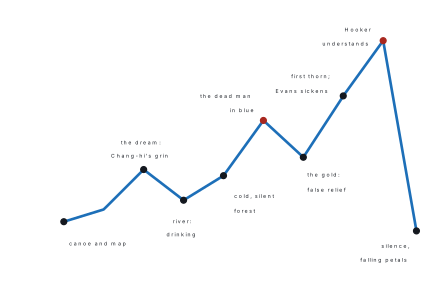
Structure. The story has a clean five-part shape:
| Stage | Events | Mood |
|---|---|---|
| Exposition | The canoe, the reef, the map | Tense, thirsty, expectant |
| The dream | The overheard secret; Chang-hi's grin | Uneasy; the first warning |
| Rising action | Drinking at the river; the forest; the corpse | Suspense grows |
| Climax | The gold; the thorns; Evans collapses; Hooker understands | Horror |
| Ending | Hooker waits in silence; the petals fall | Stillness; open, but certain |
Point of view. Third person, close to Evans at first (the dream is his) and then to Hooker (the final understanding is his). The narrator does not comment, so the men's racism appears in their own speech and thoughts; the narrator does not challenge it, and that is a fair criticism.
4.6 Style and literary devices
| Device | Example | Effect |
|---|---|---|
| Foreshadowing | The map's "little dashes"; Chang-hi's stress on "the safety"; his grin; Evans's nightmare of burning coals; the forest that is "cold" | Each detail prepares the ending and rewards a second reading |
| Suspense | The unexplained dead man; the delay before Hooker understands | Keeps the reader asking "what killed him?" |
| Dramatic irony | We suspect the thorns before Evans does | Makes every act of greed more tragic |
| Irony of situation | The men who steal a treasure die of the thing that protects it | The "prize" is the trap |
| Symbol | Gold (greed and death); the thorns (hidden danger); the map (the promise of a shortcut); the blue-clad body (a warning) | Gives objects a moral weight |
| Imagery | "The sky blazed"; "a furnace"; "vast pillars"; "blotched fungi and a red-brown incrustation"; "the white petals... floating down through the gloom" | Visual and physical: heat and glare give way to cold and dim |
| Pathetic fallacy | The forest is silent as the men die; the breeze stirs "far above" | Nature seems to watch |
| Contrast | Blazing beach against cold forest; thirst against the river; Evans's temper against Hooker's caution | Creates mood and structure |
| Dream sequence | Evans's dream | Tells the backstory without a flashback and hints at guilt |
| Understatement | "Somebody has been here before." | Plain words that carry alarm |
| Ambiguity | The corpse's cause of death; what exactly happened to Chang-hi; whether Hooker dies | Leaves work for the reader |
Language. Wells writes in short, plain sentences and uses scientific precision — the "puffed and purple" neck, the "slender thorn, perhaps two inches in length" — which makes the horror believable. The dialogue is clipped and colloquial, and the men's rudeness reveals character ("You fool!", "Lend a hand, I say!"). The description is sensory: heat, thirst, glare, cold shadow, silence. He avoids explanation, so the reader does the reasoning.
4.7 Glossary
| Word | Meaning |
|---|---|
| canoe | a light narrow boat moved by paddles |
| reef | a ridge of rock or coral near the surface of the sea |
| lagoon | shallow water separated from the open sea by a reef |
| virgin forest | forest that has never been cleared or cut |
| ingot | a block of metal, usually gold or silver, cast in a mould |
| galleon | a large Spanish sailing ship of the sixteenth to eighteenth centuries |
| junk | a flat-bottomed Chinese sailing ship |
| pigtail | a plait of hair; here, the long queue worn by Chinese men under the Qing dynasty |
| pidgin English | a simplified mixture of English and local languages used for trade |
| exhume | to dig up (usually a body); here, to dig up buried treasure |
| wastrel | a person who wastes money and lives without purpose |
| languid | slow and without energy |
| zenith | the highest point; here, the sun directly overhead |
| exaltation | a feeling of great joy and excitement |
| scrutinise | to look at very carefully |
| prospect | to search a place for something valuable |
| incrustation | a hard coating on a surface |
| canopy | the covering formed by the tops of trees |
| creeper | a climbing plant |
| excavation | a hole dug in the ground |
| ominous | suggesting that something bad will happen |
| spasmodic | happening in sudden, uncontrolled jerks |
| inarticulate | unable to speak clearly; without words |
| dilated | opened wide (of the pupils or eyes) |
| piecemeal | in small parts, one at a time |
| Dyak | a member of the indigenous peoples of Borneo, known for their blowpipes with poisoned darts |
| blowpipe | a long tube through which darts are blown |
| Chinaman | an old English term for a Chinese man, now considered offensive; used here only because the characters use it |
Every mark in this story is in the clues. When you answer "Why do you think the story is a mystery story?" or "What is the moral?", list the clues in order — the dashes on the map, the "safety", the grin, the corpse, the pricks, the ache in Evans's arms, the thorn in Hooker's thumb — and say what each meant. Never write that Chang-hi died in the forest; the dead man is someone else.
4.8 Textbook exercises
Before you read
a. Have you read any stories about treasure hunting before? If yes, what is its title?
A sample answer: Yes, I have read Treasure Island by Robert Louis Stevenson, the story of Jim Hawkins, who finds a map in a dead sailor's chest and sails with Squire Trelawney, Dr Livesey and the cunning cook Long John Silver to dig up Captain Flint's buried gold. (Any real story you have read is acceptable; name the title and one or two facts about it.)
b. Why do you think people take the risk of treasure hunting?
People are drawn to treasure hunting by hope of sudden wealth — a single lucky find can change a life, whereas years of ordinary work might not; by adventure and the excitement of a puzzle, a map and a secret; by poverty or debt, which makes a risky chance look reasonable; and by greed and the belief that they will be the lucky one, ignoring the many who found nothing. The risk is usually greater than the reward, as Evans and Hooker learn.
Understanding the text
a. Describe the expository scene of the story.
The story opens with a canoe approaching a tropical shore. The bay "opened out", and a gap in the white surf of the coral reef marks where a little river runs out to the sea; beyond it the thicker green of the virgin forest shows the river's course towards a distant hill slope, and far behind rise mountains "like suddenly frozen waves". The sea is still and "the sky blazed". Two men are in the canoe. One, Evans, is paddling; the other, Hooker, is in the front, studying the land with a yellow sheet of paper on his knee. They speak in low voices, and their lips are "hard and dry". This scene establishes the place (a tropical island), the mood (hot, tense, exhausted) and the mystery (the map, the treasure).
b. What does the map look like and how do Evans and Hooker interpret it?
The map is a rough sheet of yellow paper, "creased and worn to the pitch of separation" by much folding, so that Hooker has to hold the "discoloured fragments together" where they have come apart. On it, in almost rubbed-out pencil, is the outline of the bay, with writing in Chinese. Evans reads it as follows: here is the reef, here the gap in it; the curved, twisting line is the river; the star is the place of the treasure. Hooker points out the dotted straight line from the opening in the reef to a clump of palm trees and observes that the star lies where this line cuts the river, so that they must mark the place as they enter the lagoon. Neither of them can explain the "little marks" and "little dashes, pointing this way and that" in the corner; Evans thinks they look like the plan of a house.
c. How did Evans and Hooker know about the treasure?
They overheard it. One moonlit night they came upon three Chinese men sitting round a small fire talking in pidgin English. Hooker "caught the drift of their talk first" and signalled to Evans to listen. The men were speaking of a Spanish galleon from the Philippines that had run aground, of its treasure buried by the crew against the day of return, and of how Chang-hi, one of the three, had found the ingots a year earlier and reburied them alone, and now needed help to dig them up. Chang-hi had a map. Evans and Hooker took it from him by force.
d. Describe Evans's dream.
As Evans dozes in the canoe, his mind returns to the night they overheard the secret. He sees the moonlit trees, the fire and the three Chinese men, half silver and half red, and recalls the story of the wrecked galleon and Chang-hi's buried ingots. Then the dream shifts to the moment when he had Chang-hi's pigtail in his hand: the man's cunning face, "first keen and furious like a startled snake, and then fearful, treacherous, and pitiful", and his final "incomprehensible and startling grin". The dream then becomes a nightmare: he sees heaps of gold with Chang-hi struggling to hold him back; the gold turns to a roaring furnace, and a vast devil "surprisingly like Chang-hi" feeds him with coals that burn his mouth. Another devil shouts "Evans, Evans, you sleepy fool!" — and he wakes to find they are at the lagoon.
e. What do the two treasure hunters see when they walk towards the island?
They see the three palm trees and a clump of bushes on the beach, a "close tangle of reeds, broad fronds, and young trees", and then the vast tree-trunks of the virgin forest with creepers hanging between them, dim white flowers, blotched fungi and a red-brown incrustation on the ground. Ahead there is a gap of hot sunlight, brilliant undergrowth and coloured flowers, and they hear the rush of water. They reach a broad quiet pool in the river. Downstream they find the body of a Chinese man in blue lying face down near a spade, a heap of stones and a freshly dug hole.
f. In what condition did the treasure hunters find the dead man?
He was lying on his face, arms and hands limp, "the abandon of the pose was unmistakable". Hooker saw that his neck was "puffed and purple" and his hands and ankles were swollen. He wore blue, and near him lay a Chinese spade and a scattered heap of stones beside a freshly dug hole in which some of the gold bars were already half exposed. Hooker turned white and said nothing; Evans raved and swore.
g. How did the treasure hunters try to carry the gold ingots to the canoe?
Evans took off his jacket and spread it on the ground, flung two or three ingots into it, and then he and Hooker lifted it between them, each holding the ends of the collar and the opposite corners. They planned to carry the ingots piecemeal across the strait to the mainland and bury them there for a while. But after only a few steps Evans's arms ached, he was short of breath, and he flung the coat down and collapsed.
h. How were Evans and Hooker poisoned?
By thorns. Evans was pricked by "a little thorn" in the hand as he pulled out the first ingot, and by another "little thorn" as he loaded the jacket. When Hooker handled the ingots to put them back on the coat, he felt "a little prick on the ball of his thumb" and found a slender thorn about two inches long. Hooker recognised that the thorns were like those "the Dyaks poison and use in their blowing-tubes". Chang-hi had evidently planted poisoned thorns among the gold (the "little dashes" in the map) to protect his treasure, and the dead man had died the same way.
Reference to the context
a. How do you know the story is set on a tropical island?
Many details point to it. The story opens with a canoe and a paddle, a coral reef with a gap in its "white surf", a lagoon and a river running to the sea. There are "palm trees" and "virgin forest" with creepers and giant trees, "dim white flowers" and fungi, mountains in the distance, and a blazing sun — "the sky was like a furnace, for the sun was near the zenith". The men suffer from thirst and the heat. The treasure itself comes from a Spanish galleon from the Philippines, and the poison is that of the "Dyaks", so the story feels tropical and Asian even though no island is named.
b. Why do you think Evans and Hooker took such a risk of finding buried treasure on a desert island?
Several reasons appear in the story. They are "stranded British wastrels" — men without money or prospects — so the chance of wealth in a few hours is irresistible. The amount is huge: gold ingots that had lain hidden two hundred years. They had the map, a rare piece of evidence, so the risk looked small; and they were ready to commit violence for it ("the struggle for the plan"). Their greed and their contempt for the Chinese owners made them underestimate the danger. They also thought they could carry the gold to the mainland and hide it "for a while". In other words, they took the risk because they had nothing to lose and everything to gain — or so they believed.
c. Do you think the narrator of the story is racist? If yes, what made him feel superior to other races?
There is evidence on both sides, and a strong answer gives both.
Yes: the narrator uses the word "Chinaman" throughout, describes Chang-hi's face as "cunning" and "treacherous" and, in the dream, says that "the life of a Chinaman is scarcely sacred like a European's" and that Chang-hi is a "yellow brute". Evans says "All Chinamen are alike", and calls the dead body "that mass of corruption". The narrator does not correct these views; the story is told almost entirely from the point of view of the two Europeans. They feel superior because they belong to the imperial power and because they regard Chinese people as objects of trade and plunder.
But the prejudice belongs partly to the characters: it is part of the picture of Evans and Hooker as amoral wastrels. And the plot punishes it: the "inferior" Chang-hi outwits the two Europeans, and the "grin" they could not understand is the last word. Wells wrote in the 1890s, when such language was ordinary, but the story's moral judgement is against his heroes, not for them. Conclusion: the language is racist and reflects its period; the story as a whole criticises the greed and arrogance that go with it.
d. What do you think is the moral of the story?
The moral is that greed brings destruction and that "easy" wealth may hide a deadly trap. Evans and Hooker want the gold so much that they ignore every warning: the map's mysterious marks, Chang-hi's grin, the dead man beside the hole, Evans's first prick. Others are: that violence and theft do not pay ("the wages of sin"); that arrogance blinds people to the intelligence of others; and that a person who trusts appearances may pay for it. A good answer states one moral clearly and supports it with two or three pieces of evidence.
Reference beyond the text
a. Interpret the story as a mystery story.
A mystery story keeps back a crucial fact, offers clues, and then reveals the answer. "The Treasure in the Forest" does this. The question is: what is the danger around the treasure, and what killed the man in blue? The clues are scattered: the strange "dashes" on the map; Chang-hi's stress on "the safety" of the hoard; his final grin; the corpse's "puffed and purple" neck; Evans's first thorn, and his later symptoms; and the "profound silence" of the forest. Red herrings mislead: the corpse seems to have died of snakebite, and Evans's symptoms seem to be temper and tiredness. The solution comes in the last few lines, when Hooker feels the prick on his thumb and remembers the dashes. The reader may have guessed earlier, but the story delays confirmation until the moment it is too late. There is also an unsolved mystery left by the ending: what became of Chang-hi, and does Hooker die? A story can be a mystery without a detective; here the reader plays that part.
b. Treasure hunting is a favourite subject of children's stories. Recall a treasure-hunting story you read in your childhood and compare and contrast it with "The Treasure in the Forest".
Treasure Island by R. L. Stevenson (1883) is the best-known treasure hunt in English. A boy, Jim Hawkins, gets a map from a dead pirate's chest and sails with Dr Livesey and Squire Trelawney to find Captain Flint's gold; the ship's cook, Long John Silver, is secretly a pirate planning mutiny. After sea battles, a marooned man (Ben Gunn) and a race for the map's cross, Jim's party takes the treasure and returns home.
Similarities: both stories begin with a map; both have a treasure that was buried long ago and a pirate or a galleon in the background; both use suspense and the lure of gold; in both, greed drives most of the characters.
Differences: Treasure Island is a long novel told by a boy, with a hero who grows up and a happy ending; Wells's story is a few pages, with two selfish, unsympathetic men and no survivor. Stevenson's villain Silver is charming and survives; Wells's "villain" Chang-hi is dead before the story begins and wins anyway. Stevenson's danger is human (pirates, mutiny); Wells's is hidden nature and a trap. The first is for young readers and celebrates adventure; the second is a dark moral tale.
Chapter summary
- "The Treasure in the Forest" is a short story by the English writer H. G. Wells (1866–1946), first published in Pall Mall Budget on 23 August 1894 and collected in The Stolen Bacillus and Other Incidents (1895).
- Two British adventurers, Evans and Hooker, approach a tropical island by canoe with a stolen Chinese map, guided by a dotted line from a gap in the coral reef to a clump of palms; the star marks the treasure where the line cuts a river.
- In a dream Evans recalls how they overheard three Chinese men talk of a Spanish galleon's treasure that Chang-hi had found and reburied "very safe" — and how they took the map from him by force; Chang-hi's last grin haunts the dream.
- They drink at the river, cross the cool, silent forest and find a dead Chinese man beside a dug hole with gold ingots half uncovered; Hooker thinks he was killed by a snake.
- Evans is pricked by a "little thorn" twice while loading the gold; he becomes irritable and ill and dies in convulsions. Hooker is pricked in the thumb and understands that the map's "little dashes" were poisoned thorns and Chang-hi's "safety" a trap. He waits, dying, beside the gold.
- Themes: greed and punishment, appearance against reality, nature as silent judge, prejudice that blinds; techniques: foreshadowing, suspense, dramatic irony, symbolism, pathetic fallacy and a close third-person viewpoint.
- The story is a moral tale in the form of a thriller; the dead man, not Chang-hi, is the body in the forest; the killing of Chang-hi is only implied.
Practice questions
Short answer questions (2 marks each)
- What did Evans and Hooker know about the treasure before they reached the island, and how did they learn it? [2]
- What puzzled the two men about the marks on the map? [2]
- Why did Evans and Hooker drink at the river before doing anything else? [2]
- What did Hooker suppose had killed the dead man in the forest? [2]
- How did Hooker finally understand what was killing Evans? [2]
- What is the significance of Chang-hi's grin? [2]
Model answers — short questions
1. They knew that a Spanish galleon from the Philippines had been wrecked and its ingots buried, and that Chang-hi had found and reburied them "very safe". They learned it by overhearing three Chinese men talk in pidgin English round a fire one moonlit night; later they took Chang-hi's map from him.
2. The "little marks" looked like the plan of a house, and the "little dashes, pointing this way and that" in the corner could not be explained by either man. In fact the dashes showed where poisoned thorns had been set around the gold.
3. They had made a long night voyage in an unprovisioned canoe under a blazing sun and were almost mad with thirst — Evans said he would "have to drink sea water" and finally sucked up the water with his lips. Their physical need was stronger than their greed, for a moment.
4. He supposed "some poisonous snake" had killed him: "He stole a march on his friends. He came here alone, and some poisonous snake has killed him." The neck was "puffed and purple" and the hands and ankles swollen, which matches a snakebite, and this wrong guess kept the danger hidden.
5. He felt a little prick on the ball of his thumb and found a slender thorn two inches long. Seeing Evans twitching and the blue body among the trees, he "thought of the little dashes in the corner of the plan, and in a moment he understood": the thorns were like those the Dyaks poison for their blowpipes.
6. It shows that Chang-hi knew something the thieves did not: that his treasure was guarded by poisoned thorns, so that anyone who took the map would be killed. It is a moment of silent triumph, and when Hooker "understood that grin now" it becomes the key to the story.
Long answer questions (5 marks each)
- Discuss "The Treasure in the Forest" as a story of greed and its punishment. [5]
- How does Wells use foreshadowing and suspense in the story? [5]
- Comment on the character of Evans and Hooker and show how they differ. [5]
Model answers — long questions
1. Every stage of the story shows greed leading to destruction. Evans and Hooker are "stranded British wastrels" who have seized a map by force from Chang-hi; they cross the sea without water; and on the island Evans's only reaction to the dead body is fury that "somebody has been here before". When the gold is found they think only of carrying it away. Even after Evans is pricked twice they keep on lifting ingots, and Evans refuses Hooker's wish to bury the corpse: "Let that mass of corruption bide." Each small act of greed takes them closer to the thorns.
The punishment fits the crime. They have stolen a treasure from a man who had guarded it by poison; he is avenged without being present. The forest's silence and the falling petals suggest that nature itself has passed judgement. Wells states no moral; the men's deaths do it for him.
2. Foreshadowing is planted in every scene: the map's "little dashes"; Chang-hi's "great stress on the safety"; his "incomprehensible and startling grin"; Evans's dream of devils feeding him with burning coals and of a furnace in his mouth; the corpse's swollen neck, hands and ankles; Hooker's unease, "It scares me somehow"; Evans's two pricks; his sudden "unreasonable anger". Each looks like a small piece of description and later proves to be a clue.
Suspense comes from delay and partial knowledge. The story withholds the cause of the danger until the last page, allows a false explanation (a snake), hides the real symptoms behind Evans's bad temper and tiredness, and keeps the reader watching a man reach for more gold while the clues pile up. The structure (calm beach, cool silent forest, dead man, gold, collapse) raises the tension by stages; the final lines, in which Hooker sits silent by the ingots, leave the reader in the stillness.
3. Evans is the more impulsive, loud and greedy. He drinks so greedily that he leans out of the canoe to suck up the water, shouts and stamps at the discovery of the corpse, is exultant at the gold, insults his partner, and dismisses a dead man as "that mass of corruption". His anger, which hides his poisoning, is his most characteristic feature.
Hooker is quieter and more observant. He tastes the water, sees "something blue", notices the swollen neck, suggests burying the body, and keeps staring "searchingly among the grey depths between the trees". He wants the gold too and helped to seize the map, so he is not innocent; but he has a conscience and an imagination, and these make him the one who finally understands.
The two are opposite in temperament but equal in guilt, and the story ends by treating them alike: both are killed by the same thorns, in the same way, for the same reason.
Reference to the context
- "We shall have to take this stuff to the mainland piecemeal, and bury it there for a while."
(a) Who says this, and where? (b) What has just been discovered? (c) What does the speaker overlook? (d) What does the sentence show about his character? [5]
- "He understood that grin now."
(a) Who is "he", and whose grin is referred to? (b) When in the story did the grin appear? (c) What has "he" just understood? (d) Why is this moment important for the story as a whole? [5]
Model answers — reference to the context
1. (a) Evans says it, in the forest beside the dug hole, to Hooker. (b) The gold ingots have been found in the hole, "dull yellow bars", beside the body of a dead Chinese man. (c) He overlooks the danger: the dead man, the swollen neck, the "little thorn" that has already pricked his hand, and the fact that "somebody has been here before". He also overlooks Hooker's unease. (d) It shows that Evans is practical, calculating and completely absorbed in the gold. He thinks at once of the next step — hiding and selling — and has no room for doubt, pity or caution. It is also dramatic irony, for the reader senses that neither man will ever reach the mainland.
2. (a) "He" is Hooker; the grin belongs to Chang-hi, the Chinese man who found and buried the treasure and drew the map. (b) It appeared in Evans's dream at the moment when Evans held Chang-hi by the pigtail and Chang-hi "grinned, a most incomprehensible and startling grin". (c) Hooker has just understood that the thorns that pricked him and Evans are poisoned like the Dyaks' blowpipe darts, that the little dashes on the map marked them, and that Chang-hi's "assurance of the safety" of his treasure was literally true: the grin meant he knew the thieves would be killed. (d) It is the climax of the story and the answer to the mystery. It turns every earlier clue into meaning, reveals Chang-hi's cunning, and completes the irony: the victim has won. It also happens at the moment when it is too late for the characters to profit from the knowledge.
Practise more: English question bank