Unit 23 · Grammar · 16 min read
Determiners and Quantifiers
What the syllabus asks for 5
- The classes of determiner
- Articles: a, an, the and zero
- Which determiner goes with which noun
- Countable and uncountable nouns
- The articles a Nepali speaker forgets
A determiner is the word that opens a noun phrase and tells you which or how many: a pen, the pen, this pen, my pen, every pen, few pens, much ink. Quantifiers are the determiners that answer "how much / how many". Nepali has no articles at all, which is why a, an and the are the marks most often lost in Q7 and in the writing questions. The whole area is a matter of matching the determiner to the kind of noun that follows it, so that is what this unit drills.
(1) Is the noun countable or uncountable? Books can be counted; bread, information, furniture, advice cannot. (2) Is it singular or plural? Much goes only with uncountables, many only with plural countables, a/an only with singular countables. Get these two right and half of the item is already answered.
23.1 The classes of determiner
| Class | Members | Example |
|---|---|---|
| Articles | a, an, the, (zero) | the tallest boy |
| Demonstratives | this, that, these, those | those notebooks |
| Possessives | my, your, his, her, its, our, their, Ram's | her results |
| Quantifiers | some, any, much, many, (a) few, (a) little, several, enough, a lot of | several villages |
| Distributives | each, every, either, neither, both, all, half | each candidate |
| Numerals | one, two … ; first, second … | the second chance |
| Interrogatives | which, what, whose | whose bag |
| Negative | no, none of, neither | no water |
| Pre-determiners | all, both, half, such, what (a) | all the students |
Determiners come in a fixed order: pre-determiner + central determiner + post-determiner, as in all the three other candidates. Only one central determiner is allowed, which is why my this book is wrong. Say this book of mine.
23.2 Articles: a, an, the and zero
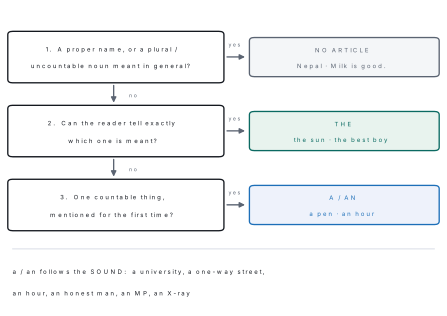
A or an is decided by sound, not by spelling. Use an before a vowel sound, a before a consonant sound.
| Use a | Because the sound is | Use an | Because the sound is |
|---|---|---|---|
| a university, a uniform, a useful map | /juː/ — a consonant sound | an umbrella, an uncle | /ʌ/ |
| a European country | /juː/ | an hour, an honest man, an heir | the h is silent |
| a one-rupee coin, a one-way street | /w/ | an MA, an MP, an SLC certificate | the letter is read em, em, es |
| a horse, a hotel, a historic day | the h is pronounced | an X-ray, an FM station, an NGO | eks, ef, en |
The is used when the listener can tell exactly which one is meant:
- mentioned before — I bought a shawl. The shawl was of pashmina.
- unique things — the sun, the moon, the earth, the sky
- superlatives and ordinals — the best answer, the first bench
- rivers, seas, oceans, ranges, deserts, groups of islands — the Koshi, the Bay of Bengal, the Himalayas, the Terai
- plural country names and organisations — the Netherlands, the USA, the UN
- newspapers, holy books, historical periods — the Kathmandu Post, the Gita, the Rana regime
- musical instruments and inventions — play the madal, the telephone
- an adjective used as a noun, and a whole community — the poor, the Nepalese
- with only, same, whole, entire and with a comparative pair — the only son, the sooner the better
Zero article (no article at all):
- plural or uncountable nouns used in general — Books are cheap in Bhotahity. Honesty pays.
- proper names of people, cities, single mountains, lakes, countries, continents — Sita, Birgunj, Everest, Phewa Lake, Nepal, Asia
- languages, school subjects, games, meals, festivals, months, days — He teaches Nepali. They play volleyball. We had lunch. during Tihar
- institutions used for their purpose — go to school, in hospital, go to bed, in prison (but go to the school to meet the principal — the building)
- means of transport after by — by bus, by air, on foot
23.3 Which determiner goes with which noun
This grid is the heart of the unit. A tick means the combination is correct.
| Determiner | Singular countable (book) | Plural countable (books) | Uncountable (information) |
|---|---|---|---|
| a / an | ✓ a book | ✗ | ✗ |
| the | ✓ | ✓ | ✓ |
| this / that | ✓ | ✗ | ✓ this information |
| these / those | ✗ | ✓ | ✗ |
| my, your, his … | ✓ | ✓ | ✓ |
| some / any | ✗ (except some day) | ✓ | ✓ |
| much | ✗ | ✗ | ✓ much time |
| many | ✗ | ✓ many books | ✗ |
| a lot of / lots of / plenty of | ✗ | ✓ | ✓ |
| (a) few, fewer, several | ✗ | ✓ a few books | ✗ |
| (a) little, less | ✗ | ✗ | ✓ a little milk |
| a great deal of, a large amount of | ✗ | ✗ | ✓ |
| a large number of, a great many | ✗ | ✓ | ✗ |
| each, every, either, neither | ✓ each boy | ✗ | ✗ |
| both | ✗ | ✓ both hands | ✗ |
| all | ✗ (except all day) | ✓ | ✓ |
| enough | ✗ | ✓ | ✓ |
| no | ✓ | ✓ | ✓ |
Notes on the trickier rows:
- much / many are normal in negatives and questions (Is there much water?). In plain positive statements a lot of sounds better: We have a lot of work rather than much work.
- some / any. Some in positive statements and in offers or requests expecting yes (Would you like some tea?); any in negatives and ordinary questions (I haven't any change. Have you any doubt?). Any in a positive statement means "it does not matter which": Take any seat.
- each / every. Both take a singular noun and a singular verb. Each looks at the members one by one and can be used of two; every looks at the whole group and needs three or more. Each of / every one of is followed by a plural noun: each of the students was present.
- either / neither are used of two: Either road leads to Tansen. Neither answer is correct.
- both / all. Both for two, all for more than two. All (of) the students — of is optional before the, compulsory before a pronoun: all of them.
- fewer / less. Fewer counts (fewer students), less measures (less sugar). Shop signs saying "10 items or less" are wrong.
- none of + plural noun takes a singular or plural verb; in the exam write the singular: None of the boys was selected.
23.4 Countable and uncountable nouns
These nouns are uncountable in English even though their Nepali equivalents can be counted. They take no -s, no a/an, a singular verb, and much / a little / a great deal of rather than many / a few:
information, advice, news, furniture, luggage, baggage, equipment, machinery, stationery, scenery, poetry, music, knowledge, work, homework, research, progress, evidence, traffic, weather, money, bread, rice, sugar, hair, jewellery, crockery, permission, accommodation, damage, fun, behaviour.
To count them, use a measure phrase:
| Instead of | Say |
|---|---|
| ✗ two informations | ✓ two pieces of information / two items of information |
| ✗ many advices | ✓ much advice / several pieces of advice |
| ✗ some furnitures | ✓ some furniture / three items of furniture |
| ✗ a good news | ✓ good news / a piece of good news |
| ✗ three luggages | ✓ three pieces of luggage |
| ✗ lightnings, thunders | ✓ a flash of lightning, a clap of thunder |
| ✗ a bread | ✓ a loaf of bread / a slice of bread |
Some nouns are plural only and take a plural verb: scissors, trousers, jeans, spectacles, binoculars, pliers, clothes, goods, premises, surroundings, belongings, earnings, thanks, cattle, police, people. To count them, use a pair of: two pairs of trousers. And note news is singular in spite of its -s: The news is encouraging.
✗ He gave me many advices. → ✓ He gave me much advice (or several pieces of advice). ✗ She has a long hair. → ✓ She has long hair. ✗ I have a good news for you. → ✓ I have good news for you. ✗ Less students came today. → ✓ Fewer students came today. ✗ Much people were waiting. → ✓ Many people were waiting. ✗ Every students must attend. → ✓ Every student must attend. ✗ Each of the boy got a prize. → ✓ *Each of the boys got a prize. ✗ One of my friend lives in Dhangadhi. → ✓ One of my friends lives … ✗ My this pen is new. → ✓ This pen of mine is new. ✗ The most of the students passed. → ✓ Most of the* students passed.
23.5 The articles a Nepali speaker forgets
Nepali marks definiteness with word order and with -euta / -ta, not with a separate word, so articles are simply left out. Check every singular countable noun in your answer: it must have some determiner in front of it.
| ✗ Wrong | ✓ Right | Why |
|---|---|---|
| He is best student in class. | He is the best student in the class. | superlative, and a known class |
| Nepal is beautiful country. | Nepal is a beautiful country. | singular countable, first mention |
| She is honest girl. | She is an honest girl. | honest begins with a vowel sound |
| He is an university student. | He is a university student. | university begins with /juː/ |
| I saw elephant in Chitwan. | I saw an elephant in Chitwan. | first mention |
| The Everest is in Nepal. | Everest is in Nepal. | single mountains take no the |
| He plays guitar very well. | He plays the guitar very well. | musical instruments take the |
| Poor are not always unhappy. | The poor are not always unhappy. | adjective used as a noun |
| She goes to the school by bus. | She goes to school by bus. | school here means study, not the building |
| Give me water in the glass. | Give me some water in a glass. | uncountable needs some, not a |
Problem. Fill in the blanks: (a) There is very _ sugar left, so make the tea without it. (b) _ students attended the extra class because of the strike. (c) He has ____ friends in Biratnagar, so he is never lonely there.
Solution — step by step.
(a) Sugar is uncountable, so the choice is between little and a little. The second half of the sentence says the tea must be made without it, so the amount is nearly none, which is the negative word. Answer: very little sugar.
(b) Students is a plural countable noun, so few or a few. The strike means attendance was poor, so again the negative word is needed. Answer: Few students attended.
(c) Friends is plural countable, and the sense is positive — he is never lonely. Answer: a few friends.
Problem. Insert articles where they are needed: Yesterday I met old friend of my father at bus park. He is engineer and works for government.
Solution — noun by noun.
- old friend — a singular countable noun, mentioned for the first time, and old begins with a vowel sound → an old friend.
- bus park — both speaker and listener know which bus park is meant → the bus park.
- engineer — a job title after be takes a / an, and engineer begins with a vowel sound → an engineer.
- government — there is only one government here, so it is definite → the government.
Answer. Yesterday I met an old friend of my father at the bus park. He is an engineer and works for the government.
Problem. Correct: The teacher gave us many useful informations and two advices, but each of the student had different doubt.
Solution — one fault at a time.
- informations — information is uncountable, so no -s, and many must become much (or use a measure phrase).
- two advices — advice is uncountable → two pieces of advice.
- each of the student — each of is always followed by a plural noun → each of the students**.
- had different doubt — doubt here is a singular countable noun and needs a determiner → a different doubt.
Answer. The teacher gave us much useful information and two pieces of advice, but each of the students had a different doubt.
Chapter summary
- A determiner opens the noun phrase; only one central determiner is allowed, so write this book of mine, never my this book.
- A / an is chosen by sound: a university, a one-way street; an hour, an honest man, an MP.
- The = the reader knows which one: second mention, unique things, superlatives, ordinals, rivers, ranges, plural country names, instruments, adjectives used as nouns.
- Zero article with proper names, generic plurals and uncountables, languages, games, meals, festivals, by bus, and institutions used for their purpose.
- Much / (a) little / a great deal of + uncountable; many / (a) few / a large number of + plural countable; a lot of with either.
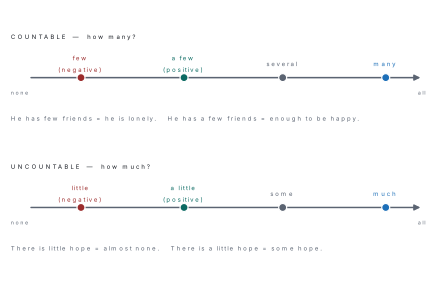
- Few / little = almost none (negative); a few / a little = some (positive).
- Each, every, either, neither + singular noun + singular verb; each of / one of + plural noun.
- Fewer counts, less measures.
- Information, advice, furniture, luggage, equipment, news, work, money, hair are uncountable: no -s, and counted with a piece of / an item of.
- Scissors, trousers, spectacles, clothes, police, cattle, people are plural and take a plural verb.
Practice questions
Fill in the blanks with a suitable determiner or quantifier (1 mark each)
- She is ____ honest and hard-working officer. [1]
- ____ Himalayas protect Nepal from the cold winds of the north. [1]
- How ____ money do you need for the excursion? [1]
- There were ____ passengers in the bus, so I got a seat easily. [1]
- ____ of the two roads leads to Gorkha Bazaar. [1]
- ____ student must bring his or her admit card. [1]
- We could not buy the tickets because we had ____ time. [1]
- He speaks ____ English, so he can manage in Delhi. [1]
- ____ of the students has been informed about the test. [1]
- There is not ____ water in the tank today. [1]
Answers
1. an — honest begins with a vowel sound.
2. The — mountain ranges take the.
3. much — money is uncountable.
4. few — a plural countable noun, and the sense is "hardly any", which is why a seat was free.
5. Either — either is used of two, with a singular verb.
6. Every (or Each) — a singular countable noun follows.
7. little — time is uncountable and the meaning is negative.
8. a little — a positive amount of an uncountable noun.
9. Each (or Every one) — each of + plural noun + singular verb has.
10. much — much is normal in a negative sentence with an uncountable noun.
Correct the errors in the following sentences (1 mark each)
- The teacher gave us many informations about the scholarship. [1]
- I have a good news for you. [1]
- Less people attended the meeting this year. [1]
- He bought three furnitures for his new flat. [1]
- Each of the boy was given a certificate. [1]
- She is best singer in our school. [1]
- My this bag was bought in Bhairahawa. [1]
- One of my friend has gone to Japan. [1]
- He is an European by birth. [1]
- The most of the villagers depend on farming. [1]
Answers
11. … gave us much information about the scholarship. — information is uncountable.
12. I have good news (or a piece of good news) for you. — news is uncountable.
13. Fewer people attended … — fewer is used with countable nouns.
14. He bought three pieces of furniture … — furniture is uncountable.
15. Each of the boys was given a certificate. — each of takes a plural noun.
16. She is the best singer in the school. — superlative, and a known school.
17. This bag of mine was bought in Bhairahawa. — two central determiners cannot stand together.
18. One of my friends has gone to Japan. — one of + plural noun.
19. He is a European by birth. — European begins with the consonant sound /juː/.
20. Most of the villagers depend on farming. — no the before most of.
Rewrite as instructed (1 mark each)
- He has little money, so he cannot buy the book. — Rewrite using enough. [1]
- All the students were present. — Rewrite beginning None … [1]
- There is some milk in the jug. — Rewrite in the negative. [1]
- Both the sisters are studying medicine. — Rewrite using Each … [1]
- I need a few more minutes. — Rewrite using a little. [1]
Answers
21. He does not have enough money to buy the book. — enough fits both countable and uncountable nouns.
22. None of the students was absent. — the opposite statement; none of takes a singular verb in formal writing.
23. There is not any milk in the jug. (or There is no milk in the jug.) — some becomes any in the negative.
24. Each of the sisters is studying medicine. — each of + plural noun + singular verb.
25. I need a little more time. — a little needs an uncountable noun, so minutes becomes time.
Practise more: English question bank