Unit 8 · Literature - Poems · 37 min read
A Day
What the syllabus asks for 10
- About the poet
- The poem: text, title and date
- The poem, stanza by stanza
- Paraphrase in plain English
- Central idea and themes
- Form, metre, rhyme and structure
- Imagery, figures of speech and sound devices
- Tone
- Critical appreciation
- Glossary
A child comes running in with news. I'll tell you how the sun rose — and out it comes, in a rush, in pictures, in the wrong grammar, with a shout at the end. Then the child stops. But how he set, I know not. The second half of the poem is spoken more slowly, in a lowered voice, and by the last line something has happened that the speaker does not quite have words for. Emily Dickinson's "A Day" is sixteen short lines long, uses almost no word of more than two syllables, and is one of the most quietly frightening poems in your course. Read it once for the colours. Read it again for what happens to the voice.
The two halves of the poem — sunrise told and sunset not known — and why the difference matters. The four picture-making lines: the ribbon, the steeples swam in amethyst, the news like squirrels ran, the hills untied their bonnets. The four quatrains, the abcb rhyme, and the hymn-book metre Dickinson grew up singing. The sunset allegory: stile, yellow children, dominie, bars, flock. And the fact that "A Day" is not Dickinson's title.
8.1 About the poet
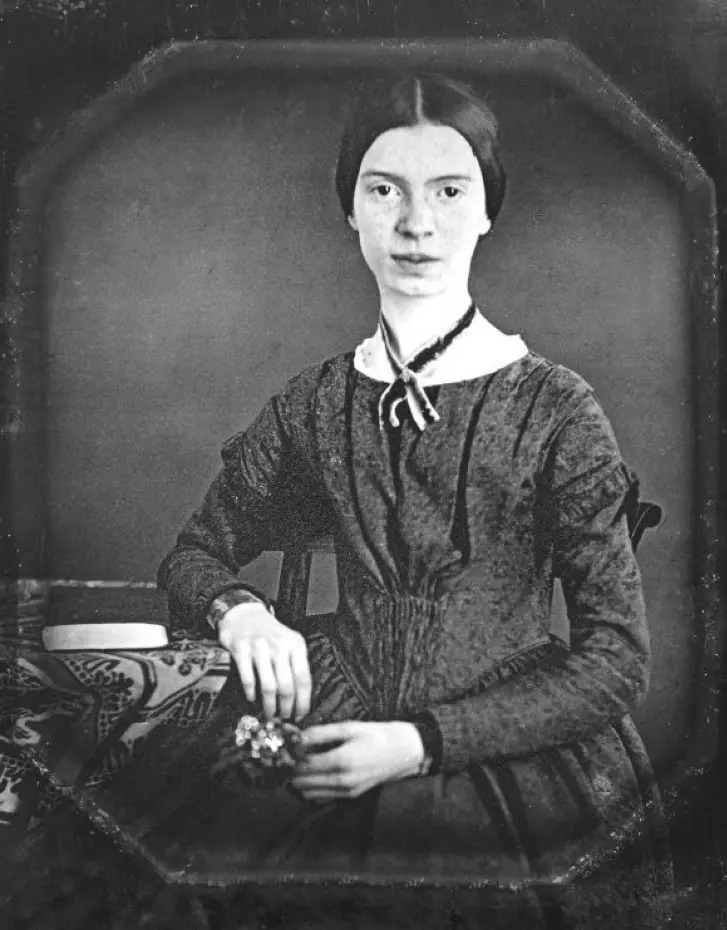
Emily Elizabeth Dickinson (1830–1886) was born, lived and died in the same house in Amherst, a small college town in Massachusetts, in the United States. Her grandfather had helped to found Amherst College; her father was its treasurer and a member of Congress. She was well educated for a woman of her time — Amherst Academy, then a year at Mount Holyoke Female Seminary — and then she came home, and gradually stopped going out. By her forties she rarely left the house and spoke to some visitors from behind a door. She wore white. Her world shrank to a garden, a bedroom, a family and an enormous correspondence.
Inside that small world she wrote about 1,800 poems. She published perhaps ten of them in her lifetime, most of them anonymously and all of them altered by editors who thought her punctuation was a mistake. She stitched the rest into little hand-sewn booklets, now called fascicles, and put them in a drawer. Her sister Lavinia found them after her death. The first selection, Poems by Emily Dickinson, appeared in 1890, edited by Mabel Loomis Todd and Thomas Wentworth Higginson.
Your textbook's note is right about the ingredients of her mind: the Metaphysical poets of seventeenth-century England (Donne, Herbert), with their habit of yoking a huge idea to a homely object; the Book of Revelation, with its purple, its jewels and its last things; and the Calvinist Puritan religion of New England, which she never comfortably accepted and never escaped. She and Walt Whitman, working at the same time and in complete ignorance of each other, are the two poets who broke American poetry away from its English models — he by making the line enormous, she by making it tiny.
Because Dickinson did not publish, her poems have no titles and no fixed order. Scholars refer to them by number. "A Day" is J318 in Thomas H. Johnson's 1955 edition and F204 in R. W. Franklin's 1998 edition. If you meet "I'll tell you how the sun rose" as a first line anywhere, it is this poem.
8.2 The poem: text, title and date
Three facts about the text in front of you, all of them examinable.
The title is not Dickinson's. She left the poem untitled, as she left almost all her poems untitled. "A Day" was supplied by Todd and Higginson in 1890, who also grouped it under the heading Nature. The title is therefore an editor's reading of the poem — a helpful one, but not evidence of what the poet intended.
The text is the 1890 editors' text. The version in your textbook descends from the 1890 printing, which smoothed Dickinson's spelling, her capitals and above all her dashes. In her manuscript line 11 begins That little yellow boys and girls; the printed tradition gives Which. Do not lose marks over this — the textbook's word is the one to quote — but know that it happened.
That mark in line one is a dash. The textbook prints:
I'll tell you how the sun rose, ___
Dickinson wrote a comma and then one of her long dashes. Your textbook's Reference-to-the-context question calls it "the hyphen"; the safe thing in the exam is to answer the question as asked while describing what the mark actually does, which is what §8.11 below models. A dash is Dickinson's fingerprint. It is a held breath, not a stop.
The poem was written about 1860 and first printed in 1890, four years after her death. It is in the public domain, which is why it can be given here in full.
8.3 The poem, stanza by stanza
Stanza 1 — the sunrise, in four pictures
I'll tell you how the sun rose, ___ A ribbon at a time. The steeples swam in amethyst, The news like squirrels ran.
The poem opens on a promise to a listener: I'll tell you. That is the voice of a child who has seen something and cannot keep it. It is also, quietly, the voice of a teacher — and by the end of the poem we shall meet a real teacher.
A ribbon at a time is the first metaphor and the best one. Dawn does not arrive; it is issued, in narrow horizontal bands, one after another, like ribbon being unrolled off a bolt in a draper's shop. The phrase makes the sunrise both slow and domestic.
The steeples swam in amethyst takes the eye upward. Church spires are the tallest things in a New England town, so they catch the light first. Amethyst is a violet quartz used in jewellery — but it is also, in the Book of Revelation, one of the twelve stones of the wall of the heavenly city. So the line is doing two things at once: it is reporting a purple sky, and it is hinting that the town has been briefly built into heaven. And swam turns the air into water; the steeples are not standing in the light, they are moving through it.
The news like squirrels ran is the only simile in the poem, and the liveliest line in it. The "news" is the light spreading downward from the steeples to the streets and gardens. It runs the way a squirrel runs — not in a straight line, but in bursts, up and along and round, stopping and starting.
Stanza 2 — the hills, the birds, and a child's conclusion
The hills untied their bonnets, The bobolinks begun. Then I said softly to myself, "That must have been the sun!"
The hills untied their bonnets is a personification so exact that it is worth slowing down over. A bonnet is a woman's or a baby's hat tied with strings under the chin. Before dawn the hills are wrapped in mist; as the light comes the mist loosens and lifts off the tops. The hills are therefore women taking off their hats — which is what New England women did when they came indoors, or when the service ended. The world is waking up and getting comfortable.
The bobolinks begun is the famous piece of bad grammar. A bobolink is a North American songbird with a bubbling, tumbling song. "Begun" for "began" is the past tense a child uses, and also the form you find in hymns and folk songs. Dickinson uses it deliberately: it keeps the speaker young. The line is also an ellipsis — begun what? Singing. The verb is missing because the speaker is too excited to supply it.
Then the voice drops. Then I said softly to myself — softly, and to myself: this is a private conclusion, not an announcement. And the conclusion is childlike to the point of comedy: "That must have been the sun!" The speaker has watched the whole performance and only worked out afterwards, by deduction, what caused it. It is charming. It is also the first warning that this speaker understands less than she is describing.
Stanza 3 — the turn
But how he set, I know not. There seemed a purple stile Which little yellow boys and girls Were climbing all the while
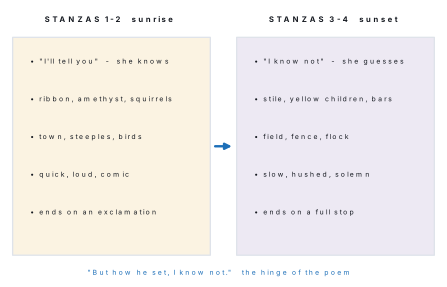
But is the hinge of the poem. Eight lines of confident telling; now, I know not. Notice what has changed grammatically: the sun, an "it" by implication in stanza 1, is now he — personified, given a will, and gone somewhere the speaker cannot follow.
Everything in the second half is hedged. There seemed a purple stile — she will not swear to it. A stile is a set of steps built into a field wall or fence so that people can climb over where animals cannot. So the horizon at evening becomes a boundary with a way over it: you can cross, but only on foot, one at a time, and you cannot bring the flock.
Little yellow boys and girls are the last rays of the sun, or the small gold-lit evening clouds, seen as children going home over the wall. Once you have accepted that image the rest of the poem follows inevitably: if the lights are children, then something must come and fetch them.
Stanza 4 — the dominie
Till when they reached the other side, A dominie in gray Put gently up the evening bars, And led the flock away.
A dominie is a schoolmaster in Scots usage and a minister of religion in American usage — and Dickinson, who knew both senses, chose the word because it holds both. He is in gray: the colour of dusk, of a Puritan minister's coat, and of nothing in particular. He has no face.
Put gently up the evening bars is a farm image. The bars are the movable poles that close a gap in a fence once the animals are inside for the night. To "put up the bars" is to shut the field. It is done gently — the poem insists on this — and it is done from the far side, after the children have crossed.
And led the flock away. "Flock" completes the transformation: the children became sheep, the schoolmaster became a shepherd, and the shepherd leading his flock is the oldest image in Christian writing for God and the dead. The last line is four plain words and a full stop, and it is where the poem is going the whole time.
8.4 Paraphrase in plain English
Stanza 1. Let me describe the sunrise to you. The light came in narrow strips, one strip after another. The church spires seemed to float in a violet-coloured glow, and the brightness spread quickly and jerkily over the town, the way squirrels dart about.
Stanza 2. The morning mist lifted off the hilltops, the way a woman takes off her bonnet. The bobolinks started singing. Only then did I say quietly to myself, "So that was the sun coming up!"
Stanza 3. But I cannot tell you how the sun went down. I thought I could see a purple set of steps over the horizon, and small golden figures — like children — were climbing over them all the time.
Stanza 4. When at last they had all got across to the other side, a grey figure like a schoolmaster (or a pastor) quietly closed the gate behind them and took them away, as a shepherd takes his sheep home for the night.
8.5 Central idea and themes
Central idea. A whole day is described by a speaker who can explain the morning perfectly and cannot explain the evening at all. Behind the day lies a life: birth and childhood can be told, but death can only be imagined, and the best the poem can do is to imagine it as a kind and orderly ending — a gate shut gently, children led home.
Nature as theatre. Dickinson does not describe the sun; she describes what the sun does to a town. Everything in the poem is a reaction — steeples, squirrels, hills, birds. The cause is the one thing she cannot look at.
Innocence and experience. The speaker of stanzas 1–2 is a child with a story. By stanza 4 she has watched something she cannot narrate. The poem enacts the loss of confidence that comes with understanding. Your textbook puts it as a movement "from innocence to experience", and that is a defensible summary provided you can point to But how he set, I know not as the moment it happens.
Death, handled gently. The word "death" never occurs. Instead: a boundary (stile), a crossing (climbing), an arrival (the other side), an authority in grey, a closing (bars) and a departure (led the flock away). Dickinson wrote dozens of poems about dying; this is one of the few that is not frightened. Whether the dominie is God, a minister, night itself or simply Death is left open, and the openness is the point.
Faith and doubt. The amethyst steeples put a church at the centre of the morning, and a shepherd at the centre of the evening — the whole apparatus of Christian consolation is present. But it is present as something seen, not something known: "There seemed a purple stile." That gap between the comforting picture and the honest verb is the most Dickinsonian thing in the poem.
8.6 Form, metre, rhyme and structure
Stanzas. Four quatrains, sixteen lines, printed without a break in sense between stanzas 3 and 4 (the sentence runs on across the gap).
Rhyme scheme: abcb in every stanza — that is, only the second and fourth lines of each quatrain rhyme, and the rhyme does not carry from one stanza to the next.
| Stanza | Line 2 | Line 4 | Rhyme |
|---|---|---|---|
| 1 | time | ran | slant (only the nasal consonance of m / n) |
| 2 | begun | sun | perfect |
| 3 | stile | while | perfect |
| 4 | gray | away | perfect |
The one imperfect rhyme is in the first stanza. Dickinson uses such slant rhymes (also called half rhymes, near rhymes or, in her case, partial rhymes) constantly, and here it has a job: the opening stanza is deliberately breathless and slightly out of control, and the rhyme does not quite land. Be careful of a common error in study notes: ribbon and amethyst are not a rhyming pair — they sit at the ends of lines 2 and 3 in some printings but carry no rhyme at all.
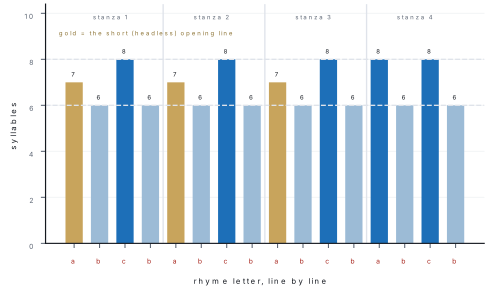
Metre. The poem is written in the common metre of the hymn book — the metre of "Amazing Grace" — which alternates lines of eight and six syllables, four iambic feet then three (iambic tetrameter / iambic trimeter). Dickinson sang this metre every Sunday of her childhood, and most of her poems are in it or close to it.
But she does not keep it exactly. Count:
| Stanza | L1 | L2 | L3 | L4 |
|---|---|---|---|---|
| 1 | 7 | 6 | 8 | 6 |
| 2 | 7 | 6 | 8 | 6 |
| 3 | 7 | 6 | 8 | 6 |
| 4 | 8 | 6 | 8 | 6 |
In stanzas 1–3 the first line is a syllable short. Such a line is called headless (or acephalous): the light opening syllable has been chopped off, so the line starts on a stress — I'LL tell you HOW the SUN rose. The effect is a small forward push, as though the speaker has begun before you were ready. Only in the last stanza does the line fill out to its regulation eight syllables, and the poem settles into perfect hymn metre exactly where its subject becomes religious. That is not an accident.
Punctuation and capitals. The printed text uses ordinary punctuation, but the exclamation mark ending stanza 2 and the full stop ending stanza 4 are worth naming in an answer: the poem's two halves end on two opposite noises.
8.7 Imagery, figures of speech and sound devices
| Device | Where it occurs (exact words) | What it does |
|---|---|---|
| Metaphor | "A ribbon at a time" | makes dawn a slow domestic unrolling, not a sudden event |
| Metaphor / colour imagery | "The steeples swam in amethyst" | jewel-purple light; swam turns air to water; the stone is one of Revelation's twelve |
| Simile | "The news like squirrels ran" | the only like in the poem; darting, restless spread of light |
| Personification | "The hills untied their bonnets" | mist lifting becomes women removing hats; the landscape is at ease |
| Personification | "how he set" | the sun becomes a person with a will and a destination |
| Ellipsis / dialect | "The bobolinks begun" | the missing verb and the child's past tense keep the speaker young |
| Symbol | "a purple stile" | the horizon as a crossing place between two fields |
| Extended metaphor (allegory) | "little yellow boys and girls … the flock" | last rays as children, then as sheep: sunset becomes the end of a life |
| Biblical allusion | "A dominie in gray … led the flock away" | the Good Shepherd of Psalm 23 and John 10, unnamed |
| Rural metaphor | "Put gently up the evening bars" | the farm gate closed for the night; the adverb gently is the poem's whole attitude to death |
| Antithesis | "I'll tell you how the sun rose" / "But how he set, I know not" | the structural opposition on which the poem is built |
| Enjambment | "Were climbing all the while / Till when they reached …" | the sentence steps over the stanza break, as the children step over the stile |
| Alliteration | "sun rose", "steeples swam", "said softly", "little yellow" | soft s sounds through the sunrise; the hush of stanza 2 |
| Assonance | "how the sun rose"; "little … climbing … while" | binds the lines aloud |
| Consonance | "time" / "ran" | the nasal near-rhyme that makes stanza 1 feel unfinished |
| Colour imagery | amethyst, yellow, gray | purple morning, gold evening, grey close: the poem fades as it ends |
| Auditory imagery | "The bobolinks begun" | the single sound in a poem otherwise entirely visual |
The hills untied their bonnets is both a metaphor (mist = bonnet) and a personification (hills = women). Either name earns the mark; naming both and explaining the picture earns the whole mark. Never stop at the label — the examiner wants "what it makes you see", not the word "personification" on its own.
8.8 Tone
The poem has two tones and the change between them is the poem.
Stanzas 1–2 are chatty, excited and faintly comic. The speaker buttonholes you, talks fast, gets the grammar wrong and ends on an exclamation mark after a conclusion anybody could have reached.
Stanzas 3–4 are hushed, tentative and reverent. The verbs go soft (seemed), the adverb gently appears, and the last line is a statement of fact with nothing added. There is no fear in it and no protest. The nearest word for the closing tone is awe — the feeling of watching something both beautiful and final that you are not being allowed to understand.
8.9 Critical appreciation
"A Day" is a miniature that behaves like an epic. In sixteen lines Dickinson moves from a draper's ribbon to the Book of Revelation, from a squirrel on a fence to the Good Shepherd, and she does it without one abstract noun.
The technique is her most characteristic one: she takes an enormous and unspeakable subject and refuses to name it, describing instead a series of small household or farmyard things that stand in its place. Death is never mentioned; what we get is a gate, a grey coat, and the word gently. This is why the poem survives re-reading. A poem that announced "the sun's setting is like dying" would be exhausted in one reading. This one lets you find the meaning yourself, and then makes you wonder whether you have put it there.
The choice of a child's voice is the second stroke. It does two jobs at once. It justifies the freshness of the metaphors — only a child would see the light as ribbon and the hills as hatted women — and it makes the ignorance of the second half innocent rather than stupid. An adult who did not know how the sun set would be a fool. A child who does not know is simply telling the truth, and the truth is that none of us knows what the other side of the stile looks like.
There is also a quiet argument with religion going on. Dickinson gives us the whole comforting Christian picture of death — the shepherd, the flock, the far side, the gentle keeper — and then sets it inside a verb she will not commit to: there seemed a purple stile. She neither believes nor denies. She reports what the evening looked like, and stops.
The poem's limitation, if you want to argue one, is the same as its strength: the allegory of stanzas 3–4 is so complete and so orderly that it risks becoming pretty. Some readers find the ending sentimental — a Victorian child's picture of dying. The defence is I know not. The poem never claims the picture is true; it claims only that this is what the speaker saw, softly, to herself.
8.10 Glossary
| Word | Meaning as used here |
|---|---|
| steeples (n.) | tall church towers with a spire on top, rising above the roof |
| amethyst (n.) | a purple precious stone used in jewellery; here, the violet colour of dawn |
| bobolinks (n.) | North American songbirds with large flat heads, short necks and short tails, known for a bubbling song |
| bonnets (n.) | hats tied with strings under the chin, worn by babies and women |
| begun (v.) | non-standard past tense of begin (for began); the form a child or a hymn would use |
| stile (n.) | a set of steps that help people to climb over a fence or wall, especially in the village |
| dominie (n.) | a schoolmaster (Scottish); a pastor or clergyman (US) |
| bars (n.) | the movable poles that close a gap in a fence to shut animals in for the night |
| flock (n.) | a group of sheep; also, a congregation under a pastor |
| the other side | the far side of the stile; in the poem's second meaning, the world after death |
| quatrain (n.) | a four-line stanza |
| common metre (n.) | the hymn-book pattern of 8-6-8-6 syllables, iambic tetrameter alternating with trimeter |
| slant rhyme (n.) | an imperfect rhyme in which the sounds are close but not identical, e.g. time / ran |
A ribbon at a time (metaphor, dawn). The steeples swam in amethyst (colour and Revelation). The news like squirrels ran (the only simile). The hills untied their bonnets (personification). But how he set, I know not (the hinge). Almost every question on this poem can be answered from these five.
Chapter summary
Emily Dickinson (1830–1886) of Amherst, Massachusetts, wrote about 1,800 poems and published almost none; "A Day" is J318 / F204, written about 1860, first printed in 1890 and given its title by her editors Todd and Higginson, not by her. Its sixteen lines are four abcb quatrains in something very close to the hymn book's common metre, with the opening line of stanzas 1–3 a syllable short. Stanzas 1–2 tell the sunrise in four bright metaphors — ribbon, amethyst steeples, squirrel-news, hills untying bonnets — in the excited, ungrammatical voice of a child, and end in an exclamation mark. At But how he set, I know not the poem turns. Stanzas 3–4 do not tell the sunset; they guess at it, in a hushed allegory of a purple stile, little yellow boys and girls climbing over, and a grey dominie who gently puts up the evening bars and leads the flock away. The day is a life, the stile is the boundary of death, and the shepherd is a consolation the poem offers without quite promising. The central movement is from knowledge to mystery, from innocence to experience, from noise to silence.
Practice questions
Understanding the text
a. How does the poet describe the morning sun in the first stanza? [2]
She never describes the sun itself — only its effects. The light arrives "a ribbon at a time", in narrow bands unrolled slowly one after another. It strikes the church spires first, so that "the steeples swam in amethyst", floating in a violet glow. Then it spreads down over the town quickly and unevenly, "like squirrels", as though the news of morning were running from house to house.
b. What does the line 'The news like squirrels ran' mean? [2]
The "news" is the news of daybreak — the light itself, and with it the knowledge that morning has come. The simile compares its spread to squirrels running: quick, darting, in short bursts with pauses, scattering in several directions at once rather than advancing in a straight line. It captures exactly the way sunlight jumps unevenly from roof to roof and tree to tree, and it fills the stanza with small animal life.
c. What do you understand by the line 'The hills untied their bonnets'? [2]
A bonnet is a hat tied with strings under the chin. Before sunrise the hilltops are wrapped in mist as though wearing bonnets; as the sun warms the ground the mist loosens and lifts away. Dickinson personifies the hills as women untying and taking off their hats — a homely, domestic gesture that makes the landscape seem to relax and become sociable now that the day has begun.
d. Is the speaker watching the morning sun? Why? Why not? [2]
Not directly. Every image in stanzas 1 and 2 is of something the sun is doing to other things — steeples, hills, birds, the town. The speaker's own conclusion, "That must have been the sun!", is a deduction made afterwards, not a report of something seen: the word must proves she inferred the cause from the effects. She is watching the sunrise, not the sun. (This is also physically true: one cannot look at the rising sun, and it is a child's habit to watch the lit world instead.)
e. How does the sun set? [2]
The speaker admits at once that she does not know — "But how he set, I know not." What she offers instead is a guess in the form of a picture. There seemed to be a purple stile at the horizon, and little yellow boys and girls — the last golden rays, or the small lit evening clouds — were climbing over it all the while. When they had all reached the other side, a grey figure like a schoolmaster or pastor gently put up the evening bars, closing the gap in the fence, and led them away like a shepherd with his flock. So the sunset is described not as an event in nature but as children being taken home at the end of school, and beneath that, as a gentle death.
Reference to the context
a. What, according to the speaker, is a day? [5]
For this speaker a day is not a measure of time but a small complete story with two unequal halves, and the shape of that story is the shape of a human life.
The first half is public, noisy and knowable. Dawn is something she can narrate to somebody else — "I'll tell you how the sun rose" — and she narrates it in four images drawn from a working town: a ribbon unrolled, steeples swimming in amethyst, news running like squirrels, hills untying their bonnets. Everything is busy, coloured and slightly comic, and it ends in the exclamation of a child who has just worked out what caused the show.
The second half is private, hushed and unknowable. "But how he set, I know not." A day, then, is something that begins in certainty and ends in mystery. The evening is not described but imagined: a purple stile at the edge of the world, little yellow children climbing over it, a dominie in grey who shuts the gate behind them and leads the flock away.
Put the two halves together and the day becomes an allegory of a lifetime. Morning is birth and childhood — loud, colourful, easy to tell. Evening is age and death — quiet, uncertain, and managed by someone else. The stile is the boundary between this world and whatever is on "the other side"; the flock and the shepherd are the oldest Christian image of the dead in God's keeping. A day, for Dickinson, is a life in miniature, and the most important thing she can say about it is that we can report its beginning and can only guess at its end.
b. What purpose does the hyphen in the first line serve in the poem? [5]
First, a point of accuracy that will improve the answer: the mark Dickinson wrote there is not a hyphen but a dash (a hyphen joins parts of a word; a dash holds a sentence open). Your textbook prints it as a long rule after the comma. Dickinson used dashes constantly, and modern editors preserve them because they do work that no other punctuation mark can do.
In this line — "I'll tell you how the sun rose, ___" — the dash does four things.
It creates a pause and an intake of breath exactly where a storyteller would pause: the promise has been made, and now the listener must wait half a second for the goods. The line becomes speech rather than writing.
It works as a colon without the finality of a colon. It announces that what follows is the content of the telling, but it refuses to close the sentence off; the poem seems to spill forward into stanza 1 rather than to start it.
It establishes the presence of a listener. A dash at that point is a turn of the head towards somebody. Without it the line is an announcement; with it, it is the opening of a conversation, which matters in a poem whose whole first half is a performance for someone else.
Finally, it sets up the poem's structural silence. The dash is a place where language stops and the reader supplies something. That is precisely what happens on a larger scale at "I know not" — the poem hands the unsayable part over to us. The little silence in line 1 rehearses the big one in line 9.
c. What makes this poem lyrical and sonorous? Discuss. [5]
A lyric is a short poem in the voice of a single speaker expressing personal feeling, and originally a poem meant to be sung; sonorous means full and pleasing in sound. "A Day" earns both words.
It is built on a song form. The four abcb quatrains are in common metre, the 8-6-8-6 pattern of the English hymn book that Dickinson heard every Sunday in Amherst. Any stanza of this poem can be sung to the tune of "Amazing Grace". The alternation of a long line and a short line gives the poem a rocking, predictable pulse, and the short fourth line lets each stanza come to rest.
The rhyme is light but sure. Only lines 2 and 4 rhyme — begun / sun, stile / while, gray / away — so the poem chimes without jingling. The one slant rhyme, time / ran, keeps the opening from sounding too neat.
The consonants are soft. Listen to the sibilants running through the sunrise: "the sun rose", "the steeples swam", "like squirrels", "I said softly". Almost nothing in the poem is harsh; there are no clusters that stop the mouth. The vowels chime too — how / sun / must; little / climbing / while.
The diction is plain and mostly monosyllabic. Out of about a hundred words, only ribbon, amethyst, steeples, bobolinks, bonnets, softly, purple, yellow, little, dominie, gently, evening have more than one syllable. Short words move quickly and sound clean.
And there is a single feeling behind it. Lyric poems are unified by emotion rather than argument, and the emotion here — delight turning into awe — is carried right through without a break. The music is the emotion: loud and quick in the morning stanzas, slow and low in the evening ones.
d. Who are the target audience of the speaker? Why? [5]
The poem is addressed, on its surface, to children, and there is plenty of evidence for it.
The opening is the opening of a story told to a child: "I'll tell you how the sun rose" is how an adult begins, or how one child begins to another. The vocabulary is deliberately simple and concrete — ribbon, squirrels, bonnets, boys and girls, bars, flock. The grammar is a child's grammar: "The bobolinks begun". The conclusion of stanza 2, "That must have been the sun!", is the delighted over-obviousness of a young listener working something out. And the figures of the second half are drawn from a child's world — a stile to climb, a schoolmaster, being taken home at the end of the day.
But it is worth saying in an answer that the poem is not only for children, and the best answers say so. The allegory of stanzas 3–4 is transparent to any adult: the stile is the edge of life, the yellow children are the dying light, the dominie in grey is death or God, "the other side" is the next world. Children will enjoy the pictures; adults will see what the pictures are of. Dickinson has written a poem that can be read aloud to a child at bedtime and leave the adult doing the reading quietly shaken.
There is a third audience: the speaker herself. "Then I said softly to myself" reminds us that half of this poem is a person thinking aloud. That is usually true of Dickinson, who wrote for a drawer rather than a public.
e. The poem seems to describe a day for children. How would the adult people respond to this poem? Discuss this poem with your parents or guardians and write the answer based on their responses. [5]
This question asks you to talk to somebody and report what they said, so your answer must contain your own family's words. The model below shows the shape and the depth expected; replace the reported opinions with real ones.
I read "A Day" aloud to my mother and my grandfather one evening and asked what they made of it.
My mother's first response was to the pictures. She said the line about the hills untying their bonnets was exactly what the ridge above our town looks like when the mist comes off it in Asar, and that she had never thought of the mist as a hat before. For her the pleasure of the poem was recognition — a child's way of seeing a morning she has seen ten thousand times.
My grandfather responded to the second half, and he did not think it was a children's poem at all. He said that once you are old you know what "the other side" is, and that the poem is about dying. What struck him was the word gently. He said most people are afraid of death because they imagine it as violent, and that this poem imagines it as a teacher closing a gate at the end of the school day — nobody is hurt, nobody is left behind, and the children go home together. He also noticed that the poet will not say she believes it: "she says there seemed," he said, "not there was."
That is the difference an adult reader makes. A child reads a bright morning and a slightly sad evening. An adult reads innocence and experience — the confident telling of what we have lived through, and the silence about what is still to come. The poem does not change; the reader brings the second meaning with them. That is why it belongs in a Grade 12 textbook and not only in a picture book.
Reference beyond the text
a. Observe your surroundings of one fine morning and write a poem based on your own experience. [5]
Write your own. Here is a model in Dickinson's manner — four abcb quatrains, 8-6-8-6, with the sun described only through its effects, and the last stanza turning away from what the speaker can explain.
I'll tell you how the morning came To Kathmandu today — It counted out the tin-roofed streets The way a shopman weighs.
Ganesh Himal put off its shawl, A crow unlocked the tree, The milkman's cycle bell went first, Then every second bell.
But how the dark had gone, who knows. There seemed a gate of smoke Through which the small blue morning boys Were carrying their loads,
Till, at the corner by the tap, A woman dressed in grey Put down her water-jar and looked, And turned, and walked away.
How to build your own. Choose one real morning and one real place. Write down four things the light did to that place — not the sun itself. Give at least one of them a human action (the hills untied, the crow unlocked). Keep the lines to eight and six syllables and rhyme only lines 2 and 4. In the last stanza, put something in that you cannot explain, and stop.
b. Write a personal essay on "A Day in the School". [5]
A personal essay is written in the first person, about your own experience, in a voice that sounds like you. It needs a shape, not just a timetable. The outline below follows Dickinson's own structure — a bright, knowable morning and an evening that closes gently — and you should fill it with your own school.
Opening. Begin at a fixed detail, not a generalisation: the sound of the gate, the smell of the corridor, the particular cold of the assembly ground at 10 a.m. One sentence that could only be your school.
The morning. The rush of arrival, the assembly, the first periods. Use the poem's trick: describe the day through what it does to things and people — the chalk dust in the window light, the noise moving down the corridor like Dickinson's squirrels, the mist going off the playing field. Keep it concrete.
The middle. Lunch break is where a school is most itself. One small incident, told properly, is worth three paragraphs of description: a borrowed tiffin, an argument over a cricket rule, a friend who sat apart.
The afternoon. The change of energy after lunch; the last period; the teacher who runs over time; the clock.
The close. Take Dickinson's ending and make it yours. The bell, the gate, the classroom emptying, the peon putting up the shutters — the dominie in gray of your own school putting up the evening bars. Finish on what you carry home rather than on "and thus the day ended", which explains a feeling instead of producing one.
Length and language. Aim for 350–400 words in six or seven paragraphs. Past tense throughout. Vary sentence length: after three long sentences, use a short one. And resist the urge to say what you learned — a personal essay shows, and lets the reader conclude.
Practise more: English question bank