Unit 3 · Literature - Short Stories · 51 min read
A Devoted Son
What the syllabus asks for 8
- About the author
- The story
- Characters
- Themes
- Setting, structure and point of view
- Style and literary devices
- Glossary
- Textbook exercises
Anita Desai's "A Devoted Son" begins with a boy touching his father's feet and ends with a father tucking his feet away from his son's hands. Between those two gestures lie forty years of Indian family life: a poor clerk's son who becomes the most successful doctor in town, and a father who lives to see every wish of his old age overruled by that son's medical judgement. The story is short, funny in the first half and bitter in the second, and it never quite tells you whether Rakesh is a saint or a tyrant. That refusal is what your examiner is testing.
The title is ironic. Rakesh is devoted in every outward and medical sense — he obeys, honours, nurses and feeds his father — yet the old man's dignity, wishes and freedom to die are lost in that devotion. The story asks a hard question: is love that cares for a person's body but ignores that person's will still love? Desai answers with irony, a shift of viewpoint half-way through, and a final gesture that reverses the opening one.
3.1 About the author
Anita Desai (born 1937) is one of the leading Indian writers in English. She was born Anita Mazumdar in Mussoorie, in the Himalayan foothills of what is now Uttarakhand. Her father, D. N. Mazumdar, was a Bengali businessman; her mother, Toni Nime, was a German who had met him in Berlin. The family moved to Delhi, where Anita grew up speaking German at home, Hindi with her neighbours and Bengali and Urdu with relatives, and learned to read and write in English only at school, at the age of seven. English became, in her own phrase, her "literary language". She published her first story at nine.
She studied English literature at Miranda House, University of Delhi (B.A. 1957), and married Ashvin Desai in 1958; they had four children, one of whom, Kiran Desai, won the Booker Prize in 2006. Her first novel, Cry, the Peacock, appeared in 1963. Later novels include Voices in the City (1965), Where Shall We Go This Summer? (1975), Fire on the Mountain (1977, Sahitya Akademi Award and Winifred Holtby Prize), Clear Light of Day (1980), In Custody (1984; filmed by Merchant Ivory in 1993), Baumgartner's Bombay (1988), Fasting, Feasting (1999) and The Zigzag Way (2004). Three of these — Clear Light of Day, In Custody and Fasting, Feasting — were shortlisted for the Booker Prize. For younger readers she wrote The Village by the Sea (1982), which won the Guardian Children's Fiction Prize.
"A Devoted Son" comes from her story collection Games at Twilight and Other Stories (1978) and has been reprinted in her later collected volumes. Desai has taught at Mount Holyoke, Smith and Baruch Colleges and, from 1993, at the Massachusetts Institute of Technology. She received the Padma Bhushan in 2014.
Her fiction is famous for interior lives — the loneliness inside families, the quiet pressures of duty, the gap between what people say and what they feel. "A Devoted Son" is unusual among her stories because it is comic and social as well as psychological: the first half is a satire on middle-class Indian ambition, and the second half turns the same social world into a trap.
Several popular study guides repeat wrong details. Check them against the text before writing them in an answer.
- Varma was not a kerosene seller or a vegetable vendor. He worked for forty years at a kerosene dealer's depot; it was his father who sold vegetables in the market. His wife spent her whole life in a kitchen.
- Rakesh's mother was not operated on. She died "soon after" the clinic was built, and it was her son who "ministered to her in her last illness" and pressed her feet at the last moment.
- The story is not set in a village. The Varmas live in a shabby colony "at the edge of the city"; Rakesh worked in the city hospital.
- Rakesh does not abandon his father. In the last scene he is still arriving with a new tonic. The last word belongs to the father.
3.2 The story
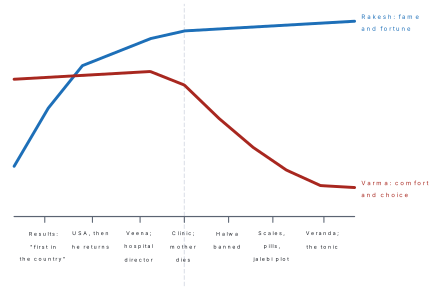
The morning of the results. The story opens on pure joy. The examination results are in the morning papers; Rakesh, barefoot and still in his pyjamas, finds his name at the top, walks up to the veranda where his father is drinking tea and bows to touch his feet. He has come first in the country. The family whoops and dances, and all day neighbours crowd into the small yellow house with garlands, halwa and gifts. Rakesh is the first son of the family ever to be educated, and the result feels like the harvest of a long sacrifice.
What the neighbours said. Varma tells every visitor the detail that moves him most: the first thing his son did was to touch his feet. The women wipe their eyes; the men nod at such "exemplary filial behaviour". But the praise is mixed with envy. Some guests grumble about the quality of the sweets, and others mutter that Varma is giving himself airs, since he comes from the vegetable market and never went to school. Desai remarks that there was "more envy than rancour" in the voices. From the start, the story is about a whole community watching one family.
The great ascent. The thesis for Rakesh's M.D. brings him still greater fame, and he wins a scholarship to "the USA" — Varma's proud correction of the neighbours' "America". He works in the most prestigious hospital there and earns praise that reaches his family. Then, to everyone's surprise, he comes back to the same small house in the same shabby colony, and the first thing he does is to touch his father's feet again.
The marriage. His mother is delighted that he has not brought home a foreign wife. Rakesh agrees, almost without argument, to marry the girl she has chosen in her own village: Veena, plump, uneducated, placid and obliging, who settles into the household and never asks for a separate home. She is pretty until, after the birth of their first son, her prettiness turns to fat — "and then what did it matter?"
The doctor's rise. Rakesh works in the city hospital, rises quickly in its administration and becomes a director, then opens his own clinic. He drives his parents to see it in a new sky-blue Ambassador car; his name stands on the signboard in red letters, followed by a long row of degrees. His fame dims a little, since people have grown used to it, but his fortune grows: he is the best and the richest doctor in town.
The parents. Varma has by now retired from the kerosene depot where he worked for forty years, and Rakesh's mother dies soon afterwards, comforted by a son who attends her to the last. Even the most resentful neighbours admit that Rakesh is a devoted son and also an excellent surgeon; how a man born to illiterate parents came by so many virtues, no one can say.
The turn. Then Desai writes the sentence on which the story hinges: talent and skill, if displayed too long, "cease to dazzle". Her tone changes. Having lost his wife and his work, the old man goes to pieces. He develops so many complaints that even his son cannot tell a real illness from a whim. He sits huddled on his string bed and takes to lying perfectly still while the family fusses round him, then sits up and spits betel-juice. At a birthday party for the youngest grandson the daughter-in-law believes she has found him dead; the party turns to mourning; and the old man sits up and spits red juice on the hem of her sari. After that, nobody minds him — except Rakesh.
Rakesh's daily care. Rakesh brings his father's morning tea in his favourite brass tumbler, reads him the news although he gets no reply, coaxes him out of his bare room into the garden in the evening and, on summer nights, has the servants carry his bed on to the lawn. The old man finds all this gratifying. What he does not like is that Rakesh also takes charge of his diet.
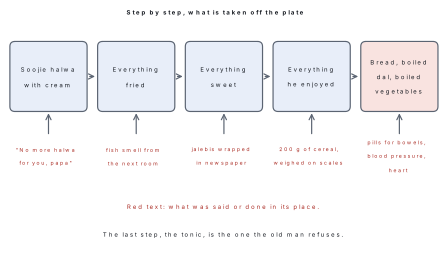
No more halwa. One day, after Varma has been really ill from soojie halwa and cream, Rakesh comes in with "the contemptuous stride of the famous doctor" and forbids it: nothing fried, nothing rich. The old man stares at him in disbelief; Veena slips out with a small smirk that only he sees. Halwa is only the first item crossed off. Fried food goes, then sweets, and finally everything the old man enjoys. His meals become dry bread, boiled lentils and boiled vegetables, and when he calls for more, Rakesh appears in the doorway, shakes his head sadly and says they cannot risk another illness.
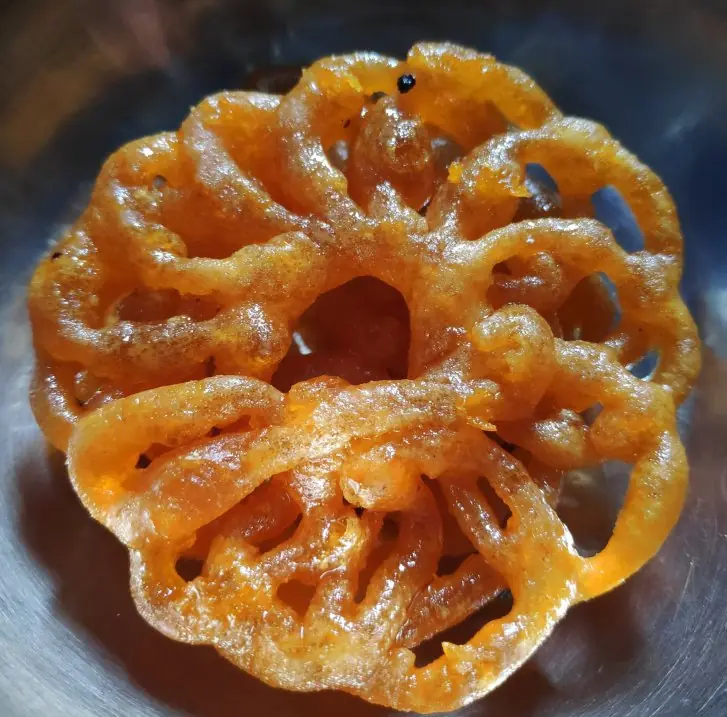
The jalebi conspiracy. Missing his generous, indulgent wife, Varma bribes his grandchildren with pocket money to buy him jalebis from the crossroads. He gets away with it once or twice, and then is caught. Rakesh storms in: is his father trying to turn the boy into a liar? Cholera and typhoid are in the city; he sees the cases every day. The old man lies down "in the corpse position". No one is worried any more.
Old Bhatia. A neighbour's visits are the one pleasure left. Old Bhatia, who still bathes under the garden tap, calls over the hedge or sits with Varma under the temple tree. "At least you have a doctor in the house," he says. Varma cries out that the doctor does not even feed him enough: Rakesh weighs his cereal on scales and Veena will not bring him even a taste of the fried fish he can smell. Bhatia is shocked that a son could refuse his father food. Here the narrator delivers the hinge of the story: the son's character has undergone "a curious sea change"; the same efficiency now looks like heartlessness, the same authority like tyranny.
The tonics. On his thin diet Varma weakens and becomes a truly sick man. Pills, powders and tonics take the place of food, one for the bowels, one for blood pressure, one for arthritis and, in the end, one "to keep his heart beating". There are panicky rushes to hospital and the humiliation of the stomach pump. When the old man begs to be let go — "Let me die" — Rakesh answers that he has his duty and, outside the door, tells someone laughing that his father lies on pillows, fed by hand, and still complains. Varma shouts out the list of his grievances, but he is too weak and all the family hears is a croak. Only Bhatia hears him say that God is calling him and they will not let him go. The tonics keep him alive, but only as a man who strains at a rope that will not break.
The evening on the veranda. That summer the servants carry the bed out to the veranda each evening and set it down with a thump. Veena props him up on pillows into a sitting position that makes his head swim and, when he asks to lie down, tells him that Rakesh says he can sit if he tries; she goes off to her transistor radio. Varma sits rigid and afraid, watching his grandsons play cricket and the gate, which carries a freshly painted board with his son's name and qualifications. His own name vanished from the gate long ago.
The tonic. The sky-blue Ambassador arrives and the doctor, all in white, steps out. "Ever a devoted son," he goes first to his father and reaches out to press his feet. Old Varma tucks his feet under him, out of the way. "I'm dying," he says; "Let me die." Rakesh smiles lovingly and produces a new tonic. Varma spits out that he wants none, and with a sudden, grand sweep of the hand knocks the bottle out of his son's grasp. It smashes; brown syrup stains the white trousers; Veena cries out; and for once there is noise and attention around the old man. He pushes the pillows away, sinks flat on his back and, pointing his chin at the ceiling "like some dire prophet", groans that God is calling him — now let him go.
3.3 Characters
| Character | Who they are | Role in the story |
|---|---|---|
| Varma | Rakesh's father; worked forty years at a kerosene dealer's depot; illiterate; son of a vegetable-seller | The protagonist of the second half; the sufferer, and the one whose viewpoint we finally share |
| Rakesh | Varma's son; first in his family to be educated; first in the country in his medical examination; a surgeon, then hospital director, then owner of a clinic | The "devoted son" of the title; the hero of the first half and the antagonist, though not a villain, of the second |
| Veena | Rakesh's wife, chosen by his mother; plump, uneducated, placid | The household's obedient agent; her smirk is what the old man "saw, and hated" |
| Rakesh's mother | Varma's wife; a lifelong kitchen worker; dies "soon after" the clinic opens | The "generous, indulgent" cook whom Varma misses most |
| Bhatia | Elderly neighbour beyond the hedge | Varma's audience and confidant; the voice of ordinary moral common sense |
| The grandchildren | Rakesh's sons; unnamed | Varma's would-be accomplices in the jalebi plot; later the cricketers on the lawn |
| The neighbours | Envious, admiring, gossiping | A chorus that praises Rakesh at the start and is silent at the end |
Rakesh. Desai is scrupulously fair to him. He is intelligent, hard-working, modest, loyal to his parents, a faithful husband and a good father. He returns from America when he need not have; he marries as his mother wishes; he nurses his mother to her death; he brings his father tea, reads him the news, arranges his pillows. Nothing in the story shows him neglecting a duty. Yet the same qualities have another side: his "confident and rather contemptuous stride of the famous doctor", his laughter outside the door at his father's complaints, his way of turning every wish into a medical fact (cholera, typhoid, gastroenteritis), and above all his inability to hear his father say, in plain words, that he wants to die. Rakesh's tragedy is that everyone around him has always agreed with him, so he has no idea how to hear a "no".
Varma. He is not simply a victim. He is vain, greedy for sweets, given to theatrical illnesses and false deaths, capable of trying to bribe a child, and exaggerates to the neighbours ("he has scales to weigh it on"). But Desai gives him the story's most powerful lines and the last word, and by the end the reader has moved from smiling at him to pitying him. Note also his social pride: he insists on the fashionable "USA" and tells every visitor that his son touched his feet — yet by the end even his own name has vanished from his own gate.
Veena. She has no independent story. The narrator describes her only from Varma's angle ("smiling, hypocritical pudding in a rustling sari"), so we cannot tell whether she is really unkind or only obedient and bored. Her transistor radio and her "Try, papa, Rakesh said you can if you try" show a household in which nobody thinks for themselves; everyone repeats the doctor.
Bhatia. A comic figure with white hairs twitching in his ears, but the only person in the story who is shocked on Varma's behalf. His disbelief is the reader's first hint that something has gone wrong with Rakesh's "devotion".
3.4 Themes
Duty and devotion — and their limits. The story sets two ideas of what a son owes his father against each other. The community's idea is ritual and visible: touch the feet, obey, marry as your mother says, give a car ride and a comfortable bed. Varma's idea is emotional and personal: to be listened to, fed what he loves, and allowed to choose how his life ends. Rakesh fulfils the first completely and never notices the second.
Care versus control. Everything Rakesh does is for his father's health, and almost everything he does takes away his father's choices. The story does not say he is medically wrong — the diet, the pills and the hospital visits do keep Varma alive — but it asks what a long life is worth when it is lived "only to eat your medicines". This is a very modern question about elder care, and Nepali students will recognise it at once.
Appearance and reality. Desai plays a series of tricks with perspective. In the first half everyone agrees that Rakesh is perfect; in the second Varma says he is a tyrant; and the narrator's key sentence — "the interpretation had altered" — admits that both views are looking at the same behaviour. Whether efficiency is heartlessness depends on who is on the receiving end.
Ambition, sacrifice and social climbing. Varma and his wife gave up everything for Rakesh's education, and the result is a family that has moved from the vegetable market to the ownership of a clinic and a sky-blue Ambassador. Desai treats this mobility with affection and with satire (the "USA" joke, the red letters on the signboard) — and with a sting: in the new prosperity there is no room for the old man's tastes or for his name.
Old age, loneliness and the wish to die. After his wife's death Varma has no work, no partner and nothing to look forward to but food, and even that is taken from him. His wish to die is the story's most disturbing element: he does not want more life, he wants respect for his exhaustion. The ending grants him nothing but noise and attention — the "hubbub" he has really been craving.
Generational and cultural change. The old man's world is that of the string bed, betel-juice, halwa and the brass tumbler; Rakesh's is that of stainless-steel trays, stomach pumps, scales and the transistor radio. The story suggests that "modernisation" brings competence and cleanliness but also a certain coldness.
Irony as a moral instrument. Desai never states her judgement. She lets the word "devoted" carry two opposite meanings and leaves the reader to decide which is truer.
A gap between what is said or expected and what is actually so. In verbal irony a speaker means the opposite of the words ("such a son as few women had borne"). In situational irony events turn out contrary to expectation (the son who does everything right makes his father miserable). In dramatic irony the reader knows more than a character (we know Varma is serious when he says he is dying; his family thinks he is acting). "A Devoted Son" uses all three.
3.5 Setting, structure and point of view
Setting. A small yellow house "at the end of the road" in a colony on the edge of an unnamed Indian city, probably in the 1960s–70s (the Ambassador car, the fifty paise coin, the transistor radio, the string bed). The setting is quietly two-faced: neat wire fences and well-tended gardens on one side, rubbish vans, pigs and rag-pickers just outside. The house itself changes little; what changes is its inhabitants' rank. The father's room is "as bare and desolate as a cell" while the doctor's fame fills the gate.
Structure. The story has two halves of roughly equal length and opposite mood.
| Part | Mood | Narrator's stance | Central image |
|---|---|---|---|
| 1. From the results to the clinic | Festive, comic, admiring | Ironic but warm; mimics the neighbours' praise | Garlands, halwa, the touched feet |
| Hinge: "talent and skill... cease to dazzle" | Cooling | Detached | The old man "went to pieces" |
| 2. The old man's decline | Bitter, tragi-comic | Increasingly Varma's | The tray, the pills, the veranda |
| 3. The tonic | Climax and release | Close to Varma | The smashed bottle |
Point of view. Third person, "omniscient" in the loose textbook sense but actually shifting: at first the narrator shares the community's admiration and even echoes its clichés ("such a son as few women had borne", "radiant heights of fame and fortune"); after the hinge-line the narrator moves close to Varma and adopts his words ("that smiling, hypocritical pudding"). We are never taken inside Rakesh. This is why the ending feels like an accusation: we know exactly what the father feels and can only guess what the son feels.
The symmetry of the feet. Watch the gesture that frames the story. Rakesh touches his father's feet on the morning of the results (the gesture the whole town praises); again when he returns from the USA; he presses his mother's feet as she dies; and in the last scene he reaches out to press his father's feet — and "Old Varma tucked his feet under him, out of the way." A ritual of respect has become a gesture of refusal. Desai never comments; the reversal does it.
3.6 Style and literary devices
| Device | Example | Effect |
|---|---|---|
| Irony (title) | "A Devoted Son" | The phrase means one thing in the first half and another in the second; the story is built on the gap |
| Verbal irony | "such a son as few women had borne" | The praise is sincere on the surface and faintly mocking underneath |
| Situational irony | The son's every kindness increases the father's misery | The reader sees what the son cannot |
| Satire | "the USA (that was what his father learnt to call it and taught the whole family to say — not America, which was what the ignorant neighbours called it)" | Gently mocks status-seeking and the small snobberies of a rising family |
| Hyperbole | "the radiant heights of fame and fortune"; "great, sweeping ascent" | Echoes the community's inflated praise, preparing for the fall |
| Simile | "cracking like an ancient clay jar"; "like some stiff corpse"; "like some dire prophet"; "as sharp and bitter as poison" | Vivid, physical images of the old man's age, terror and fury |
| Metaphor | "that pearl amongst pearls"; "little black slaves of the regent" | The first flatters Rakesh; the second, for his degrees after his name, mocks the vanity of titles |
| Contrast and parallelism | First half against second; the feet at the beginning and the end | Gives the story its shape |
| Motif | Feet; food (halwa, jalebi, boiled vegetables); medicine; the colour yellow (the yellow house, the "yellow air") | Repeated images that connect the two halves |
| Symbol | The signboard with the son's name (and the father's vanished from the gate); the tonic bottle | Stand for the son's authority and the father's last refusal |
| Diction | Halwa, jalebi, betel, string bed, dhoti, "Mubarak, Varmaji" | Indian English and Hindi words give the story its social texture |
| Comic exaggeration | Varma's "corpse position"; Bhatia's ear-hairs "twitching" | Keeps the tone light so that the bitterness comes as a shock |
| Free indirect style | "A son who actually refused his father the food he craved? No, it was unheard of, it was incredible." | Lets us hear the old man's outrage in the narrator's voice |
Language and tone. Desai's sentences in the first half are long, breathless and piled up with lists — garlands, halwa, party clothes, fountain pens, watches — imitating the crowd's excitement. In the second half they shorten and turn to precise, sensory detail: the thump of the bed, the taste of betel that is no longer allowed, the red spittle on the organza. The change of style is the change of sympathy.
3.7 Glossary
| Word | Meaning |
|---|---|
| bedlam | wild, noisy confusion |
| wunderkind | (German) a child prodigy; a young person of remarkable ability |
| Mubarak | (Urdu/Hindi) congratulations |
| halwa | a rich Indian sweet made of semolina, ghee and sugar (here soojie halwa, semolina) |
| sweetmeats | small sweet delicacies |
| exemplary | serving as a model of good behaviour |
| filial | of or befitting a son or daughter |
| rancour | bitter, long-lasting resentment |
| encomiums | formal expressions of high praise |
| complaisant | willing to please; obliging |
| placid | calm; not easily disturbed |
| gloat | to enjoy one's success with smug pleasure |
| medley | a varied mixture |
| fathom | to understand after thought |
| peevish | irritable; complaining |
| gaunt | thin and bony, especially from age or illness |
| gob | a lump of something wet; here of betel-juice |
| betel | leaf chewed with areca nut, which turns saliva red |
| distraught | deeply upset and agitated |
| organza | a thin, stiff, transparent fabric |
| decrepit | worn out and weak with age |
| spry | lively and active despite age |
| sterling | excellent; of the highest quality |
| tyranny | cruel and oppressive use of power |
| supplant | to take the place of |
| hubbub | a confused noise of many voices |
| derisive | mocking |
| dire | dreadful; warning of disaster |
| ministered | attended to someone's needs, especially in illness |
| jalebi | a coil of deep-fried batter soaked in sugar syrup |
| dhoti | a long cloth wrapped round the waist and legs, worn by Hindu men |
Do not answer the question "Is Rakesh a devoted son?" with a flat yes or a flat no. The strongest answers do three things: they give the evidence for Rakesh's devotion (the touched feet, the return from the USA, the marriage to his mother's choice, the nursing of the mother, the tea, the news, the pillows, the diet); they give the evidence for its failure (the scales, the pills, the laughter at the door, the refusal to hear "let me die"); and they say what Desai's irony is asking — whether devotion that overrules a person's wishes is devotion at all.
3.8 Textbook exercises
Before you read
a. Will you be ready to sacrifice your career, status and economic opportunities for the good of your parents? Why or why not?
This is an opinion question; the examiner wants a clear position with reasons. A balanced model: I would be ready to sacrifice some things — a posting far from home, a few years of extra earning — because my parents sacrificed far more for me, and because some duties cannot be postponed. But I would not give up my whole career, since a person who abandons his own future may end up a burden to the very parents he wished to help. The best sacrifice is one that is made with the parents' knowledge and consent, so that both sides remain dignified.
b. In your view, what are the qualities of a devoted son or daughter?
A devoted child is grateful (remembers what was given), attentive (notices a parent's health and feelings without being told), respectful (speaks gently even in disagreement), patient (especially with the irritability of old age), dependable (is there in illness, not only at festivals) and a good listener — which is exactly the quality Rakesh lacks. Devotion is not only doing things for a parent; it is also letting the parent have a say.
Understanding the text
a. How did the morning papers bring an ambience of celebration in the Varma family?
The morning papers published the results of the medical examination, and Rakesh found his name at the very top: "first in the country". Varma, who was sitting on the veranda over his morning tea, heard the news from his son's own lips. The family "whooped and danced", and the quiet morning turned into a festival of "garlands and halwa, party clothes and gifts". A private joy at the gate became a public holiday for the whole road.
b. How did the community celebrate Rakesh's success?
All day long neighbours and relatives "streamed into the small yellow house" to congratulate the parents of this "wunderkind" and to slap Rakesh on the back. They filled the house and garden "with the sounds and colours of a festival". There were garlands, halwa, sweetmeats and betel leaves passed round on trays, party clothes and gifts — enough fountain pens "to last years, even a watch or two". Varma told each visitor how Rakesh had touched his feet, and the women were moved to tears. The celebration was not entirely innocent, however: some guests grumbled about the lack of ghee sweets and about Varma "giving himself airs".
c. Why was Rakesh's success a special matter of discussion in the neighbourhood?
Because it was a double triumph from the very bottom. He came from a poor home in a "shabby little colony at the edge of the city"; his father had worked at a kerosene depot and his grandfather sold vegetables; and he was "the first son in the family to receive an education". For such a boy to stand first in the country in a medical examination was astonishing. The neighbours' talk was half admiration and half envy, since "not every son in that shabby little colony" could shine as Rakesh shone.
d. How does the author make fun with the words "America" and "the USA"?
When Rakesh wins a scholarship and goes abroad, Varma "learnt to call it" the USA and "taught the whole family to say" it, because "America" was what "the ignorant neighbours" said. Desai is poking fun at a small snobbery: the father, who has never been to school, believes that a change of word raises his family above the neighbours. The phrase "with a grand familiarity" makes the joke explicit — Varma speaks of a distant country as if it were a cousin. It is satire of status-seeking, but gentle, because we can see how proud and how poor he is.
e. How does the author characterise Rakesh's wife?
Veena is presented as "a plump and uneducated girl", chosen by Rakesh's mother from her own village as the daughter of a childhood friend. She is "so old-fashioned, so placid, so complaisant" that she slips into the household "like a charm", and is "too lazy and too good-natured" to urge her husband to live separately. She is pretty "in a plump, pudding way", and the prettiness turns to fat after the first baby. Later the narrator, from Varma's angle, calls her "that smiling, hypocritical pudding in a rustling sari": a woman who smirks at the old man, repeats her husband's orders, and listens to film songs on her transistor.
f. Describe how Rakesh rises in his career.
Rakesh first stands first in the country in his medical examination. His M.D. thesis brings him greater glory "in select medical circles" and a scholarship to the USA, where he works in "the most prestigious of all hospitals". He returns, joins the city hospital and "quickly" rises to the top of its administration, becoming a director. He then leaves to set up his own clinic, with his name in red letters on the signboard followed by his degrees. He becomes "not only the best but also the richest doctor in town", with a sky-blue Ambassador car. Desai adds that all this "took up Rakesh's whole life".
g. How does the author describe Rakesh's family background?
As poor, uneducated and humble. The family lives in a small yellow house at the end of the road in a shabby colony. Rakesh's father had worked at a kerosene dealer's depot for forty years, and his mother "spent her life in a kitchen"; both were illiterate. The grandfather sold vegetables. Rakesh was the first person in the family to go to school. The neighbours never let Varma forget it: "he comes from the vegetable market himself... and he has never seen the inside of a school".
h. What is the impact of Rakesh's mother's death on his father?
Varma, already retired from his post, "very quickly went to pieces". He developed "so many complaints" and "such mysterious diseases" that even his son could not tell a serious illness from "a peevish whim". He sat huddled on his string bed, lay perfectly still to alarm the family and then sat up to spit betel-juice. Later he says how much he misses his wife, "that generous, indulgent and illiterate cook", who would have given him the food he is now denied. The loss of the one person who understood him turned a healthy old man into a lonely, demanding patient.
i. What did Rakesh do to make his father's old age more comfortable?
He brought his father's morning tea in his favourite brass tumbler instead of a china cup and read the news aloud. In the evening he persuaded the old man to leave his cell-like room and sit in the garden, arranging the pillows on the divan. On summer nights he had the servants carry the bed to the lawn and helped his father into it "for a night under the stars". He also supervised his diet, brought him medicines, vitamins and tonics, and rushed him to hospital when he was ill.
j. Why did the old man try to bribe his grandchildren?
Because Rakesh had banned halwa and then all fried and sweet food, and the old man could not bear the boiled meals. He gave a grandchild fifty paise, asked him to buy thirty paise worth of jalebis at the crossroads and keep the rest for himself. It was the only way to get the food he craved, since his son, daughter-in-law and servants would not bring it. The plot was found out, and Rakesh scolded his father for turning his little son into "a liar".
k. Are Mr Varma's complaints about his diet reasonable? How?
This is an opinion question; both sides can be argued with evidence.
Yes, they are reasonable. A man of Varma's age who is not dying of anything in particular is being weighed out two hundred grams of cereal "on scales", denied butter and oil, and given pills in place of meals. He is not consulted. The pleasure of eating is one of the few left to him, and taking it away makes him "a genuinely sick man". Even Bhatia finds it hard to believe.
No, they are exaggerated. Varma was really ill after the soojie halwa and cream; Rakesh is a doctor who sees cholera and typhoid every day; the diet and tonics do keep him alive. The old man also lies, fakes death and bribes children, so his complaints cannot all be taken at face value.
A mature conclusion: the complaints are reasonable in spirit (a person's wishes matter) even if exaggerated in detail; the solution was a compromise — small, well-cooked portions of what he loves — rather than a ban.
Reference to the context
a. How did the Varma couple make sacrifices for their son's higher education?
Varma worked for forty years at a kerosene dealer's depot, a humble and poorly paid job, and his wife spent her whole life in the kitchen. They were illiterate and lived in a small house in a shabby colony. The story says plainly that "so much had been sacrificed in order to send him to school and then medical college". That means years of doing without comforts, of spending on fees and books and later on the cost of a long medical degree, and of letting the eldest son study when he could have earned. The morning of the results is the day "the fruits of their sacrifice had arrived, golden and glorious".
b. Mr Varma suffers from diseases one after another after his wife's death. Would he have enjoyed better health if she had not died before him? Give reasons.
Probably yes, though not perfectly. His collapse follows his wife's death and his retirement so closely that loneliness and idleness look like the real illness: he "very quickly went to pieces". With his wife alive he would have had someone who understood his tastes — the "generous, indulgent" cook — and someone to talk to in the long day. He would probably have eaten what he liked, and Rakesh's daughter-in-law would not have become the keeper of his plate. Old age would still have brought ailments; but much of the suffering in the story comes not from disease but from isolation and helplessness, which a living wife could have eased.
c. Dr Rakesh is divided between a doctor and a son. As a son he loves his father and worries about his weakening health, but as a doctor he is strict on his father's diet and medicine. In your view, what else could Rakesh have done to make his father's final years more comfortable?
He could have treated his father as a person first and a patient second. Specifically: (1) Listen. When Varma said "let me die" and "I want none of your medicines", a loving son would have sat down and asked why, rather than laughing outside the door. (2) Negotiate the diet. A doctor could allow a small portion of halwa once a week and explain the risk; a rule with a reason is easier to accept than a ban. (3) Give company, not only care. Visits from Bhatia, time with the grandchildren, evenings spent talking rather than reading the newspaper to a silent bed would have fed the loneliness that was killing the old man. (4) Stop the humiliations — the bed thumped down on the veranda, the propped-up pillows, the stomach pump. (5) Accept that the goal of medicine in old age is comfort, not simply length of life.
d. What does the story say about the relationship between grandfather and grandchildren?
It is a relationship of affection, play and conspiracy, cut short by the parents. Varma tries to win the children as allies: he whispers "Here's fifty paise", presses the coins into a "tight, hot fist" and sends them for jalebis. The children are willing accomplices at first, and the old man "got away with it once or twice". But their loyalty is to their parents: one is "scolded by his father and smacked by his mother". By the end the grandsons are only distant figures playing cricket on the lawn, and Varma complains that he is "laughed at by his grandchildren". The closeness that might have comforted him is forbidden as bad influence.
e. Do you call Rakesh a devoted son? Give reasons.
Yes, in action, and no, in understanding — and the story is deliberately about that gap. For: he touches his father's feet at every great moment; he returns from the USA although he need not; he marries the girl his mother chose; he ministers to his mother "at the last moment"; he brings his father's tea, reads him the news, arranges pillows, carries him out under the stars, supervises his diet and medicines at great cost of time and money. Against: he never listens; he laughs at his father's complaints; he treats a man as a case; and he forces tonics on a father who begs to be let go. A fair answer: Rakesh is devoted to his father's life, but not to his father's wishes; by the last page the word "devoted" is ironic, not false.
Reference beyond the text
a. Write an essay on "The Parents' Ambition for Their Children in Nepali Society". You must give at least five examples.
The Parents' Ambition for Their Children in Nepali Society
In most Nepali homes a child is not only a child but also a hope. Parents who have lived through hardship want their sons and daughters to rise higher than they could, and they are ready to give up a great deal for it. This ambition has lifted many families, but it also carries a danger: the dream can belong more to the parent than to the child.
The first and commonest example is the choice of career. Thousands of families dream of a doctor or engineer in the house, and every year students from Kathmandu to Jhapa sit entrance examinations that their parents chose for them. Second, parents sacrifice their savings and sometimes their land to pay fees, to send a child to a good boarding school or to a foreign university. The parents of Rakesh, who worked forty years at a kerosene depot for their son's education, are a fictional version of a very real village story. Third, many parents compare their children with relatives and neighbours ("Sharma's daughter got a scholarship"), which raises pressure. Fourth, ambition decides what a child may study; a student who wants to be a musician, a footballer or a farmer is often told that it is not "serious". Fifth, parents hope to be cared for in old age, so ambition and security are tied together — a son who works abroad and sends money is a success even if he rarely visits.
Such ambition deserves respect, for it comes from love. But it needs listening. A parent who asks a child what he or she wants, and then helps, builds a happier success than one who commands. Desai's story ends with a warning on the other side: the son who fulfilled every hope could still not hear his father.
b. Medicines replace our diets in old age. What can be done to make old age less dependent on medicine?
Old age cannot be made free of medicine, but it can be made less dependent on it. Begin early. A balanced diet, regular walking or yoga, enough sleep and no tobacco in youth and middle age prevent most of the diseases that later need pills. Keep eating well in old age: small, frequent, home-cooked meals with vegetables, pulses, fruit and enough water, with sugar, salt and fried food reduced rather than banned. Keep the body moving with daily walks and light exercise. Go for regular check-ups so that problems are found early, and ask the doctor to explain each medicine. Look after the mind: loneliness and boredom cause real illness, so the old need company, purpose, religion or hobbies, visits from friends and time with grandchildren. Finally the family should make the old person part of decisions about diet and treatment; Varma's misery came not only from pills but from the loss of choice.
c. Write an essay on "Care of Elderly Citizens" in about 300 words.
Care of Elderly Citizens
An old proverb says that a household without an elder is like a house without a roof. In Nepal, where the joint family has long been the ideal, the elderly have traditionally been honoured as sources of wisdom and blessing. But modern life — migration abroad, nuclear families and rising costs — has made their care one of our most urgent social questions.
Old age brings weak health, failing eyesight, loss of income and, often, loneliness. Many old people in cities live alone while their children work in Kathmandu, the Gulf or Malaysia. Those who do live with their families may be fed and sheltered, yet ignored. Care therefore has two parts: material (food, medicine, shelter, money) and emotional (company, respect, being listened to). Anita Desai's Rakesh gives the first part in full and fails the second.
The family must come first. Children owe their parents what their parents gave them: time, patience and affection. A son or daughter should eat with the old, consult them on family decisions, and listen without correcting. The state also has a duty. Nepal's old-age allowance is a good beginning, but it is small; we need accessible senior health services, more geriatric care in hospitals and community day centres where the old can meet. Schools and the media can teach young people to respect age, and neighbourhood groups can visit the isolated.
Finally, the old themselves can help: by staying active, sharing their experience and accepting change gracefully. A society is judged by how it treats those who can no longer repay it. If we keep our elders in comfort and dignity, we not only give them peace in their last years; we also show our own children what they can expect.
Chapter summary
- "A Devoted Son" is a short story by the Indian writer Anita Desai (born 1937), from her collection Games at Twilight and Other Stories (1978).
- Rakesh, the son of a poor, illiterate man who worked forty years at a kerosene depot, stands first in the country in his medical examination, wins a scholarship to the USA, returns, marries the girl his mother chooses (Veena), becomes hospital director and then the richest doctor in town.
- After his wife's death and his retirement, old Varma "went to pieces". Rakesh nurses him tenderly but takes over his diet: halwa, fried and sweet food are banned, meals are weighed, and pills and tonics "became his diet".
- Varma resists in small ways — the jalebi plot, complaints to old Bhatia — and cries, "Let me die"; the family hears only "an incoherent croak".
- In the last scene Rakesh reaches out to press his father's feet and Varma tucks them away; Varma sweeps the tonic bottle out of his son's hand and prays, "God is calling me — now let me go."
- The title is ironic: Rakesh is devoted to Varma's health but deaf to his wishes. Themes: duty and its limits, care versus control, appearance and reality, class ambition, old age and loneliness.
- Techniques: irony (verbal, situational, dramatic), satire, hyperbole, simile, contrast and the shifting point of view; motifs of feet, food and medicine; the signboard and the tonic bottle as symbols.
Practice questions
Short answer questions (2 marks each)
- What did Rakesh do first when he saw the examination results, and why did Varma repeat it to every visitor? [2]
- Why did Varma teach his family to say "the USA" rather than "America"? [2]
- What kind of wife did Rakesh's mother choose for him, and what did that show about Rakesh? [2]
- How did Rakesh's supervision of his father's diet begin? [2]
- What did old Bhatia say when Varma told him about the scales? [2]
- What did Varma do with the tonic Rakesh brought him at the end? [2]
Model answers — short questions
1. He bowed down and touched his father's feet. Varma repeated it because it proved that his son, for all his new glory, was still respectful — the kind of "exemplary filial behaviour" that made the parents proud, and of which the neighbours said, "One does not often see such behaviour in sons any more."
2. Because "the USA" sounded grander and more familiar, "with a grand familiarity", than "America", which was what the "ignorant neighbours" said. It shows Varma's pride in his son's success and his wish to rise above the neighbours; Desai smiles at his small snobbery.
3. She chose a plump, uneducated girl from her own village, the daughter of a childhood friend: "so old-fashioned, so placid, so complaisant". That Rakesh accepted her "almost without argument" shows his obedience to his mother and his lack of interest in a foreign or educated wife.
4. One day Varma, ill, had ordered soojie halwa and eaten it with a saucerful of cream. Rakesh walked in "with the confident and rather contemptuous stride of the famous doctor" and announced "No more halwa for you, papa." After that everything fried, then everything sweet, and finally everything the old man enjoyed was crossed off his diet.
5. Bhatia was shocked. He asked in disbelief whether "even in this evil age" a son could refuse his own father food, and murmured "Never" and "Your own son?" He is the voice of common sense, and his amazement tells the reader that Rakesh's care has gone too far.
6. Varma refused it: "Keep your tonic — I want none." With a sudden, "grand" wave of his hand he swept the bottle out of Rakesh's grasp, so that it smashed and the brown syrup stained his son's white trousers.
Long answer questions (5 marks each)
- Is Rakesh a "devoted son"? Give a balanced answer with evidence from the story. [5]
- Discuss the use of irony in Anita Desai's "A Devoted Son". [5]
- "The story is about the conflict between care and freedom in old age." Discuss. [5]
Model answers — long questions
1. The title names Rakesh a "devoted son", and Desai spends the first half of the story proving it. He touches his father's feet on the day of the results and again on his return from the USA; he comes home when he could have stayed abroad; he marries the girl his mother chose; he nurses his mother "at the last moment"; he brings his father's tea in his favourite tumbler, reads him the news, arranges his pillows and carries him out to the lawn on summer nights. Even the "most rancorous" neighbours admit his goodness.
In the second half Desai shows the other side. Rakesh bans halwa and then every fried, sweet and enjoyable food; he weighs his father's cereal; he replaces meals with pills; he laughs outside the door at the old man's complaints; and he ignores the plain plea, "Let me die." The narrator says it outright: "his masterly efficiency was nothing but cold heartlessness, his authority was only tyranny in disguise." At the end, when Rakesh comes with a new tonic, Varma tucks away his feet and smashes the bottle.
So Rakesh is devoted to Varma's health, duty and public image, but not to Varma's wishes. The title is therefore ironic: he is a devoted son in every outward sense, yet the old man's dignity is lost in that devotion.
2. Irony — the gap between appearance and reality — is the method of the story. (a) The title means one thing in the first half and another in the second. (b) Verbal irony: "such a son as few women had borne", "that pearl amongst pearls", and the "radiant heights of fame and fortune" echo the community's exaggerated praise with a gentle smile. (c) Situational irony: the son who does everything right makes his father miserable; the medicine meant to prolong life prolongs a life the old man wants to end; and the mother's death is greeted with "a sigh that sounded positively happy". (d) Dramatic irony: the reader believes Varma when he says "I'm dying", while the family, used to his fake deaths, laughs. (e) The shift in the narrator's stance after "talent and skill... cease to dazzle" turns the same acts of care into tyranny. (f) The ending reverses the opening gesture: the feet Rakesh touched in respect are now tucked away in refusal. Desai never explains the irony; she lets the reader feel it, which is why the story is disturbing rather than merely sad.
3. Rakesh's care is medically sound. Varma's diet is cut, his pills taken and his hospital visits made because a doctor believes that a long life is the greatest gift. But Varma wants something else: to eat what he loves, to be heard, and, at the last, to be allowed to go: "I do not want to live only to eat your medicines." The story sets care and freedom against each other.
Desai gives the reader the details of what care costs: the scales, the boiled lentils, the propped-up pillows, the stomach pump, and the servants thumping the bed down on the veranda. She shows that the old man's dignity is lost step by step, and that the family cannot tell a fair complaint from "a peevish whim". His final act — sweeping the bottle from his son's hand — is the only free act left to him, and it is "suddenly grand, suddenly effective". The story does not say that care is wrong; it says that care without listening becomes control, and that even loving control can be a kind of cruelty.
Reference to the context
- "Keep your tonic — I want none — I want none — I won't take any more of — of your medicines. None. Never."
(a) Who speaks these words, to whom, and where? (b) What had the listener just said or done? (c) What does the gesture that accompanies the words show? (d) How does this moment reverse the beginning of the story? [5]
- "It was a strange fact, however, that talent and skill, if displayed for too long, cease to dazzle."
(a) Which "talent and skill" are meant and whose? (b) What immediately follows this sentence in the story? (c) What change does it mark in the narrator's attitude? (d) Why is the sentence important? [5]
Model answers — reference to the context
1. (a) Old Varma speaks them to his son Rakesh on the veranda of their house one summer evening. (b) Rakesh had just arrived from the clinic in his sky-blue Ambassador, sat on the edge of the bed, reached out to press his father's feet and offered him a new tonic ("Promise me you will take it regularly, papa"). (c) Varma sweeps the bottle out of Rakesh's hand "with a wave of his own, suddenly grand, suddenly effective": it shows that the old man, weak and unheard for years, has found one moment of power and dignity, and that he refuses the medical regime that has replaced his life. (d) The story opened with Rakesh bowing to touch his father's feet in respect; it ends with Rakesh reaching for those feet and Varma tucking them away, then rejecting the son's gift. The ritual of respect has become an act of refusal, and the "devoted son" of the title is shown to be devoted to the wrong thing.
2. (a) The talent and skill are Rakesh's — his brilliance in examinations, his scholarship, his surgery and his success as director and clinic owner. (b) The very next lines describe Varma, who, "having retired from work and having lost his wife", "very quickly went to pieces", growing complaining, ill and theatrical. (c) Until now the narrator echoed the community's praise; from here the story turns from admiring the son to watching the father, and the same qualities begin to look different: the narrator will soon say that "efficiency" was "cold heartlessness". (d) The sentence is the hinge of the story. It says that public glory fades with habit, that a whole town has stopped looking at the doctor, and that only the father, who lives with him, is left to judge. It also introduces the story's real subject, which is not success but what success does to those closest to it.
Practise more: English question bank