Unit 18 · Literature - One Act Plays · 37 min read
A Matter of Husbands
What the syllabus asks for 9
- About the author
- What kind of play is this?
- The play, beat by beat
- Characters
- Dramatic techniques
- Themes
- Critical appreciation
- Glossary
- Textbook exercises
Ferenc Molnár's "A Matter of Husbands" takes only a few minutes to read and a few more to perform, yet it contains a whole comedy: a frightened wife, a glamorous actress, a great deal of acting, and a last line that turns everything upside down. There are only two speaking characters, one room and one conversation. The wife arrives to beg the actress to give back her husband; the actress, without telling a single plain lie about love, sends her home happy and grateful. The play is short, but it is a model of how a one-act play builds a surprise, and it is a favourite with examiners because it is easy to misread.
The Famous Actress is acting even when no curtain has risen. She meets the wife's accusation with a story so smooth and so flattering that the wife thanks her for it. Only the last stage direction lets us see that the accusation was true: the husband is hiding in the next room. The play is about appearance and reality, about how persuasion can be stronger than proof, and about irony: the wronged wife leaves the stage feeling happier than she has felt for months, and is more deceived than she was when she arrived.
18.1 About the author
Ferenc Molnár (1878-1952), often written "Franz Molnar" in English, is the most celebrated Hungarian playwright. He was born Ferenc Neumann in Budapest on 12 January 1878, the son of a prosperous doctor. He began to study law in Budapest and Geneva, but in 1896 he abandoned law for journalism and spent his early years as a court reporter for a Budapest daily. His first novel, The Hungry City (1901), made his name in Hungary; his boys' novel The Paul Street Boys (1906), about two rival gangs in Budapest, was translated into dozens of languages and is still read by young people.
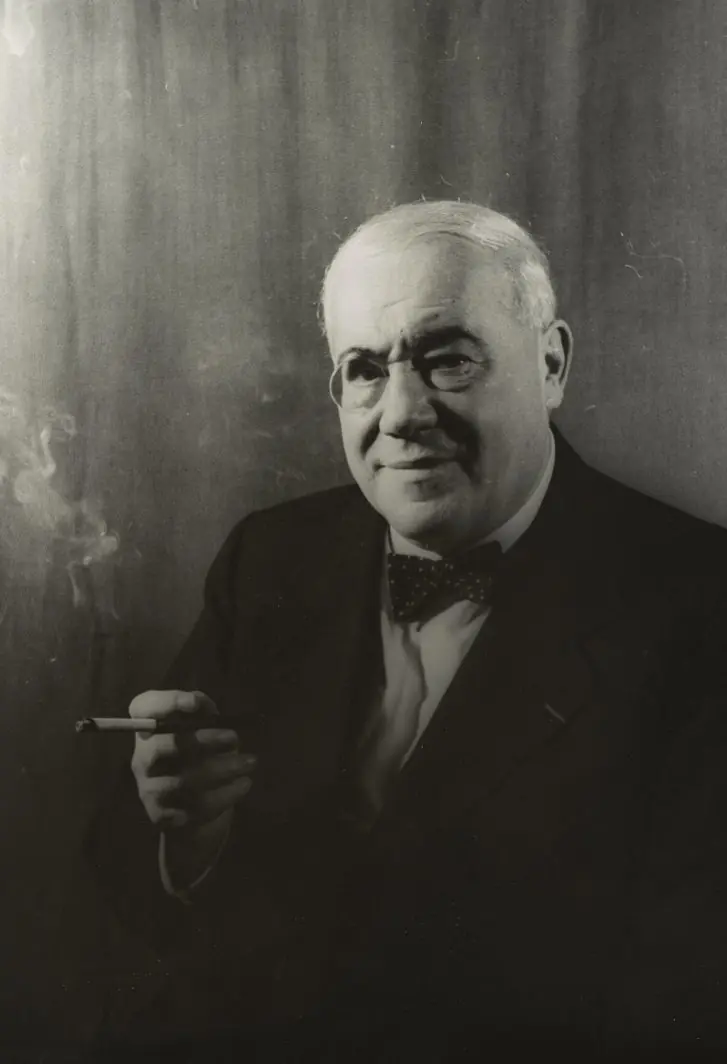
His first play, The Lawyer (1902), was followed by the comedy The Devil (1907), which brought him fame across Europe and in New York. Other famous plays are Liliom (1909), a failure in Budapest but a triumph abroad, later turned into the musical Carousel; The Guardsman (1910); The Swan (1920); and The Play's the Thing (1926). As a war correspondent in the First World War he was decorated by the Habsburg emperor. A Jew, he left Europe in January 1940 and lived the rest of his life in New York, where he died on 1 April 1952.
Molnár's aim, he said in effect, was to entertain. He wrote "graceful, whimsical, sophisticated drawing-room comedies" that blend realism with fantasy and cynicism with sentiment. He is often compared with Oscar Wilde and Bernard Shaw.
| Fact | Detail |
|---|---|
| Born / died | Budapest, 12 January 1878 / New York, 1 April 1952 |
| Nationality | Hungarian (later an American citizen) |
| Best-known plays | The Devil, Liliom, The Guardsman, The Swan, The Play's the Thing |
| Best-known novel | The Paul Street Boys (1906) |
| English text of this play | translated by Benjamin Glazer and printed in 1923 (in Ten Minute Plays, edited by Pierre Loving) |
| Genre | one-act comedy; drawing-room comedy (a duologue for two women) |
The play is usually classed as a one-act comedy of manners or drawing-room comedy. "Comedy of manners" means a comedy about the behaviour of people in polite society, and in particular about how they hide their real feelings behind polite talk.
18.2 What kind of play is this?
| Term | Meaning | How it applies here |
|---|---|---|
| One-act play | a short play with no act breaks, usually one setting and one continuous time | one drawing room, one late afternoon |
| Duologue | a scene with only two speaking parts | the two women carry all the talk |
| Stage directions | the author's notes on scenery, movement, tone and gesture, written in brackets | the wife "gulps emotionally", the actress "regards her appraisingly" |
| Twist ending | a surprise final turn that changes how we see the whole play | the last line reveals the husband |
| Play within a play | a character stages a performance inside the drama | the actress's story of the husband's "comedy" is her own performance |
Because the play has no acts or scenes, teachers divide it into beats: short stretches in which one purpose drives the talk. The next section follows the beats.
18.3 The play, beat by beat
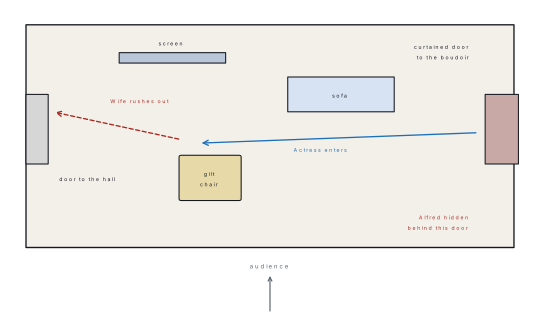
Setting. A drawing room in the apartment of a famous Hungarian actress, late in the afternoon. The stage direction says the furniture should be "exotic and suggestive", but "a screen, a sofa and a chair will do". The wife has been sitting on the edge of a gilt chair "a long time", staring at the furnishings and at a curtained door that leads to the actress's boudoir. She wears "a very modest frock" and keeps on her hat and furs, as if ready to flee.
| Beat | What happens | What the audience learns |
|---|---|---|
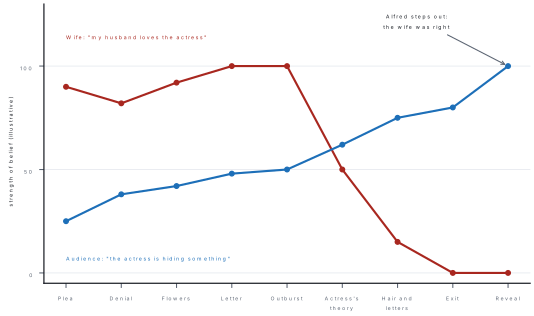
| 1. The plea | The Famous Actress enters from her boudoir. The Earnest Young Woman begs: "Give me back my husband!" She describes him: a blond, not very tall, bespectacled lawyer, called Alfred, who works for the actress's manager | The wife is sure her husband is in love with the actress |
| 2. The denial | The actress is "speechless" and then calm. She says she cannot give back what she has not got; she knows Alfred only as the man who drew up her last contract and whom she has seen backstage. She does not remember him in spectacles | The actress plays the innocent |
| 3. The evidence | The wife says Alfred sends flowers twice a week to the actress's dressing room, charged to his account (she learned it at the florist's); the actress calls this a lie. Then the wife reads a letter she found on his desk: "My darling, Shan't be able to call for you at the theater tonight. Urgent business. A thousand apologies. Ten thousand kisses. Alfred." | The proofs look damning; the actress's "Oh!" is her only reaction |
| 4. The outburst | Sobbing, the wife contrasts herself with the actress, who has cosmetics, bright lights and an author's lines ("Mr. Shakespeare") to make her seem beautiful and witty, while she has "my cheap little frock, my own lips and eyebrows" | The wife's real trouble is her own lack of confidence |
| 5. The turn | The actress studies her and says, "This is a very interesting case." She asks whether the couple has been getting on badly lately, whether they were once affectionate and recently cold. The wife says yes to each question. "A typical case!" | The actress has found her weapon: the wife's own admission |
| 6. The theory | The actress explains that the wife's husband is "playing a little comedy to make you jealous". It happens, she says, "Endless times" to actresses: authors, composers, scene designers, lawyers, orchestra leaders and even managers invent a love affair with an actress to win back a wife | The "explanation" is neat, plausible and flattering |
| 7. The "proofs" | The letter on the desk, the flowers ordered and cancelled, the lock of hair taken by a bribed hairdresser: all are tricks. She herself, she says, would gladly have written such a letter if Alfred had asked "frankly" | Every piece of evidence is turned round into its opposite |
| 8. The parting | The wife is "a perfect fool", kisses the actress and rushes out. The actress advises her not to be taken in a second time and promises to say nothing to Alfred | The wife is won over completely |
| 9. The twist | Alone, the actress goes to the boudoir door and calls: "All right, Alfred. You can come in now. She has gone." The curtain falls | The husband was in the next room all along |
The final image
The last line does more than surprise us. It tells us that (1) the wife's fears were right; (2) the actress knew the husband was listening; (3) the letter, the flowers and the lock of hair were exactly what they seemed; and (4) the "comedy" the actress described so well was the comedy she had just performed. A clever reader finds the clues in retrospect (see section 18.5).
18.4 Characters
| Character | Who she is | Key traits |
|---|---|---|
| The Famous Actress | a celebrated Hungarian actress, the owner of the apartment | poised, quick-witted, worldly, persuasive, amoral; an improviser of genius |
| The Earnest Young Woman | a wife who has come to confront the actress | sincere, modest, emotional, insecure, trusting; easily moved from grief to joy |
| Alfred | the wife's husband, a lawyer; never seen | sly, unfaithful, cowardly; leaves a trail of clues for his wife to find |
Notice that the two women have no personal names in the list of characters. They stand for types: a woman of the stage and a woman of ordinary life. Only in a made-up speech does the actress imagine a man calling her "Sara".
The Famous Actress
She is a real professional. Watch what she does in the first beats: she says little, gives away nothing, and lets the wife talk until she has heard everything that she will need. She denies flatly whatever the wife cannot check: "He never sent me a flower in all his life." When the wife breaks down, she stops acting outraged and watches her "appraisingly": she is a practical person looking for an opening. Her weapon is flattery mixed with pity. She tells the wife that she is foolish, but also that her husband is a "cunning lawyer" who adores her and that "no man deserves to be adored as much as that." Finally she tops it with advice: "don't let him fool you like this again." She does all this without telling the wife a word about the real affair; she simply tells her a better story.
She is also amoral. She does not seem to feel any guilt about deceiving the wife or betraying her. The author does not condemn her, though; the play's humour depends on our admiring her skill while disapproving of her use of it.
The Earnest Young Woman
"Earnest" means serious and sincere, and she is exactly that. She has rehearsed her speech, sat waiting for a long time and dressed plainly. Her grief is real; so is her jealousy. She believes that the actress's looks and magic come from "cosmetics and bright lights" and "an author's lines". She has a clear eye for her rival's tricks of the trade, which makes her final gullibility more ironic: she sees all the artificial things about the actress except the one that matters. Her weakness is lack of self-confidence. She would sooner believe that her husband is playing a game than that she has lost him, and the actress offers her exactly that belief. She is also generous; she is ready to apologise to her rival ("I have been a perfect fool") and to kiss her.
Alfred
He never speaks, but his hand is on everything. The wife's clues (the letter left on the desk, the flowers charged to his account, the lock of hair) are all his doing, and ironically the actress's "theory" that he leaves clues deliberately is partly true: he is careless, and his wife is always finding evidence. He is hiding in the boudoir while his wife is being comforted. He is a small, comic figure, a "little blond man with spectacles" who, as the actress says, does not deserve to be adored.
- The husband is not a character who appears during the conversation. He is hidden in the actress's boudoir and is called out only in the very last line.
- The actress does not tell the wife outright that she loves Alfred. She tells a different story which explains the evidence away.
- The play is not set on a stage or in a theatre; it is set in the actress's own drawing room. The theatre appears only in talk.
- The wife is not stupid. She is frightened, inexperienced and, above all, willing to believe the version that hurts least.
- The wife's name and the actress's name are not given; the author calls them by their type. Only in the actress's imagined speech does Alfred call her "Sara".
18.5 Dramatic techniques
1. Irony
Irony is the gap between what is said or seen and what is true. This play uses three kinds.
| Kind | Example |
|---|---|
| Verbal irony (saying one thing, meaning another) | The actress says: "I'm neither better nor worse than any other girl in the theater." Coming from a woman who has just betrayed a wife, it is sly understatement. Her "Oh!" at the letter is another example |
| Situational irony (the opposite of what we expect) | The wife came to win back her husband and leaves thanking the woman who has him; she is happiest at the very moment when she is most deceived |
| Dramatic irony (the audience knows more than a character) | From the moment the actress begins her "explanation", we may suspect she is hiding something the wife does not know. At the end the truth is shown |
2. The twist and the clues
The surprise is not cheating; the author has planted clues.
- She is too ready. When the wife mentions flowers, she answers at once, "That's not true", and after the letter is read her only comment is "Oh!".
- She first says she does not remember Alfred "with spectacles", but at the end she calls him "a little blond man with spectacles", which matches the wife's description.
- She asks, "hasn't he a lock of my hair?" before anyone has mentioned one. How would she know, unless she knows the man well?
- She promises not to tell Alfred that the wife had come, in the last moments of the talk, while he is behind the door, listening.
3. The stage directions
Stage directions carry the acting. Compare the two women.
| Wife | Actress |
|---|---|
| "[She gulps emotionally]" | "[Without anger, slowly, regards her appraisingly]" |
| "[Extends her arms in a beseeching gesture]" | "[With a gracious little laugh]" |
| "[Fumbles in her bag for a letter]" | "[Goes to the door of her boudoir, calls]" |
| "[She kisses the FAMOUS ACTRESS impetuously, wetting her cheek with tears; then she rushes out.]" |
The wife's directions are physical and melodramatic (sobbing, pleading, fumbling). The actress's are controlled and watchful. The contrast shows who is in charge long before the dialogue does. The last direction ("There is a pause.") is silence before the reveal.
4. Dialogue and rhythm
The first half is fast question-and-answer ("You wished to see me?" / "Yes." / "What can I do for you?"), which builds tension. The second half gives the actress a long speech, the central piece of persuasion, now often used as an audition monologue. The shift from short lines to one long speech mirrors the shift of power from the wife to the actress.
5. Comic devices
- Reversal: each proof is turned into its opposite.
- Understatement: "This is a very interesting case."
- Deflation: the actress pricks the wife's joy: "you do look a bit silly, standing there with tears in your eyes".
- Exaggeration: "I'd have written a letter that would have made you weep into your pillow for a fortnight."
- The hidden listener: the comedy of a third person overhearing a scene.
6. Structure
| Part | Beats |
|---|---|
| Exposition | 1-2: the plea, the denial |
| Rising action | 3-4: the evidence, the outburst |
| Climax | 5-6: the actress's diagnosis and theory |
| Falling action | 7-8: the "proofs", the thanks, the exit |
| Surprise ending | 9: "You can come in now." |
18.6 Themes
| Theme | Where we see it |
|---|---|
| Appearance and reality | The actress's calm helpfulness hides her guilt; the wife's happiness hides her deception |
| Acting in real life | The actress acts outside the theatre; the husband's "comedy" is acting too. The wife herself, who says that actresses fake everything, is the audience that is fooled |
| Jealousy and insecurity | The wife is afraid of the actress's glamour; her jealousy makes her easy to manage |
| Deception and self-deception | The wife wants to believe that her husband loves her, so she helps the actress fool her |
| Marriage and trust | The play is cynical about marriage: husbands cheat, wives are gullible, and the third party "saves" the marriage only by lying |
| Power of persuasion | The actress wins by understanding her listener; eloquence beats evidence |
| Gender and social roles | Two women, one rich and glamorous, one ordinary, negotiate over a man who stays hidden; he gets his way while they talk |
The title. "A Matter of Husbands" has a dry, comic air. Marriage is treated as a practical "matter" to be managed, like a contract. "Husbands" is plural: the actress talks of every man in the theatre who tries the trick, so this one lawyer is merely one example.
18.7 Critical appreciation
Strengths. Economy: two characters, one room, one conversation, yet there is exposition, complication, climax and a surprise. Brilliant theatrical speech: the actress's long speech is a masterpiece of persuasion, and every stage direction is precise. Humour and irony: the audience enjoys the wife's misery and the actress's deception because the play never becomes cruel. Re-readability: once you know the ending, the whole play reads differently.
Criticisms. Some readers find the play cynical about marriage and unfair to the wife, who is treated as a fool. The actress is never punished, so it may seem to reward deceit. The hidden husband is an old comic device (the lover in the cupboard).
Verdict. It is a polished comic miniature, a joke about how easily people believe what they wish to believe. Its moral, if any, is ironic: the cleverest liar is the one who tells the listener what she most wants to hear.
A possible sympathetic reading. The actress may also be seen as teaching the wife a lesson she needs: she tells her not to be taken in again, and calls herself "neither better nor worse than any other girl in the theater". But the ending undoes this reading, since the actress's "help" saves only her own secret.
18.8 Glossary
| Word | Meaning as used here |
|---|---|
| drawing room (n.) | a room in a large house for receiving guests |
| gilt (adj.) | covered with a thin layer of gold paint |
| boudoir (n.) | a woman's private sitting room or bedroom |
| exotic (adj.) | unusual and striking, often from another country |
| beseeching (adj.) | asking in an earnest, pleading way |
| bewilderment (n.) | confusion; being puzzled |
| implore (v.) | to beg someone strongly |
| manager (n.) | here, the person who runs the actress's business affairs |
| contract (n.) | a legal agreement; Alfred drew up the actress's |
| dumbfounded (adj.) | too shocked to speak |
| appraisingly (adv.) | with a judging look, as though weighing the value of something |
| expedient (n.) | a convenient means to an end |
| conspicuous (adj.) | easily seen; attracting attention |
| siren (n.) | a dangerously attractive woman (from Greek myth) |
| scruples (n.) | moral doubts that prevent one from doing wrong |
| plausible (adj.) | seeming reasonable or likely |
| fortnight (n.) | a period of two weeks |
| contritely (adv.) | with sorrow for having done wrong |
| impetuously (adv.) | suddenly and without thinking |
| duologue (n.) | a scene or play with two speakers |
- The play: two women, one drawing room; a wife begs an actress to "give me back my husband".
- The actress's theory: husbands invent love affairs with actresses to make wives jealous.
- The wife is convinced, thanks the actress and leaves happy.
- Last line: "All right, Alfred. You can come in now. She has gone." The husband was hiding in the boudoir.
- Techniques: irony (verbal, situational, dramatic), twist ending, stage directions, persuasive monologue.
18.9 Textbook exercises
The wording follows the CDC Grade 12 textbook as reproduced in common guides; your printing may differ slightly, so match the question in your own book.
Understanding the text
a. What favour does the Earnest Young Woman ask from the Famous Actress?
She asks the actress to give back her husband. She has come to believe that her husband, Alfred, has fallen in love with the actress, and she begs: "Give me back my husband!"
b. What, according to the Earnest Young Woman, are the indications that her husband has fallen in love with the Famous Actress?
She names three signs. (1) Alfred sends flowers to the actress's dressing room twice a week, charged to his account; she learned this at the florist's. (2) She found a love letter on his desk, beginning "My darling" and ending "Ten thousand kisses". (3) He has grown cold and careless towards her: he "doesn't care how he looks" when she is around, she says, but takes off his spectacles to look his best for the actress. (She also mentions a lock of the actress's hair in his drawer, which the actress brings up later.)
c. Is the Earnest Young Woman convinced by the argument of the Famous Actress? How?
Yes, completely. The actress explains that the letter, flowers and hair are a trick by which Alfred is trying to make his wife jealous and win back her love, a trick played by many men of the theatre on many actresses. The wife is relieved, calls herself "a perfect fool", thanks the actress, promises not to be taken in again, and kisses her "impetuously".
d. Where is the Earnest Young Woman's husband hiding while they talk?
In the actress's boudoir behind the curtained door on the right. We learn this only at the end when she goes to the door and calls, "All right, Alfred. You can come in now. She has gone."
e. When do you feel that the Famous Actress is really good at acting?
Opinion, but with evidence. The best moments: (1) when she stares at the wife "in speechless bewilderment" as if she has no idea what she means; (2) when she says "Oh!" at the letter and then hides her real reaction; (3) when she suddenly changes from accused to expert ("This is a very interesting case") and (4) in her long speech, where she produces detail after detail that turns every proof into a trick, with a "gracious little laugh".
f. How do we come to know that the Famous Actress and the husband of the Earnest Young Woman are in love?
Only at the end, when the actress calls Alfred from her boudoir with a familiar "All right, Alfred." Hints earlier in the play: she knows the lock of hair, calls him "a little blond man with spectacles", and knows exactly how a lawyer behaves. The last line shows that the wife's suspicions were right.
g. Write down the plot of the play in a paragraph.
An Earnest Young Woman waits in the drawing room of a Famous Actress. When the actress enters, the wife begs her to "give me back my husband", a blond, bespectacled lawyer called Alfred. The actress pretends to know him only slightly. The wife says her husband sends the actress flowers twice a week and reads out a love letter she found on his desk. The actress then asks about the marriage and, learning that the couple have grown cold, declares that Alfred is only making his wife jealous, a common trick that men of the theatre play on actresses. She explains the letter, the flowers and the lock of hair as parts of this game. Relieved and ashamed, the wife thanks her, kisses her and leaves. The actress then calls, "All right, Alfred. You can come in now. She has gone." He has been hiding in her boudoir all along.
Reference to the context
a. Sketch the character of the Famous Actress.
The Famous Actress is a glamorous, poised and exceptionally clever woman. She is quick- witted: within a minute of hearing the wife's accusation, she can begin to create a cover story. She is a skilled actress off the stage, using facial expression, pauses and a "gracious little laugh". She is persuasive and flattering, praising the wife's husband for loving her and calling him a "cunning lawyer". She is worldly: she says every actress is a target for such tricks, and speaks about authors, composers and managers with an air of weary knowledge. And she is unscrupulous: she deceives a trusting woman to protect her affair with the woman's husband. Finally she is self-controlled, for she never loses her temper, even when accused of theft. By the last line we see her as a clever deceiver who manages the truth as she would a part on the stage.
b. Shed light on the difference between an ordinary woman and an actress.
The play makes the contrast through dress, manner and skill. The Earnest Young Woman wears "a very modest frock", shows her feelings openly (she gulps, sobs, pleads), tells the plain truth, and has no training in concealment. The Famous Actress lives in an "exotic" apartment, governs her feelings, says what suits her purpose and invents with ease. The wife thinks the difference lies in cosmetics and "an author's lines"; the play shows that the real difference is practice in pretending. The ordinary woman is honest and therefore easily deceived; the actress is skilled and therefore always in control. The irony is that the ordinary woman sees through the actress's make-up but not through her acting.
c. According to the Famous Actress, men associated with the theatre use actresses to make their estranged wives jealous so as to woo them back. Do you agree with her argument? Why or why not?
A good answer argues one side with evidence. Disagree: the actress's "general rule" is an invention. She offers no proof. The wife's evidence (regular flowers, a tender letter, a lock of hair) suggests a real affair; the ending proves it. A man who really wanted to make his wife jealous would not hide in the actress's boudoir. The argument is also insulting to women: it assumes they are simple enough to be won back by a trick. Partly agree: people do sometimes try to provoke jealousy, and jealous thoughts do revive interest; and the actress's theory is cunning because it is plausible. Conclusion: the argument is clever but false; the play shows it is a performance.
d. How does the Famous Actress make a fool of the Earnest Young Woman?
She does it step by step. (1) She denies everything calmly, so that the wife doubts her own suspicions. (2) She asks leading questions about the marriage ("And of late you have been quite cold?") so that the wife supplies the premise of the actress's story herself. (3) She says "a typical case", flattering the wife by telling her that she is not special but cleverly manipulated by her husband. (4) She explains each proof, the letter, flowers and hair, in a way that fits her theory. (5) She even says she would have written such a love letter herself if Alfred had asked "frankly". (6) She finishes with friendly advice and a promise of silence, which makes the wife feel protected. By the end the wife is grateful to the woman she came to accuse.
e. The conversation between the two women takes place in a drawing room. What does the setting contribute to the play?
The drawing room is the actress's home ground, which gives her the advantage; the wife, in hat and furs, sits on the edge of a chair as a guest who has waited a long time. The "exotic" furnishings suggest the actress's glamour and the theatrical world the wife fears. A private room also allows what a public place would not: a confession of jealousy, a boudoir door beside the action, and a hidden listener. The limited set and unity of time and place keep the focus on the talk itself, as a one-act play needs.
f. What do you think about the ending of the play?
An opinion answer with reasons. Model: The ending is surprising, ironic and very funny. It reveals that the actress has lied from the start, that Alfred is indeed her lover, and that the wife has been tricked into thanking her rival. It is fair, because the clues are in the text (her knowledge of the lock of hair, the spectacles). It is also a little bitter: the wife's happiness is built on a lie and the liars go unpunished. So I find the ending successful as comedy but uncomfortable as a view of marriage; it leaves us thinking how easily kindness can be used as a weapon.
Chapter summary
- Ferenc Molnár (1878-1952), Hungarian playwright, wrote "A Matter of Husbands", a one-act comedy, translated into English by Benjamin Glazer (1923).
- The Earnest Young Woman begs the Famous Actress to "give me back my husband", Alfred, a blond, bespectacled lawyer. Her evidence: flowers, a love letter, a lock of hair.
- The actress denies everything, then uses the wife's admission that she has been cold to Alfred to offer a theory: men of the theatre invent love affairs with actresses to make their wives jealous. She explains each proof as a trick.
- The wife is convinced, apologises, kisses the actress and leaves.
- The last line reveals the truth: "All right, Alfred. You can come in now. She has gone."
- Characters: the actress (clever, poised, unscrupulous), the wife (earnest, insecure, trusting), Alfred (never seen, sly).
- Techniques: irony (verbal, situational, dramatic), twist ending, detailed stage directions, dialogue that turns from quick questions to a long speech, comic reversal.
- Themes: appearance and reality, acting in life, jealousy, deception and self-deception, marriage and trust, the power of persuasion.
Practice questions
Short answer questions (2 marks each)
- Why has the Earnest Young Woman come to the Famous Actress? [2]
- How does the actress first answer the wife's plea? [2]
- What evidence of the affair does the wife produce? [2]
- What does the actress say is "one of the oldest expedients in the world"? [2]
- How does the actress explain the lock of hair? [2]
- What advice does the actress give the wife before she leaves? [2]
- What do the last words of the play reveal? [2]
- Why does the author call the characters "Famous Actress" and "Earnest Young Woman"? [2]
Model answers — short questions
1. She believes her husband, the lawyer Alfred, has fallen in love with the actress, and she has come to beg the actress to "give me back my husband".
2. The actress pretends to be bewildered. She says she cannot return a husband she has not got, and that she knows Alfred only as the lawyer who drew up her last contract and whom she has seen backstage.
3. She says he sends flowers to the actress's dressing room twice a week (she learned it at the florist's), she reads a letter found on his desk ("My darling... Ten thousand kisses. Alfred"), and she has a lock of the actress's hair found in his drawer.
4. Inventing a love affair with an actress to make a wife or sweetheart jealous and win back her affection. The actress says authors, composers, scene designers, lawyers, orchestra leaders and managers have all used it.
5. She says men bribe her hairdresser to steal a lock, so Alfred's possession of it is part of his plan to make his wife jealous, not proof of a love affair.
6. She advises the wife not to be taken in a second time, no matter what letters, handkerchiefs, photographs or flowers she finds in his pockets, and promises not to tell Alfred about the visit.
7. The actress calls out, "All right, Alfred. You can come in now. She has gone." They reveal that the husband has been hiding in her boudoir all the time, so the wife's suspicion was true and the actress has deceived her.
8. They are types, not individuals: a woman of the theatre who lives by acting, and an ordinary, sincere woman. The labels highlight the contrast that drives the play: pretending versus plain dealing.
Long answer questions (5 marks each)
- Discuss "A Matter of Husbands" as a comedy of deception. [5]
- Describe how the Famous Actress persuades the Earnest Young Woman that her husband is innocent. [5]
- Discuss the use of irony and stage directions in the play. [5]
- "The play shows that appearance is not always reality." Discuss with examples. [5]
Model answers — long questions
1. The play is a comedy because it is built on deception that we enjoy watching. The wife comes to claim her husband and the actress denies any knowledge. Then the actress changes the ground: she turns each of the wife's proofs into a sign of something harmless. The wife leaves relieved; only in the last line, when the actress calls "Alfred" out of her boudoir, do we see that the wife's fears were true. The humour lies in the gap between what the wife believes and what the audience learns. There is little cruelty: the wife leaves the stage happy. The irony of the ending, that the wife thanks her rival, makes the comedy complete. The deception is both the plot (the actress deceives the wife) and the theme (people believe what they wish). The play is also short and economical: two characters, one room and one twist.
2. The actress works in five steps. First she denies everything calmly, so the wife's certainty weakens. Second, she asks whether the couple have been getting on badly of late, whether they were once affectionate and whether the wife has grown cold; the wife's "Yes" to each supplies the premise of the actress's theory. Third, she declares it a "typical case": it happens "endless times" to actresses, because men of the theatre invent love affairs to make wives jealous. This flatters the wife, making her less a victim than the target of a clever husband. Fourth, she explains every proof: the letter left "on the desk" on purpose, flowers ordered by telephone and then cancelled, the lock of hair taken by a bribed hairdresser. Fifth, she offers a story of her own: she wrote ten passionate letters for an eminent playwright, but his proper wife returned them unread. Finally she advises the wife not to be fooled again and promises not to tell Alfred. The wife, now happy, kisses her.
3. Irony is the play's main method. Verbal irony: the actress says she is "neither better nor worse than any other girl in the theater" while deceiving a wife. Situational irony: the wife, who came to fight her rival, leaves grateful to her. Dramatic irony: the audience gradually suspects what the wife does not; and in the last line what we suspected becomes certain. The stage directions supply most of the acting. The wife "gulps emotionally", "extends her arms in a beseeching gesture", "fumbles in her bag", "weeps", and at the end kisses the actress "impetuously". The actress's directions show control: "without anger, slowly, regards her appraisingly", "with a gracious little laugh". These contrasting movements show which woman is in charge. The final directions, "goes to the door of her boudoir, calls", are the most important of all, for they reveal the truth through an action, not an explanation.
4. The play shows that things are not what they seem. The actress seems kind and helpful but is deceiving the wife. The wife seems to be gaining her husband's love but is being fooled. The letter seems to be a love letter and is, but the actress makes it seem a trick. The "drawing room" seems private and safe, yet the husband is hiding behind its door. Even the wife's view of the actress as someone who seems beautiful through "cosmetics and bright lights" is half true: the actress's real power is in her acting of sincerity. The theatre itself is about appearance, and Molnár shows that the same art can be practised in a drawing room. The last line is the moment at which appearance and reality are finally shown together.
Reference to the context
- "I mean that I never received a flower, or a letter, or anything else from your husband. Tell me, haven't you and your husband been getting on rather badly of late?"
(a) Who speaks to whom? (b) What has the listener just told the speaker? (c) Why does the speaker ask this question? (d) What is ironic about what she says? [5]
- "Usually we don't know a thing about it. But even when it is brought to our notice we don't mind so much."
(a) Who says this and to whom? (b) What is "it"? (c) What does the speaker claim? (d) Is she telling the truth? [5]
- "Well, you do look a bit silly, standing there with tears in your eyes, and your face flushed with happiness because you have discovered that a little blond man with spectacles loves you, after all."
(a) Who says this and to whom? (b) Why is the listener "flushed with happiness"? (c) What is the tone of the remark? (d) What does the reader later learn that changes the meaning of these words? [5]
Model answers — reference to the context
1. (a) The Famous Actress speaks to the Earnest Young Woman. (b) The wife has said that flowers go to the actress's dressing room twice a week, and has read out the love letter she found on Alfred's desk. (c) The actress has found her opening: if the couple have been cold, she can say Alfred is making his wife jealous. (d) The actress lies flatly ("never received a flower") in order to appear innocent, while asking questions that help her to construct the lie.
2. (a) The Famous Actress, to the Earnest Young Woman. (b) "It" is the invention of a love affair between a man of the theatre and an actress to make his wife jealous. (c) She claims that actresses are often used in this way without knowing it, and do not mind because they save marriages. (d) No. It is a story she has invented to hide her own affair with Alfred. The final scene shows that she knows exactly what her "victim" has done.
3. (a) The Famous Actress to the Earnest Young Woman. (b) The actress has persuaded her that her husband has been playing a game to win her love back, so she believes he loves her. (c) Teasing, amused and superior, almost affectionate, with hidden mockery. (d) Alfred is in the actress's boudoir and the "love" is his love for the actress. The remark is therefore richly ironic: the wife is indeed "silly" to believe the story, and the husband, the "little blond man with spectacles", does not deserve to be adored.
Reference beyond the text
- Write a paragraph describing your favourite actor or actress. [5]
- "Honesty is the best policy." Do you agree? Discuss with reference to the play and your own experience. [5]
Answer hints — reference beyond the text
1. Give the name; say what he or she is famous for, three qualities of the acting (voice, emotion, range) and two or three works; end with why he or she inspires you. Use present tense and concrete examples.
2. Take a side. Support with the play: the actress's lies work for a while but rest on the wife's trust, and the ending shows they have cost the wife her dignity. Give a real example (a white lie that became a bigger problem) and conclude that trust is easier to keep than to rebuild.
Practise more: English question bank