Unit 30 · Grammar · 16 min read
Prepositions, Tenses and Relative Clauses
What the syllabus asks for 4
- Prepositions of time and place
- Fixed prepositions, and verbs that take none
- The twelve tenses at a glance
- Relative clauses
This last grammar unit gathers the three areas that appear most often in Q7 and do most damage in Q10. Prepositions are small, fixed and unforgiving: nothing in logic explains why we are good at English, married to someone and angry **with them. Tenses are the backbone of every sentence you write, and the errors here are errors of sequence rather than of form. Relative clauses let you join two short sentences into one adult sentence — and a single misplaced comma changes what the sentence means. Take the three in turn.
- Prepositions of time and place narrow down: in for the largest area, on for a surface or a named day, at for a single point.
- A past main verb pulls its subordinate clause into the past — except for universal truths.
- Commas decide the meaning of a relative clause. No commas = the clause identifies which one (defining). Commas = the clause merely adds information (non-defining), and that is then forbidden.
30.1 Prepositions of time and place
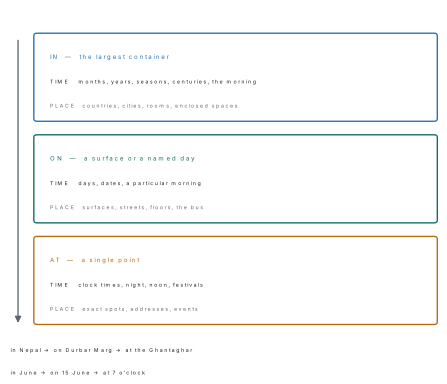
| Preposition | Time | Place |
|---|---|---|
| in | in May, in 2026, in winter, in the 19th century, in the morning, in two hours (= after two hours from now) | in Nepal, in the box, in bed, in the sky |
| on | on Sunday, on 5 June, on Monday morning, on my birthday | on the table, on the wall, on the second floor, on the bus |
| at | at 6 o'clock, at night, at noon, at Dashain, at present | at the bus stop, at the door, at school, at 25 Durbar Marg |
Pairs that are regularly confused.
| Pair | Difference |
|---|---|
| since / for | since + a point of time (since 2019); for + a length (for three years) |
| during / for | during + a noun (during the holidays); for + a period (for a week) |
| by / until | by = not later than (Finish it by Friday); until = up to that moment (Wait until Friday) |
| in time / on time | in time = early enough; on time = punctually |
| between / among | between two; among more than two |
| beside / besides | beside = next to; besides = in addition to |
| across / through | across a surface; through something you go inside |
| in front of / opposite | in front of = ahead of; opposite = facing |
30.2 Fixed prepositions, and verbs that take none
| Adjective + preposition | Verb + preposition | ||
|---|---|---|---|
| good at, bad at | afraid of | depend on, rely on | consist of |
| married to | angry with (a person) | apologise to … for | belong to |
| interested in | angry at (a thing) | congratulate on | complain about |
| famous for | proud of | accuse of, suspect of | insist on |
| different from | capable of | prevent from, prohibit from | succeed in |
| similar to, superior to | aware of | blame for | object to |
| responsible for | fond of | remind of | refer to |
| tired of, sure of | absent from | deal with, cope with | translate into |
| grateful to (person) for (thing) | keen on | provide somebody with | divide into |
Verbs that need no preposition at all. These are the ones Nepali speakers add a preposition to, and every one of them is marked wrong.
| ✗ Wrong | ✓ Correct |
|---|---|
| discuss about the problem | discuss the problem |
| enter into the hall | enter the hall (but enter into an agreement is correct) |
| marry with her | marry her / be married to her |
| reach at the station | reach the station (but arrive at the station) |
| return back home | return home |
| repeat again** | repeat |
| cope up with the pressure | cope with the pressure |
| emphasise on the point | emphasise the point / lay emphasis on it |
| investigate into the case | investigate the case |
| resemble to his father | resemble his father |
| describe about the scene | describe the scene |
| obey to the rules | obey the rules |
| order for a coffee | order a coffee |
| comprise of five members | comprise five members / consist of five members |
✗ She is good in Mathematics. → ✓ good at Mathematics ✗ He is married with a teacher. → ✓ married to a teacher ✗ This book is different than that one. → ✓ different from that one ✗ I am waiting your reply. → ✓ waiting for your reply ✗ He replied my letter. → ✓ He replied to my letter. ✗ She listened the news. → ✓ She listened to the news.
30.3 The twelve tenses at a glance
| Tense | Form | Typical signal words |
|---|---|---|
| Simple present | V1 / V1+s | always, usually, every day, generally |
| Present continuous | am / is / are + V-ing | now, at present, at the moment, look! |
| Present perfect | has / have + V3 | just, already, yet, ever, never, so far, recently |
| Present perfect continuous | has / have been + V-ing | for, since, all day, how long |
| Simple past | V2 | yesterday, last week, in 2018, ago |
| Past continuous | was / were + V-ing | while, at 5 p.m. yesterday, when … came |
| Past perfect | had + V3 | before, after, by the time, already (in the past) |
| Past perfect continuous | had been + V-ing | for / since + a past point |
| Simple future | will / shall + V1 | tomorrow, next week, soon |
| Future continuous | will be + V-ing | at this time tomorrow |
| Future perfect | will have + V3 | by next year, by the time |
| Future perfect continuous | will have been + V-ing | for + a period, by next month |
Sequence of tenses. When the main verb is in the past, the verb in the subordinate clause is normally past as well.
He said that he was unwell. · She asked what I wanted. · They left before the guests arrived.
Three exceptions: a universal truth stays in the present (He said that honesty is the best policy); a comparison after than may keep its own tense (He worked harder than I do); and a habitual present fact may be kept (*She told me that she goes* to the gym every morning).
✗ I am knowing the answer. → ✓ I know the answer. (stative verbs — know, believe, like, want, see, own — are not used in the continuous) ✗ He has gone to Pokhara last week. → ✓ He went to Pokhara last week. (the present perfect never takes a finished past time) ✗ I am working here since 2020. → ✓ I have been working here since 2020. ✗ When I reached the station, the train left. → ✓ …the train had left. (the earlier of two past events takes the past perfect) ✗ If he will come, I will meet him. → ✓ If he comes…
30.4 Relative clauses
A relative clause describes a noun and begins with a relative pronoun.
| Pronoun | Used for | Example |
|---|---|---|
| who | a person, as subject | the girl who won the prize |
| whom | a person, as object (formal) | the man whom we met |
| whose | possession (people or things) | the boy whose bag was lost |
| which | a thing or animal | the house which stands on the hill |
| that | person or thing, defining clauses only | the bus that goes to Bhaktapur |
| where | a place | the village where I was born |
| when | a time | the day when we met |
| why | a reason | the reason why he left |
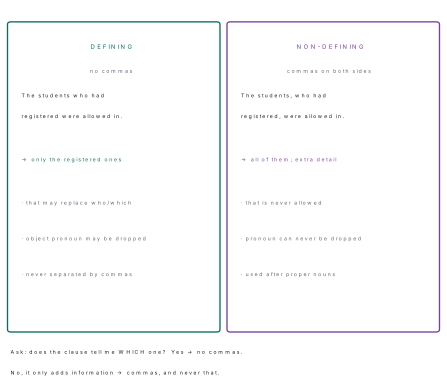
Defining clauses
A defining clause says which one is meant. Without it the sentence is incomplete in sense, so it takes no commas.
The man who lives next door is a doctor. This is the book that I told you about. The house which we bought needs repair.
In a defining clause the relative pronoun may be dropped when it is the object of its clause: This is the book (that) I told you about. The man (whom) we met was her uncle. It can never be dropped when it is the subject: ✗ The man lives next door is a doctor. → ✓ The man who lives next door…
That is preferred after superlatives and after all, any, only, everything, nothing, the first, the last: This is the best film that I have ever seen.
Non-defining clauses
A non-defining clause gives extra information about a noun that is already identified. It is enclosed in commas, and that cannot be used.
My uncle, who lives in Biratnagar, is visiting us. Mount Everest, which stands at 8,849 metres, is the world's highest peak. She passed the examination, which delighted her parents. (here which refers to the whole preceding idea)
Prepositions, and reduced clauses
A preposition may stand before whom or which (formal) or at the end of the clause (normal): the officer to whom I spoke = the officer whom I spoke to = the officer I spoke **to ✗ the officer to that I spoke — that never follows a preposition.
A relative clause can often be shortened to a participle: the boy who is standing at the gate → the boy standing at the gate the letter which was written by him → the letter written by him
✗ The boy who he came yesterday is my cousin. → ✓ The boy who came yesterday… (the pronoun is the subject; do not repeat it) ✗ This is the pen which I bought it yesterday. → ✓ …which I bought yesterday. ✗ My father, that is a teacher, retired last year. → ✓ My father, who is a teacher, … ✗ The house where I bought is small. → ✓ The house which / that I bought is small. (where is not used when the noun is the object of the verb) ✗ Kathmandu, which is the capital, … written without commas — a proper noun is already identified, so the clause must be non-defining.
Problem. Fill in the blanks: We reached _ the airport 6 o'clock _ the morning 5 June, and waited _ two hours _ our flight.
Solution — one gap at a time.
- reach takes no preposition. The gap is filled by nothing — or the sentence is rewritten with arrived at. (Examiners set this deliberately; if a blank is given, the intended verb is arrived.)
- 6 o'clock is a single point of time → at.
- the morning is a part of the day → in.
- 5 June is a date → on.
- two hours is a length of time → for.
- wait always takes for before its object.
Answer. We arrived at the airport at 6 o'clock in the morning on 5 June, and waited for two hours for our flight.
Problem. Put the verbs into the correct tense: When I (reach) the hall, the chief guest already (deliver) his speech, and the audience (clap).
Solution — order the events.
- Establish the main time. The sentence is about the past, so the when clause takes the simple past: reached.
- Find the earlier event. The speech was finished before I reached — the earlier of two past actions takes the past perfect: had already delivered.
- Find the action in progress. The clapping was going on at the moment I arrived, so it takes the past continuous: was clapping.
Answer. When I reached the hall, the chief guest had already delivered his speech, and the audience was clapping.
Problem. Join each pair with a relative pronoun. (a) This is the girl. Her painting won the prize. (b) I met a doctor yesterday. He treated my grandfather. (c) Pokhara attracts many tourists. It lies beside a lake.
Solution — decide the pronoun, then the commas.
- (a) The link is possession (her painting), so the pronoun is whose. The clause identifies which girl, so it is defining — no commas. → This is the girl whose painting won the prize.
- (b) He is the subject of the second sentence and refers to a person → who. A doctor is not yet identified, so the clause is defining. → I met a doctor yesterday who treated my grandfather. (better: The doctor whom I met yesterday treated my grandfather.)
- (c) Pokhara is a proper noun, already fully identified, so the clause can only be non-defining: commas, which, and never that. → Pokhara, which lies beside a lake, attracts many tourists.
Chapter summary
- in → the largest container, on → a surface or a named day, at → a single point, for both time and place.
- since + point, for + period; by = not later than, until = up to then; between two, among many.
- Learn adjective + preposition pairs as units: good at, married to, different from, interested in, afraid of, angry with.
- Discuss, enter, reach, marry, resemble, obey, describe, emphasise, investigate, comprise take no preposition; return back, repeat again and cope up with are all wrong.
- A past main verb pulls its subordinate clause into the past, except for universal truths.
- The present perfect never takes a finished past time; the earlier of two past events takes the past perfect; stative verbs have no continuous form.
- Defining relative clause: no commas, that allowed, object pronoun may be dropped.
- Non-defining relative clause: commas, that forbidden, pronoun never dropped — and always non-defining after a proper noun.
- That never follows a preposition; use to whom / in which, or move the preposition to the end.
- A relative clause can be reduced to a participle: the boy standing there, the letter written by him.
Practice questions
Fill in the blanks with the correct preposition, or leave it blank where none is needed (1 mark each)
- She is very good ____ solving puzzles. [1]
- My sister was married ____ an engineer last year. [1]
- We discussed ____ the matter for nearly an hour. [1]
- The meeting will begin _ ten o'clock _ Monday. [1]
- He has been living in Butwal ____ 2015. [1]
- Please reply ____ my letter as soon as possible. [1]
- The committee consists ____ seven members. [1]
- She is quite different ____ her twin sister. [1]
- They reached ____ the village before sunset. [1]
- The guests will arrive _ the hotel _ the evening. [1]
Answers
1. at — good at + noun or -ing.
2. to — married to, never with.
3. (no preposition) — discuss is transitive; discuss about is wrong.
4. at … on — a clock time takes at, a named day takes on.
5. since — 2015 is a point of time.
6. to — reply to someone or something.
7. of — consist of.
8. from — different from.
9. (no preposition) — reach the village; arrive at the village would need at.
10. at … in — arrive at a building, in the evening.
Put the verbs in brackets into the correct tense (1 mark each)
- He (work) in this office since 2019. [1]
- When we reached the theatre, the film already (start). [1]
- Look! The children (play) in the rain. [1]
- The teacher told us that the sun (rise) in the east. [1]
- I (not see) him since last Dashain. [1]
- By next June we (complete) our course. [1]
- She (know) the answer, but she refused to say it. [1]
Answers
11. has been working — since + a point of time with an action continuing to now.
12. had already started — the earlier of two past events.
13. are playing — Look! signals something happening now.
14. rises — a universal truth does not shift after a past reporting verb.
15. have not seen — present perfect with since.
16. will have completed — future perfect with by next June.
17. knew — know is stative, so was knowing is impossible.
Join or rewrite as instructed (1 mark each)
- That is the boy. His father is a pilot. — Join with a relative pronoun. [1]
- Lumbini is visited by thousands of pilgrims. It is the birthplace of the Buddha. — Join with a non-defining clause. [1]
- The pen is missing. I bought it yesterday. — Join with a defining clause. [1]
- The girl who is sitting near the window is my cousin. — Reduce the relative clause. [1]
- This is the officer. I complained to him. — Join, beginning This is the officer to … [1]
Answers
18. That is the boy whose father is a pilot. — possession takes whose.
19. Lumbini, which is the birthplace of the Buddha, is visited by thousands of pilgrims. — a proper noun requires commas and which.
20. The pen (that) I bought yesterday is missing. — the pronoun is the object, so it may be dropped.
21. The girl sitting near the window is my cousin. — who is is deleted and the -ing form remains.
22. This is the officer to whom I complained. — a preposition may precede whom but never that.
Practise more: English question bank