Unit 15 · Literature - Essays · 36 min read
Knowledge and Wisdom
What the syllabus asks for 7
- About the author
- The essay: context and argument
- The essay, paragraph by paragraph
- Ideas and themes
- Style and devices
- Glossary
- Textbook exercises
A student can know the date of every treaty in a history book and still quarrel with a classmate for a year over a borrowed pen. A scientist can understand the atom perfectly and still build something that frightens the world. Bertrand Russell's short essay asks why more knowledge has not made us wiser — and what wisdom actually is. He was one of the great thinkers of the twentieth century, and he wrote this piece in 1954, nine years after the bombs on Hiroshima and Nagasaki and in the year the United States tested a hydrogen bomb at Bikini Atoll. It is a calm, clear, argued essay, and it rewards close reading, because each paragraph adds one idea to the last.
The central idea: knowledge and wisdom are different things, and knowledge without wisdom is dangerous. The factors of wisdom Russell names in turn: a sense of proportion, awareness of the ends of human life, freedom from personal prejudice, and — the essence — emancipation from the tyranny of the here and now. The examples: the medical researcher and the atom; Hegel; the seekers of the philosopher's stone; Mr A and Mr B; the Samaritan. The teaching of wisdom: it can be taught, by widening the intellectual element of moral instruction. The three leaders: Queen Elizabeth I, Henry IV of France and Abraham Lincoln. Many short questions ask you to differentiate the two terms; learn the textbook's simple definition as well as Russell's own.
15.1 About the author
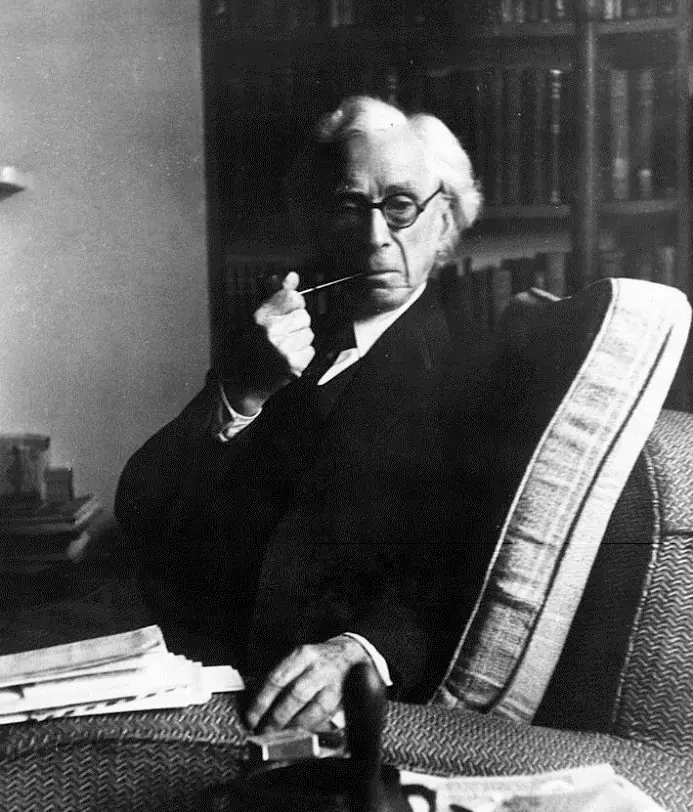
Bertrand Arthur William Russell was born on 18 May 1872 in Wales, into one of the great political families of Britain: his grandfather, Lord John Russell, had been prime minister. He was orphaned at the age of four and brought up mainly by his grandmother. He won a scholarship to Trinity College, Cambridge, where he studied mathematics and graduated in 1893. He went on to become one of the founders of analytic philosophy. With Alfred North Whitehead he wrote Principia Mathematica (1910–13), an attempt to show that mathematics could be built on pure logic — the view called logicism in your textbook's note. He also wrote The Problems of Philosophy (1912) and A History of Western Philosophy (1945), which made philosophy readable for millions.
Russell was also a public figure who acted on what he believed. He was a pacifist and went to prison in 1918 for an article against the First World War. Between the wars he wrote on education, marriage and religion; after 1945 he became one of the leading campaigners against nuclear weapons, and in 1955 he and Albert Einstein issued the Russell–Einstein Manifesto, warning that nuclear war threatened the human race. In 1950 he received the Nobel Prize in Literature "in recognition of his varied and significant writings in which he champions humanitarian ideals and freedom of thought". He died in Wales on 2 February 1970, aged 97.
Russell loved clear prose and hated pretentiousness. "Knowledge and Wisdom" has almost no technical words; every idea is tied to a concrete example that any reader can picture. The mathematician in him shows in the order of the argument: define the problem (what is wisdom and how can it be taught?), list the factors one by one, test them on cases, then draw the conclusion.
15.2 The essay: context and argument
"Knowledge and Wisdom" is an argumentative (reflective) essay. The writer states a problem, answers it with reasons and examples, anticipates an objection and ends with a call to action. It was written in 1954. The date matters: in his own words the power of the atom was "in everybody's mind at the present time". Nuclear weapons were the perfect example of knowledge running ahead of wisdom.

Your textbook's headnote gives a short, simplified version of the idea: knowledge is "the acquisition of data and information", wisdom is "the practical application and use of the knowledge to create value", gained "through learning and practical experience, not just memorization". This is a modern summary, not Russell's wording. Board answers usually quote it, so learn it — but in the essay Russell's own account is richer, and it is what you should use in long answers:
| Knowledge | Wisdom (Russell's sense) | |
|---|---|---|
| What it is | information and skill; what a specialist knows | a comprehensive view of life: proportion, awareness of ends, freedom from prejudice and from self-centredness |
| Where it lives | in the mind | in mind and feeling ("knowledge … wide but … feelings narrow" is not wisdom) |
| Its risk | can be misused; "may become harmful" | guards against harm |
| Teaching | taught by instruction | taught by widening the intellectual element in moral instruction |
| Growth | always increasing | grows with the approach to impartiality |
The essay moves in three stages. First, it states the problem and defines wisdom through its factors (paragraphs 1–5). Second, it asks whether wisdom can be taught and answers yes (paragraphs 6–8). Third, it says how, and why the need is urgent (paragraph 9).
15.3 The essay, paragraph by paragraph
Paragraph 1 — the problem
Most people, Russell says, would agree that "our age far surpasses all previous ages in knowledge" but has had "no correlative increase in wisdom". Correlative means "corresponding": wisdom has not grown in step with knowledge. Agreement stops, however, as soon as anyone tries to define wisdom or to discuss how to promote it. So his plan is two questions: what is wisdom? and what can be done to teach it?
Paragraph 2 — the first factor: a sense of proportion
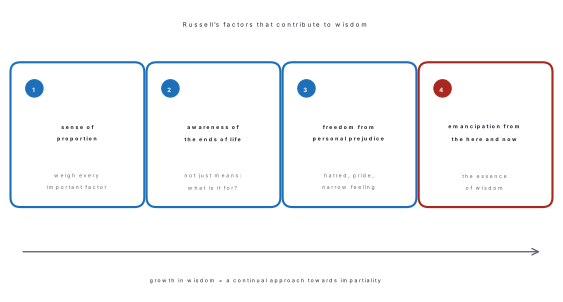
Of the factors that contribute to wisdom, Russell puts first a sense of proportion: "the capacity to take account of all the important factors in a problem and to attach to each its due weight". This has become harder because modern life needs specialists. Suppose you are a medical researcher; the work takes all your energy and you have no time to think about its effects outside medicine. You succeed — as modern medicine has — in greatly lowering the infant death-rate, in Europe, America, Asia and Africa. The unintended result is that the food supply becomes inadequate and the standard of living falls in the most populous parts of the world. A still more striking example, "in everybody's mind at the present time": you study the composition of the atom out of a disinterested desire for knowledge and thereby put into the hands of "powerful lunatics the means of destroying the human race". His conclusion: "the pursuit of knowledge may become harmful unless it is combined with wisdom; and wisdom in the sense of comprehensive vision is not necessarily present in specialists".
The infant death-rate example is not a complaint that saving babies is bad. It is a reminder that every discovery has effects beyond the field of the discoverer, and that someone must look at the whole picture. The fault is narrow vision, not medicine or physics.
Paragraph 3 — the second factor: awareness of the ends of human life
"Comprehensiveness alone, however, is not enough." There must also be "a certain awareness of the ends of human life" — a sense of what life is for. He illustrates with history. Many eminent historians "have done more harm than good because they viewed facts through the distorting medium of their own passions". Hegel, the German philosopher, had a philosophy of history that was certainly comprehensive — it began with the earliest times and stretched into an indefinite future — but its chief lesson was that from the year 400 AD to Hegel's own time Germany had been the most important nation and the standard-bearer of progress. A comprehensive mind had been bent by national pride. Russell therefore stretches the definition: wisdom includes not only intellect but feeling. "It is by no means uncommon to find men whose knowledge is wide but whose feelings are narrow. Such men lack what I call wisdom."
Paragraph 4 — wisdom in private life
Wisdom is needed "not only in public ways, but in private life equally": "in the choice of ends to be pursued and in emancipation from personal prejudice". Even a noble end may be pursued unwisely if it is impossible. Many men in past ages devoted their lives to the search for the philosopher's stone (which alchemists believed could turn base metals into gold) and the elixir of life (a potion to give endless life). If they had found them they would have benefited mankind, but "their lives were wasted".
He then takes a humbler case: Mr A and Mr B, who hate each other and, through that mutual hatred, bring each other to destruction. Ask Mr A why he hates Mr B and you get "an appalling list" of B's vices, part true and part false. Ask Mr B and you get "an exactly similar list" about A. Tell each that the other says the same about him, and at first their hatred grows, because each is horrified by the other's injustice. But with patience and persuasiveness you may convince each that the other has "only the normal share of human wickedness" and that their enmity harms both. "If you can do this, you will have instilled some fragment of wisdom."
Paragraph 5 — the essence: emancipation from the tyranny of the here and now
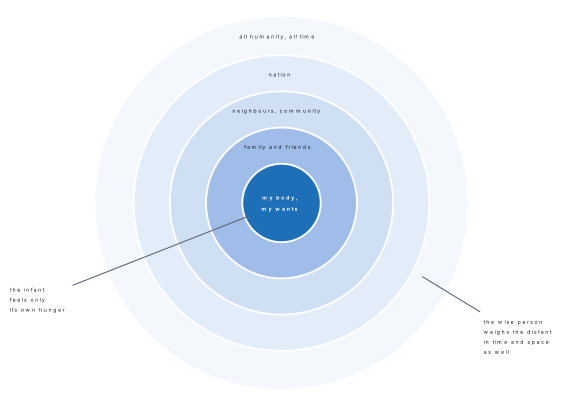
"I think the essence of wisdom is emancipation, as far as possible, from the tyranny of the here and now." We cannot help the "egoism of our senses": sight, sound and touch are bound up with our own bodies, and our emotions start from ourselves. A baby feels only its own hunger or discomfort. With the years a person's horizon widens, and as thoughts and feelings become less personal and less concerned with one's own physical states, one "achieves growing wisdom". This is a matter of degree: no one can view the world with complete impartiality (and if anyone could, says Russell, he would hardly remain alive). But one can make "a continual approach towards impartiality", both by knowing things somewhat remote in time or space, and by giving such things their due weight in our feelings. "It is this approach towards impartiality that constitutes growth in wisdom."
Paragraph 6 — can wisdom be taught?
"Can wisdom in this sense be taught? And, if it can, should the teaching of it be one of the aims of education?" Russell answers yes to both. He reminds the reader that "we are told on Sundays that we should love our neighbours as ourselves. On the other six days of the week, we are exhorted to hate." The parable of the Good Samaritan made a foreigner the neighbour; we no longer hate Samaritans, so we miss the point. "If you want to get its point, you should substitute Communist or anti-Communist, as the case may be, for Samaritan." (In 1954, at the height of the Cold War, hatred between the two camps was the most dangerous hatred of all.) The irony is sharp: people who profess love on Sunday practise hatred on Monday.
Paragraph 7 — "Hatred of evil is itself a kind of bondage to evil"
"It might be objected that it is right to hate those who do harm. I do not think so." If you hate them, you will probably become as harmful as they are, and you are unlikely to persuade them to give up their evil ways. "Hatred of evil is itself a kind of bondage to evil. The way out is through understanding, not through hate." Russell adds a precaution: "I am not advocating non-resistance." Resistance is right, but it should combine "the greatest degree of understanding and the smallest degree of force that is compatible with the survival of the good things that we wish to preserve".
Paragraph 8 — is wisdom weak?
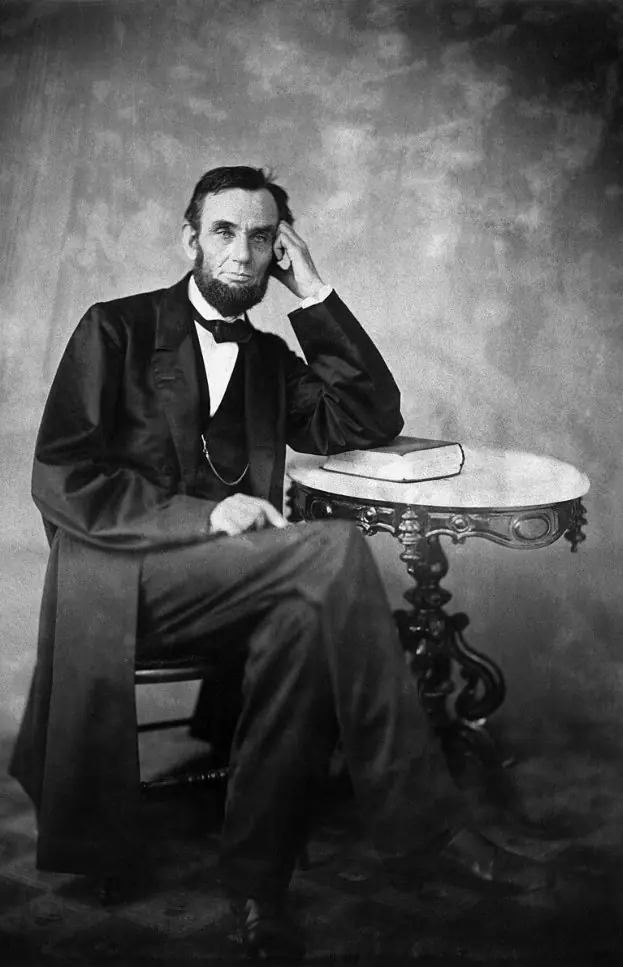
It is often said that such a view is "incompatible with vigour in action". Russell denies that history supports this. Queen Elizabeth I of England and Henry IV of France lived in a world where almost everybody was fanatical on the Protestant or the Catholic side; both "remained free from the errors of their time" and, by remaining free, "were beneficent and certainly not ineffective". Abraham Lincoln "conducted a great war without ever departing from what I have called wisdom".
Paragraph 9 — teaching wisdom, and why the world needs it
"I have said that in some degree wisdom can be taught." The teaching, says Russell, "should have a larger intellectual element than has been customary in what has been thought of as moral instruction". The "disastrous results of hatred and narrow-mindedness to those who feel them can be pointed out incidentally in the course of giving knowledge". He does not think that knowledge and morals ought to be "too much separated". Specialised skills have little to do with wisdom, but they should be "supplemented in education by wider surveys calculated to put it in its place in the total of human activities". "Even the best technicians should also be good citizens; and when I say 'citizens', I mean citizens of the world and not of this or that sect or nation."
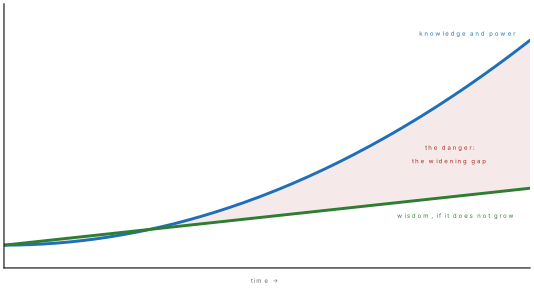
The final argument is the one the examiner loves: "With every increase of knowledge and skill, wisdom becomes more necessary, for every such increase augments our capacity of realizing our purposes, and therefore augments our capacity for evil, if our purposes are unwise. The world needs wisdom as it has never needed it before; and if knowledge continues to increase, the world will need wisdom in the future even more than it does now."
Factors of wisdom; technicians → ¶2–5. Hegel → ¶3. Private life; Mr A and Mr B → ¶4. Essence of wisdom → ¶5. Can wisdom be taught; the Samaritan → ¶6. Why not hate? → ¶7. Elizabeth, Henry IV, Lincoln → ¶8. Aim of education; citizens of the world; why the world needs wisdom in the future → ¶9.
15.4 Ideas and themes
1. Knowledge alone is dangerous. The two examples — the medical researcher and the atomic scientist — show that discoveries have effects the discoverer never intended. Wisdom is what notices those effects in advance. Russell does not ask us to know less; he asks us to see more.
2. Wisdom is a wide view, of mind and of feeling. It is not cleverness. The historian Hegel was clever but his love of his own nation bent his history. Russell adds feeling to intellect: a person whose knowledge is wide but whose sympathies are narrow is not wise.
3. Hatred is unwise — and self-destroying. Mr A and Mr B ruin each other by hatred; the seeker of the philosopher's stone wastes his life on an impossible end. Russell's conclusion, "Hatred of evil is itself a kind of bondage to evil", is the moral heart of the essay. Understanding replaces hatred; it does not replace resistance.
4. The tyranny of the here and now. We begin life locked inside our own bodies and moment. Wisdom is a lifelong movement outwards — to other people, other places, other times. This is why history, geography, foreign cultures and imagination matter: they put the here and now in its place.
5. Education must teach wisdom. Skills are necessary, but a technician who is not also a good citizen of the world is a danger. Education should teach facts and show their effects; moral teaching should be intellectual, not just sermons.
6. Urgency. Every increase of knowledge increases our power to realise our purposes — good or bad. The more powerful we become, the more we need wisdom. The ending points forward: "the world will need wisdom in the future even more than it does now".
Proportion (weigh all factors) · Aims of life (awareness of the ends) · Prejudice (freedom from it) · Here-and-now (emancipation from its tyranny).
15.5 Style and devices
Argument, not story. The essay states a problem in the first paragraph, gives reasons, tests them on examples, raises an objection (¶7) and answers it (¶8) before concluding (¶9). This "thesis – support – objection – reply – conclusion" shape is the classic form of an argumentative essay.
Examples from everyday and world life. The medical researcher, the atom, Hegel, the alchemists, Mr A and Mr B, the Samaritan, Elizabeth I, Henry IV and Lincoln move from public to private life and from ancient to modern times. Each example is chosen to show one idea clearly.
Hypothetical dialogue. "Suppose you go to Mr A and say, 'Why do you hate Mr B?'" Russell turns an abstract point about prejudice into a little play that the reader can follow and imagine doing.
Antithesis and parallelism. "Knowledge … wide but … feelings … narrow." "The greatest degree of understanding and the smallest degree of force." "On Sundays … On the other six days." The balanced sentences make ideas memorable.
Aphorism. "Hatred of evil is itself a kind of bondage to evil." "The essence of wisdom is emancipation … from the tyranny of the here and now." Short, quotable sentences that sum up a paragraph — often the lines examiners pick for "reference to the context".
Irony. The contrast between Sunday love and weekday hatred is ironic: people praise a teaching they do not practise.
Metaphor and personification. "Tyranny" (of the here and now), "bondage" (to evil) and "distorting medium" (of passion) use political and physical images for mental states; "egoism of our senses" treats the senses as selfish.
Allusion. The Good Samaritan (the Bible), the philosopher's stone and elixir of life (alchemy), Hegel, Elizabeth I, Henry IV, Lincoln. The reader is assumed to be educated, which itself suits the subject.
Tone. Calm, reasonable, sometimes humorous ("they would hardly be able to remain alive") and humane. The last sentences rise to a serious warning.
15.6 Glossary
| Word | Meaning |
|---|---|
| surpasses | goes beyond; is greater than |
| correlative | corresponding; going along with |
| proportion | the right relation of parts to each other and to the whole |
| absorb | (here) to take up completely; to occupy fully |
| disinterested | not influenced by personal gain; impartial (not the same as uninterested) |
| comprehensive | including all the important aspects |
| distorting | twisting out of true shape |
| inculcate | to fix an idea firmly in the mind by repeating it; to instil |
| standard-bearer | a leader who carries the banner of a cause |
| emancipation | release from restriction or control |
| philosopher's stone | an imaginary substance that alchemists thought could turn base metals into gold |
| elixir of life | an imaginary drink that would give eternal life |
| appalling | shocking and terrible |
| admixture | something mixed in |
| enmity | deep hatred between people |
| instilled | put gradually into someone's mind |
| tyranny | cruel or absolute control |
| egoism | concern only with oneself |
| impartiality | fairness; not taking sides |
| exhorted | urged strongly |
| precept | a rule of conduct |
| exemplified | illustrated by an example |
| fanatical | too enthusiastic about a cause, to an extreme and unreasoning degree |
| beneficent | doing good; kind |
| augments | increases |
| bound up | closely tied to something (the textbook's gloss, "to limit", is not the meaning here) |
In the printed passage "as fat as possible" should read "as far as possible", and "the extent and complexity for the specialized knowledge" should read "…of the specialized knowledge". They are typing errors; do not copy them in your answers.
15.7 Textbook exercises
Before you read
a. What are the differences between a learned man and a wise man?
A learned person has acquired a great deal of information, often through long study; a wise person knows how to use experience and understanding to judge well and act rightly. A learned man can tell you what is known; a wise man can tell you what to do and what matters. A learned man may be proud and narrow; a wise man is usually humble, patient and fair. Knowledge can be gained by reading; wisdom needs reflection and life.
b. Why do you think some knowledgeable people are not wise?
Because knowledge can be collected without any change of character. Some people specialise so narrowly that they never see the wider effects of what they do; some use their learning for pride or profit; some are ruled by prejudice, anger or self-interest that no amount of information removes. Russell's own example is Hegel: wide knowledge, but distorted by national pride.
Understanding the text
a. What are the factors that contribute to wisdom?
Russell names several. First and foremost, a sense of proportion — the ability to take account of all the important factors in a problem and give each its due weight. Second, an awareness of the ends of human life — knowing what life is for, rather than seeing facts through one's own passions. Third, feeling as well as intellect — a wide heart as well as a wide mind. Fourth, freedom from personal prejudice in the choice of ends. Fifth, and essentially, emancipation from the tyranny of the here and now — a growing impartiality reached by knowing things remote in time and space and giving them their due weight in our feelings.
b. What message does the writer try to convey with the example of technicians?
That specialist knowledge, without a wide view, can cause harm. The medical researcher who lowers the infant death-rate unintentionally causes a shortage of food in crowded countries; the scientist who studies the atom for pure knowledge puts the means of destroying humanity into dangerous hands. Technicians are so absorbed in their own field that they do not consider the wider results, so knowledge must be combined with wisdom, which is comprehensive vision.
c. Which leaders does Russell say were able to mix knowledge and wisdom soundly?
Queen Elizabeth I of England, Henry IV of France and Abraham Lincoln. Elizabeth and Henry lived among fanatics on both the Protestant and Catholic sides, yet remained free from the errors of their time and were kind and effective. Lincoln led a great war "without ever departing from what I have called wisdom".
d. Why is wisdom needed not only in public ways, but in private life equally?
Because in private life, too, we must choose our aims and free ourselves from personal prejudice. A noble aim pursued unwisely (the search for the philosopher's stone) wastes a life; and private hatred, as in the case of Mr A and Mr B, destroys both people. Wisdom helps us see the other side, to see hatred for what it is and to live at peace.
e. What, according to Russell, is the true aim of education?
The passage does not use the words "true aim", but it makes Russell's view clear: education should teach wisdom along with knowledge and skill. Specialised training is not enough; it should be supplemented by "wider surveys" that put it "in its place in the total of human activities", so that even the best technicians become good citizens of the world, not of "this or that sect or nation". Its aim is thus to produce wise, humane people, not only skilled ones.
f. Can wisdom be taught? If so, how?
Yes, "in some degree". Russell says its teaching should have a larger intellectual element than traditional moral instruction: rather than preaching, teachers should, in the course of giving knowledge, point out the disastrous results of hatred and narrow-mindedness to those who feel them. Knowledge and morals should not be kept apart. Wisdom can also be taught by examples like the parable of the Samaritan applied to modern enemies.
g. Why does the world need more wisdom in the future?
Because "with every increase of knowledge and skill, wisdom becomes more necessary": more knowledge increases our power to achieve our purposes, and therefore our power to do evil if our purposes are unwise. Nuclear weapons show the danger. If knowledge keeps growing, the world "will need wisdom in the future even more than it does now".
Reference to the context
a. According to Russell, "The pursuit of knowledge may become harmful unless it is combined with wisdom." Justify this statement.
Russell justifies it with two examples in the second paragraph. A researcher in scientific medicine, absorbed in his own field, greatly lowers the infant death-rate throughout the world; but the unintended result is a food supply that is inadequate and a lower standard of life in the most populous regions. Still more seriously, the scientist who studies the composition of the atom out of pure curiosity unintentionally places in the hands of "powerful lunatics the means of destroying the human race". In both cases knowledge was good but was not joined to the wide view — the sense of proportion and awareness of consequences — that is wisdom. He adds the example of Hegel, whose great learning produced a false philosophy of history because his feelings were narrow. The statement is therefore true: without wisdom, knowledge can harm, and the more knowledge we gain, the more wisdom we need.
b. What, according to Russell, is the essence of wisdom? And how can one acquire the very essence?
"I think the essence of wisdom is emancipation, as far as possible, from the tyranny of the here and now." We are born with the "egoism of our senses" and feelings: a baby cares only for its own hunger or discomfort. As we grow, our horizon widens and our thoughts and feelings become less personal; in proportion, we become wiser. Complete impartiality is impossible, but we can move towards it "by knowing things somewhat remote in time or space" and "by giving to such things their due weight in our feelings". In practice, one acquires it by learning history and about other places and cultures, by understanding the other side's case (as Mr A and Mr B need to), by refusing hatred and by treating all humanity as one's neighbours. This "continual approach towards impartiality", says Russell, "constitutes growth in wisdom".
Reference beyond the text
a. Why is wisdom necessary in education? Discuss.
Education gives knowledge and skill, which are power, and power without wisdom is dangerous. A student who learns chemistry without learning responsibility may harm others; a student who learns facts without learning to weigh them is easily misled by prejudice and propaganda. Wisdom teaches what to do with what we learn: to see the whole picture, to respect other people and to take care of consequences. It also makes learning humane: education that aims only at marks and jobs produces clever but narrow people. In the words of Russell, the best technicians should also be good citizens of the world. In Nepal, where education is sought for employment abroad as well as at home, wisdom reminds us to use our skill for the community. Education is complete only when it develops both the head and the heart.
b. How can you become wise? Do you think what you are doing in college contributes to wisdom?
A personal answer is expected. Model: I can become wise by reading widely, especially history and literature, which show me other times and places; by listening to people who disagree with me; by learning from mistakes and thinking about their causes; by serving others; and by practising patience instead of anger. In college I learn science and language, which are knowledge. They contribute to wisdom only partly — when a teacher relates a lesson to life, when group work teaches me to respect others, and when essays like this one make me question my own habits. To contribute more, college should give more time to discussion, to service and to asking what is this knowledge for?
Chapter summary
- Bertrand Russell (1872–1970), British philosopher, logician and social critic, Nobel Prize for Literature 1950, wrote "Knowledge and Wisdom" in 1954.
- Central idea: our age far surpasses earlier ages in knowledge without a matching increase in wisdom; knowledge may become harmful unless combined with wisdom.
- Textbook headnote: knowledge = acquiring data and information; wisdom = practical application of knowledge to create value. Russell's own account: wisdom is comprehensive vision.
- Factors of wisdom: sense of proportion (medicine and atom examples); awareness of the ends of human life (Hegel); feeling as well as intellect; freedom from personal prejudice (philosopher's stone; Mr A and Mr B).
- Essence of wisdom: emancipation from "the tyranny of the here and now" — moving towards impartiality by knowing the remote in time and space.
- Wisdom can be taught, by a larger intellectual element in moral instruction; hatred of evil is itself "a kind of bondage to evil"; understanding, not force. Elizabeth I, Henry IV and Lincoln show that wisdom is not weakness.
- Education should produce good citizens of the world; "with every increase of knowledge and skill, wisdom becomes more necessary".
- Style: argument and example, hypothetical dialogue, antithesis, aphorism, irony, allusion, calm tone.
Practice questions
Short answer questions (2 marks each)
- What is the difference between knowledge and wisdom, according to Russell? (NEB 2079, Set B; NEB 2080, Set C) [2]
- Why does the world need more wisdom than knowledge in the future? (NEB 2081, Set C) [2]
- Do you agree with the author that wisdom is more important than knowledge? Why, or why not? (NEB 2080, Set D) [2]
- What is the central idea of the essay "Knowledge and Wisdom"? (Model) [2]
- How can wisdom be taught? Give examples. (Model) [2]
- Why does Russell say that Hegel lacked wisdom? [2]
- What point does Russell make through Mr A and Mr B? [2]
- What does Russell mean by "the tyranny of the here and now"? [2]
- Why does Russell refuse to say that it is right to hate those who do harm? [2]
Model answers — short questions
1. According to the textbook's summary, knowledge is the acquisition of data and information, while wisdom is the practical application of that knowledge to create value. In Russell's own account, knowledge is what a specialist knows; wisdom is a comprehensive vision — a sense of proportion, awareness of the ends of life, freedom from prejudice and from the "tyranny of the here and now". Knowledge can be harmful without wisdom.
2. Because "with every increase of knowledge and skill, wisdom becomes more necessary". More knowledge gives people greater power to achieve their purposes, and so greater power for evil if their purposes are unwise. Since knowledge will go on increasing, the world will need wisdom even more in the future than now.
3. Yes, I agree. Knowledge tells us what we can do; wisdom tells us what we should do. Without wisdom, knowledge can be harmful, as nuclear weapons and misused medicine show. A person with wisdom can continue to learn and will use what he knows for good, but a person with knowledge alone may harm others.
4. The central idea is that knowledge and wisdom are different, that our age has gained enormously in knowledge without a corresponding increase in wisdom, and that knowledge may become harmful unless it is combined with wisdom, which can and should be taught.
5. Russell says it can be taught "in some degree", by giving moral teaching a larger intellectual element: in the course of teaching facts, teachers can point out the disastrous results of hatred and narrow-mindedness. For example, when teaching atomic physics they can show how the atom has been used for destruction; by applying the Samaritan parable to today's enemies, teachers can show that hatred harms the hater.
6. Hegel's philosophy of history was comprehensive in time, but its chief lesson was that from 400 AD Germany had been the most important nation and the standard-bearer of progress. His national pride distorted the facts, so he lacked the awareness of the ends of human life and the freedom from prejudice that wisdom needs.
7. Two men who hate each other and are ruined by their hatred each give an equally one-sided list of the other's vices, partly true and partly false. By showing each that the other says the same, a wise person can make both see that the other has "only the normal share of human wickedness" and that their enmity harms both. That is a "fragment of wisdom": seeing a quarrel from outside oneself.
8. It means the natural self-centredness of our senses and feelings, which tie us to our own bodies, needs and moment. An infant knows only its own hunger. Wisdom is freedom from this as far as possible, by understanding and caring about things remote in time and space.
9. Because hatred makes the hater as harmful as the enemy and is unlikely to persuade anyone to give up evil ways. "Hatred of evil is itself a kind of bondage to evil." The way out is understanding, though he does not advocate non-resistance: resistance should use the smallest force compatible with preserving what is good.
Long answer questions (5 marks each)
- Discuss Russell's view of wisdom and the factors that contribute to it. (Model) [5]
- "The pursuit of knowledge may become harmful unless it is combined with wisdom." Discuss with reference to the essay. [5]
- Can wisdom be taught? Explain Russell's views on wisdom, hatred and education. (Model) [5]
- Why, according to Russell, is wisdom more necessary today than ever before? Do you agree? [5]
Model answers — long questions
1. Russell begins from the fact that our age far surpasses earlier ages in knowledge, without a corresponding increase in wisdom. He defines wisdom through its factors. The first is a sense of proportion, the capacity to take account of all the important factors in a problem and give each its due weight; specialists often lack this, as the medical researcher and the atomic physicist show. The second is awareness of the ends of human life: Hegel's comprehensive history failed because national pride bent it. The third is feeling as well as intellect, since people with wide knowledge but narrow feelings are not wise. The fourth is freedom from personal prejudice, in private life as well as public, as the stories of the alchemists and of Mr A and Mr B show. The essence of all these is emancipation from the tyranny of the here and now — a continual approach towards impartiality, by knowing things remote in time and space and giving them their due weight in our feelings. For Russell, wisdom is therefore a comprehensive vision of mind and heart, and a rare one.
2. Russell proves the statement with examples. A medical researcher lowers the infant death-rate; but because no one weighs the wider results, the food supply becomes inadequate and living standards fall in crowded regions. A physicist studies the atom from pure curiosity, and the result is that "powerful lunatics" can destroy the human race. In each case knowledge itself is good, but without comprehensive vision it leads to harm. The same is true in history: Hegel knew a great deal, but national pride produced a false lesson. And in the final paragraph Russell explains why this will get worse: each increase of knowledge and skill increases our capacity to realise our purposes, "and therefore augments our capacity for evil, if our purposes are unwise". The statement is therefore true: the answer is not less knowledge but more wisdom, taught alongside it.
3. Russell answers yes, "in some degree". The need is great, because people are taught on Sundays to love their neighbours and on other days to hate them; the Good Samaritan's lesson would be understood today only if we put "Communist or anti-Communist" in his place. He holds that hatred of evil is "a kind of bondage to evil": hate makes us as harmful as those we hate and rarely persuades them; the way out is understanding, combined with resistance using the smallest force necessary. Examples from history (Elizabeth I, Henry IV, Lincoln) show that such wisdom is not weakness. In education, moral instruction should have a larger intellectual element: while teaching knowledge, teachers should show the disastrous results of hatred and narrow-mindedness; skills should be put in the context of human life by wider surveys; and technicians should be good citizens of the world. Knowledge and morals should not be separated.
4. According to Russell, wisdom is more necessary than ever because the power of knowledge has grown enormously. "With every increase of knowledge and skill, wisdom becomes more necessary", since greater power to realise our purposes is also greater power to do evil if the purposes are unwise. Nuclear weapons, unknown to earlier ages, show what this means: for the first time humans can destroy themselves. Modern specialisation also narrows the vision of experts, who therefore cannot see the wider effects of their work. And if knowledge continues to grow, "the world will need wisdom in the future even more than it does now". I agree. Modern examples such as climate change and the misuse of the internet show that cleverness without responsibility is dangerous, and that schools and colleges should teach the question "What is this knowledge for?" as well as the answer.
Good lines to practise: "Hatred of evil is itself a kind of bondage to evil." "I think the essence of wisdom is emancipation, as far as possible, from the tyranny of the here and now." "With every increase of knowledge and skill, wisdom becomes more necessary." For each, say where it occurs, what comes before, what it means and what it adds to the essay. For the first, for instance: it follows Russell's rejection of the idea that one should hate those who do harm, and it prepares his statement that the way out is understanding.
Practise more: English question bank