Unit 20 · Literature - One Act Plays · 39 min read
The Bull
What the syllabus asks for 9
- About the author
- Background: the king, the court and the word "chakari"
- The play, part by part
- Characters
- Themes
- Dramatic techniques
- Critical appreciation
- Glossary
- Textbook exercises
Bhimnidhi Tiwari's "The Bull" is the only play in your book written by a Nepali, about Nepal, and it is one of the funniest. Its hero is a dead animal, a royal bull called Male. The bull's death does not trouble the people who loved it; it terrifies the people who looked after it, because the king of Nepal, Ranabahadur Shah, is known to be fond of the bull and quick to punish. The play follows a bull-doctor and two cowherds through one day as they try to save their own lives by pretending the bull is still alive. Behind the comedy is a hard question: what kind of society values an animal above the people who serve it?
"The Bull" is a satire on the feudal system of late-eighteenth-century Nepal. A king's pet is treated as more valuable than human beings; subjects live in fear, cringe before power and practise chakari (flattery and pleading in order to win favour). The humour comes from the gap between what people say and what they feel: the cowherds howl with grief for a bull they resent, and the doctor pretends to nurse a corpse. Every exam answer about this play should mention satire, feudalism, dehumanisation, fear and chakari.
20.1 About the author
Bhimnidhi Tiwari (1911-1973; BS 1968-2030) was one of the leading Nepali poets, dramatists and social reformers of the twentieth century. He was born at the end of Falgun, BS 1968, at Dillibazar in Kathmandu, to Lalnidhi and Nandakumari Tiwari. He lost his mother at the age of seven, an experience he later described in his moving poem "Dagbatti" ("The Funeral Fire"), in which the boy's head is shaved and he watches the fire take his mother's body.
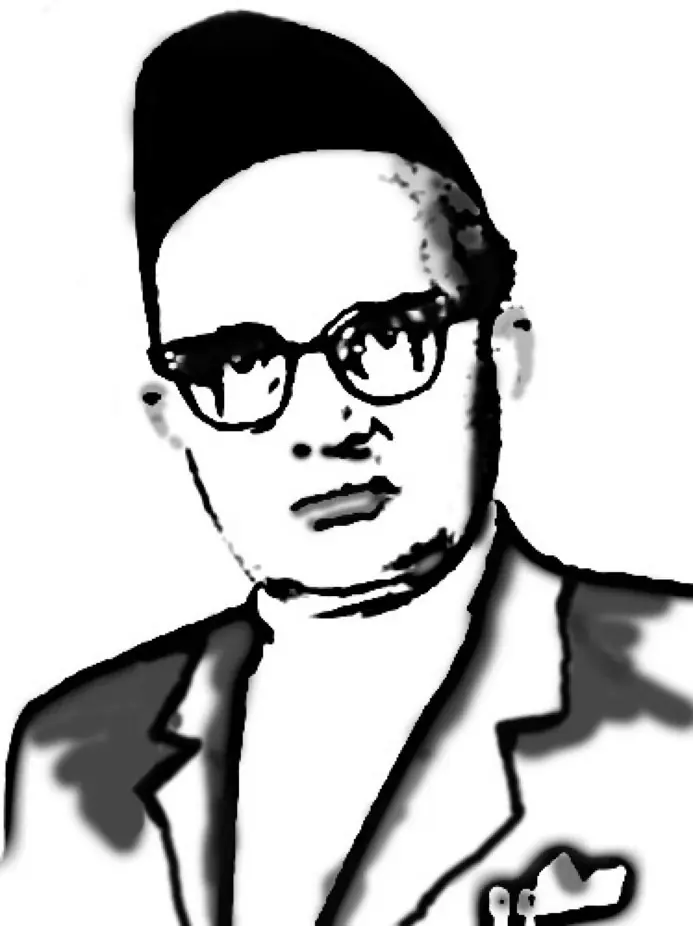
Tiwari was a reformer in action as well as in writing. Under the Rana regime he opened a school of his own; in BS 1995 he founded the Nepali Sahitya Press; and around BS 2006 (1949) he founded the Nepal Natak Sangh (Nepal Drama Society), which staged Nepali plays and encouraged writers to write for the theatre. He studied up to the I.A. level and served the government for thirty-two years, retiring as a deputy secretary. He wrote against smoking, drinking and gambling, and he published more than thirty-eight works.
| Kind | Works |
|---|---|
| Poetry | Kavitananda (BS 2010), Bisphot (BS 2017), Kavita Kunja (BS 2020), Singhadarbar (BS 2025) |
| Elegies | Tarpan (BS 1994), Yashasvi Shava (BS 2013) |
| Didactic verse | Barshiksha (BS 2012) |
| Novel | Insaf |
| Plays | Matoko Maya, Shilanyas, Sahanshila Sushila, Indradhanush, Chautara Laxminarayan, and "The Bull" |
| Essays and jokes | Pandhra Prabandha, Battisputali |
He received the Madan Puraskar for his verse collection Bisphot ("Explosion"), a work about social injustice and social disintegration, and several honours for service to literature.
Some study guides print that Tiwari won the Madan Puraskar in 1970. The Madan Puraskar Guthi's own record lists his prize as the Madan Puraskar of BS 2017 (about 1960 CE) for Bisphot. If you must give a date, write "BS 2017", or avoid giving a year.
Bhimnidhi Tiwari (1911-1973) was a Nepali poet, story-writer and dramatist and a social reformer who founded the Nepal Natak Sangh to promote Nepali plays; he won the Madan Puraskar for his poetry.
20.2 Background: the king, the court and the word "chakari"
The time and the king
The play is set in Ashwin, BS 1854 (autumn 1797 CE), in Kathmandu. The king is Ranabahadur Shah, grandson of Prithvi Narayan Shah, the founder of modern Nepal. He had come to the throne as an infant in 1777 under the regency of his mother and then his uncle; he took power himself as a young man, and in the play he is a king of twenty-three. He gave up the throne in 1799 in favour of his infant son and was murdered by his half-brother in 1806. The real king had a reputation for sudden rages and eccentric passions; the play dramatises one such passion, for bulls.
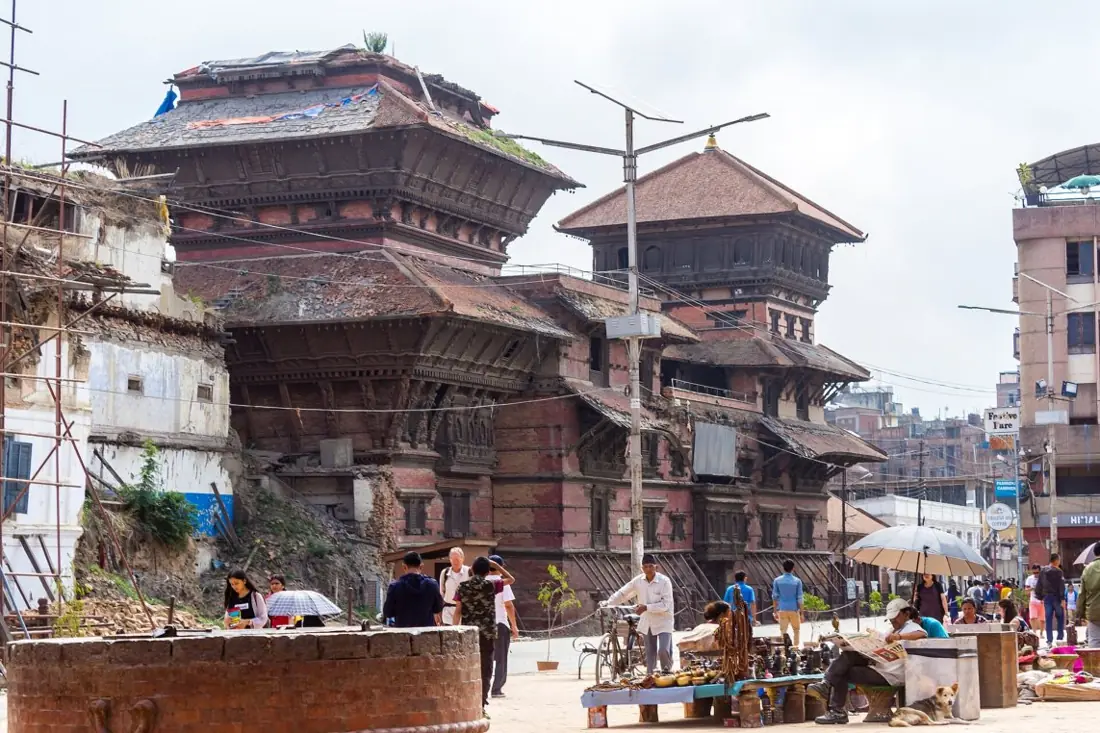
The places of the play
| Place | What happens there |
|---|---|
| Laxminarayan's house (early morning) | the cowherds bring the news; Laxminarayan makes his plan |
| The Basantapur palace | Laxminarayan tells the king the bull is ill; the king decides to visit |
| Thulo Gauchar (the royal cow-pasture and cowshed) | the king arrives, sees the bull and declares it dead |
Thulo Gauchar was the royal pasture for cattle on the open ground east of the city, where Kathmandu's airport stands today.
The chakari system
Chakari is the practice of serving, flattering and showing loyalty to a person of rank in the hope of favour, promotion or protection; it also means appealing to a great man by showing your poverty or distress. In the old court, appointments depended on the ruler's whim, so people who wanted to survive had to cultivate patrons and please them. In the play everyone practises it: Laxminarayan with the king, the cowherds with Laxminarayan and the king, and even the wives with their husband (though with less success).
What is satire?
Satire uses humour, irony, exaggeration and ridicule to expose the faults of people or institutions, especially in the hope of correcting them. The play's target is the feudal system: a social order in which a king and nobles hold all the power and land, and common people owe them service and obedience. (Compare the poem in the textbook's own exercise: "But satire, ever moral, ever new / Delights the reader and instructs him, too.")
A social and political system in which power belongs to a king and a class of lords, who own the land and receive service and loyalty from the common people. Ordinary people have few rights and depend on the favour of their superiors.
20.3 The play, part by part
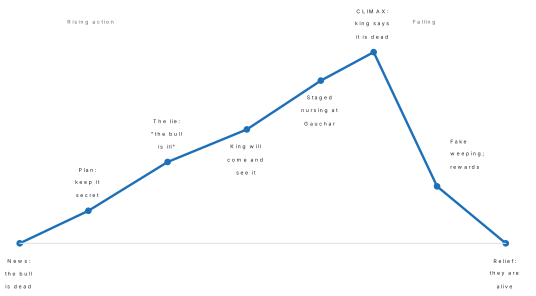
"The Bull" is a one-act play; its action runs without a break through three places and one day. Teachers divide it into three parts.
| Part | Place | What happens |
|---|---|---|
| 1. The news | Laxminarayan's yard at dawn | Laxminarayan, bull-doctor and court official, is angry that his wives have not brought his hookah. The cowherds Jitman and Gore run in to say that the king's bull, Male, has died. The three are terrified: the king has threatened to punish anyone who lets the bull die. The cowherds say it died because it was fed fine rice and lentil soup instead of grass. They resent how well the bull was treated: it had a mattress, quilt and mosquito net, while they sleep on straw in winter. Laxminarayan tells them to keep quiet and sets off for the palace |
| 2. The lie | The Basantapur palace | Laxminarayan bows low to the king and says the bull is ill: it will not get up, eat, move or speak, and its eyes are fixed and still. He praises the bull's beauty and courage and suggests that a change of climate in the hills may cure it. The king agrees, then changes his mind: he will go and see the bull himself at Thulo Gauchar, with his convoy |
| 3. The show | Thulo Gauchar cowshed | The cowherds wait in fear and think of running away, but they know they would be caught. Laxminarayan runs ahead of the convoy and orders them to massage the bull's back feet and fan it, as if it were alive. The king arrives and calls the bull by name. Seeing that it does not breathe, that its tail has gone loose and its ears have dropped, he says it is dead. The cowherds burst into loud weeping. Jitman cries that he is an orphan; the king gives him four hundred rupees. Gore says the bull was dearer to him than his parents, wife and children and that he will follow it or hang himself; he gets five hundred. Laxminarayan weeps too, and the king gives him orders for the bull's last honours. The three, safe, thank God that they are alive |
Why the ending is funny and bitter
The laughter at the end is sharp. The three men escape death by performing grief for an animal. The king rewards the performance with cash. It costs the king four hundred and five hundred rupees to be reassured that his pet was loved, while the real human beings in the play, the cowherds, have been living on straw. The audience laughs but also sees the injustice.
20.4 Characters
| Character | Who he is | Key traits |
|---|---|---|
| Laxminarayan | bull-doctor to the king, a court officer (bichari), about forty, with seven wives | clever, fearful, flattering, quick-thinking; a tyrant at home and a slave at court |
| Jitman | a cowherd | simple, frightened, resentful; an excellent weeper |
| Gore | a cowherd | simple, frightened, outspoken; he makes the boldest show of grief |
| King Ranabahadur Shah | the ruler of Nepal, a young man of twenty-three | absolute, proud, fond of bulls, prone to anger, easily moved by shows of loyalty |
| Laxminarayan's wives | heard offstage | neglect or ignore him; symbols of a household where one man has many wives |
| Male | the king's bull | never speaks; dead from the start; the pivot of the whole plot |
Laxminarayan
He is the play's central comic figure. At home he is a bully; his first words are a complaint that none of his wives has given him a puff of the hookah, though he has seven. Before the king he is a model of obedience: he bows his head, tells a believable lie and praises the bull's beauty, gait and bravery. He is a master of chakari, knowing just what the king likes to hear. He thinks fast: when he hears of the bull's death he does not faint, he plans. He suggests a change of climate (so that the bull can "die" far away in the hills), and when the king decides to come and see, he runs ahead to arrange a show. His courage is that of the frightened: he lies because he does not dare to tell the truth. He is also a reminder of what fear has done. He has suffered before for speaking loudly in front of the king (one guide notes that half his moustache never grew back after the punishment), and so every move is calculated for survival. The audience laughs at him and also sees how low the system has brought a clever man.
Jitman and Gore
The cowherds are the voice of the common people. They do the real work and suffer the consequences. Their honest first reaction to the bull's death is not grief but fear for their heads. Their resentment of the bull, which had a mattress, quilt and mosquito net while they slept on straw and got no better food than "grass" themselves, is plain and funny. When they weep before the king, the weeping is acting, but it is also real fear: they are begging the king to spare them. Jitman claims he is an orphan now; Gore says the bull was dearer to him than his mother, father, wife and children. The comedy lies in their exaggeration; the pathos lies in the fact that such lies are the only language that protects them.
King Ranabahadur Shah
The king never has to shout; his power is felt in everyone's fear. He is fond of bulls (the textbook's introduction says he released a branded bull at Pashupatinath every month) and absolute: the people believe he can have a man beheaded or shaved for losing an animal. In the play he is not cruel in action: he accepts the show of grief, rewards the cowherds with money and is kind to Laxminarayan. The satire lies in what he is not: he is not a king who asks whether the people who look after his pets are fed, nor one who sees through flattery. He can be read as gullible (he believes the show), vain (he is pleased that others love his bull) or shrewd (he knows and lets them off). All three readings are acceptable in an exam if you give evidence.
The bull (Male)
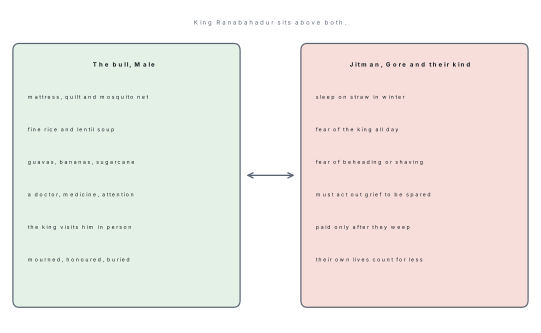
The bull is a character who never moves. Yet everyone talks to it, about it or around it. In a satire, this is a perfect trick: a dead animal becomes the most powerful person on stage, because the king loves it. By the end, three living men have been treated as less valuable than a carcass.
20.5 Themes
| Theme | Where it appears |
|---|---|
| Feudalism and absolute power | The king's whim can cost a man his head; everyone's life depends on his pleasure |
| Dehumanisation | A bull gets a mattress; men sleep on straw. Human beings are valued less than a royal pet |
| Fear and the culture of silence | Laxminarayan cannot speak loudly; the cowherds think of running away but fear arrest |
| Flattery (chakari) | Laxminarayan's praise of the bull; the cowherds' weeping; the king is surrounded by people who tell him what he wants to hear |
| Hypocrisy and false grief | The cowherds howl for a bull they resent |
| Patriarchy and polygamy | Laxminarayan has seven wives and expects to be waited on by all of them; the women are offstage and voiceless |
| Survival and cunning | The weak defend themselves by wit, lies and acting |
| Justice and truth | Truth is dangerous at court; the lie is rewarded |
What the play says about the society of that time
- The king and his subjects. The relation is one of command and dread. A king's animal is sacred; a subject's life is cheap. Subjects cannot complain, speak loudly or bring bad news.
- The family. Men like Laxminarayan hold absolute power in the home, as the king does in the state. A man can have many wives, expects service, and is resented in secret.
- The court. Advancement goes to the flatterer. Skill is less important than chakari.
- Work and class. The working people, the cowherds, live on straw and are paid only when they perform for the master.
To what extent has Nepal changed? A good answer balances the two sides. Changes: the monarchy has ended and Nepal is a republic with a constitution that guarantees equality and freedom of speech; polygamy is a legal offence; girls go to school and women hold office; citizens can criticise rulers openly; there is a free press. Continuities: patronage ("afno manche") and chakari still influence jobs and promotions; some powerful people still expect special treatment; poor and marginalised groups may still fear officials; and gender and caste inequality have not disappeared.
20.6 Dramatic techniques
Satire
The whole play is a satire. It works by exaggeration (a king who orders a bull's nursing in the hills), irony (people rewarded for lying), ridicule (the men fanning a dead animal) and contrast (the bull's bed against the cowherds' straw). The target is not a single king but a system that makes such behaviour reasonable.
Irony
| Kind | Example |
|---|---|
| Dramatic irony | The audience knows the bull is dead from the opening scene; Laxminarayan tells the king it is ill, and the king does not know. We watch the lie being built |
| Situational irony | The men who did nothing wrong (the bull died naturally or of rich food) are terrified of being killed; the men who lie are rewarded |
| Verbal irony | The cowherds say the bull was dearer than their parents; Laxminarayan speaks of the bull's "courage and beauty" as if it were a hero |
Black comedy and farce
The play turns a death into comedy. A corpse is massaged and fanned on stage. Farce is comedy of exaggeration and mistaken belief, here in the nursing of a dead animal and the loud weeping; black comedy laughs at something serious, here death and the threat of execution.
Structure and suspense
The play has a clear beginning (the news), middle (the lie and the journey) and end (the staged mourning). Suspense builds as the king approaches; the audience asks, "Will he see through it?" The pace is fast, with short exchanges. The three places and the single day give it the unity that a one-act play needs.
Language and stage business
The language is everyday and lively, with repeated formal greetings (swosti) to the king and forms of address such as baje that signal rank. Much of the action is physical: running in, bowing, massaging, fanning, weeping. The entrance of the convoy is a strong stage moment: the king's arrival makes the actors play their parts.
Symbols
| Symbol | Meaning |
|---|---|
| The bull | the king's power and whims; the thing that matters more than people |
| The hookah | a man's privilege at home |
| Mattress, quilt, net, straw | the contrast of care and neglect |
| The weeping | fear expressed as grief |
| Money at the end | the price the king pays for reassurance |
- The bull dies of natural causes or rich food; nobody kills it. The fear is of being blamed.
- The king does not punish anyone in this play; the point is the fear of punishment.
- The cowherds' weeping is not grief for the bull; it is fear, and an attempt to win the king's forgiveness.
- Do not write that the play is "about a bull". It is about people, and about a king and a system.
- Keep the numbers straight: Jitman receives 400 rupees, Gore 500 (as in the textbook's summary).
20.7 Critical appreciation
Strengths. The play has a bold idea (a dead bull at the centre), a swift plot with real suspense, strongly drawn comic characters and sharp dialogue. Its humour does not weaken its seriousness: we are laughing at something cruel. It is a rare example of Nepali satire on the stage, rooted in Nepali history and language.
Limits. The women of the play are offstage and silent; the king's inner life is not explored; the plot is simple. Some readers find the comedy gentle compared with the cruelty of the system it describes.
Relevance today. The play is still topical in any society where people fear to tell the truth to power and where favour matters more than merit.
Verdict. "The Bull" is a compact, witty satire whose joke is also its argument: a society that makes men weep for a dead animal to save their own lives needs to change.
20.8 Glossary
| Word | Meaning as used here |
|---|---|
| avid (adj.) | passionate and keen, e.g. about bulls |
| bichari (n.) | a legal officer or judge in the old court |
| baje (n.) | a respectful word for a grandfather; also a Brahman of any age |
| pathi (n.) | a measure of grain, about 3.2 kg |
| dharni (n.) | a measure of weight, about 2.5 kg |
| ana (n.) | a small coin (the textbook glosses it as a quarter of a rupee) |
| swosti (n.) | a respectful greeting from subjects to their lords |
| convoy (n.) | a procession of horses or vehicles accompanying an important person |
| wethers (n.) | castrated male goats |
| palanquin (n.) | a covered litter for one passenger, carried on poles by bearers |
| chakari (n.) | serving and flattering a person of rank to win favour |
| carrion (n.) | the dead body of an animal |
| feudal (adj.) | belonging to a system in which lords and kings hold power over common people |
| satire (n.) | writing that mocks faults in people or society |
| dehumanise (v.) | to treat people as less than human |
| sycophancy (n.) | excessive flattery of a powerful person |
| subservient (adj.) | too ready to obey others |
| hookah (n.) | a pipe for smoking tobacco with the smoke drawn through water |
| cowherd (n.) | a person who looks after cattle |
- Setting: Kathmandu, Ashwin BS 1854; King Ranabahadur Shah; the bull Male has died.
- Laxminarayan, the bull-doctor, tells the king the bull is ill and proposes a change of climate.
- At Thulo Gauchar he has the cowherds massage and fan the dead bull; the king declares it dead.
- The cowherds weep loudly; the king gives them 400 and 500 rupees; all are relieved.
- A satire on the feudal system: dehumanisation, fear, chakari, patriarchy.
20.9 Textbook exercises
The wording follows the CDC Grade 12 textbook as reproduced in common guides; match it with your own printing.
Understanding the text
a. Why have Gore and Jitman come to see Laxminarayan?
They have come to tell him that the king's bull, Male, has died. Laxminarayan is the bull-doctor, so the news is his responsibility, and they want his help because they fear the king's punishment.
b. What, according to the cowherds, is the reason behind the death of Male?
They say the bull died because it had been over-fed on food unfit for it: fine rice and split-gram (lentil) soup instead of grass, which it could not digest. They also complain that the bull was given a mattress, quilt and mosquito net, while they slept on straw in the winter.
c. Why does Ranabahadur want to see the bull himself?
To find out for himself how ill it is. When Laxminarayan suggests moving the bull to the hills for a change of climate, the king first agrees, then decides that if the bull can be treated at Thulo Gauchar it need not be moved, and he wants to see its condition with his own eyes before deciding.
d. Why does Laxminarayan run ahead of the convoy at Thulo Gauchar?
To reach the cowherds before the king and give them orders: they must massage the bull's back feet and fan it and say nothing of its death, so that the king will find them nursing the animal with devotion. He also starts preparing medicine, to show that all care has been given.
e. Why do Gore and Jitman cry when the king declares that Male is dead?
Not because they are sad for the bull. They cry to show loyalty and grief and to beg the king's forgiveness. They believe the king may punish them as if they had caused the death, so loud weeping is their best defence.
f. How do we learn that the bull is dead?
The cowherds tell Laxminarayan in the first part: its body is stretched out, its eyes are still and its tail is loose. Later, at Thulo Gauchar, the king himself examines it and says it does not breathe, its tail is loose, its ears have dropped and it does not eat: the bull is dead.
g. How does the play make a satire on the feudal system?
The play shows a king whose pet matters more than his subjects. The bull sleeps on a mattress under a mosquito net and eats fine food, while the cowherds sleep on straw. Everyone lives in fear of a king who can punish a man for a bull's death. To survive, the characters have to lie, flatter and weep on order, and the king rewards them with money. The society it depicts degrades human beings (dehumanisation), encourages flattery (chakari), and holds all power in a single man. The satire exposes these faults through irony, exaggeration and black comedy.
h. Write down the plot of the play in a paragraph.
In the autumn of BS 1854, two cowherds, Jitman and Gore, run to the house of the bull-doctor Laxminarayan with the news that King Ranabahadur Shah's favourite bull, Male, has died. All three are terrified of the king's anger. Laxminarayan goes to the Basantapur palace and, instead of telling the truth, reports that the bull is ill and suggests a change of climate. The king first agrees, then decides to see the bull at Thulo Gauchar. Laxminarayan runs ahead and tells the cowherds to massage and fan the dead animal. When the king arrives, he finds that the bull is dead. The cowherds burst into tears and the king, moved, gives them four and five hundred rupees; Laxminarayan is given orders about the bull's last rites. The three men, safe, thank God that they are alive. The play is a satire on a feudal society in which men fear for their lives because of an animal.
Reference to the context
a. Discuss the late-eighteenth-century Nepali society as portrayed in terms of the relation between the king and his subjects.
The play shows a rigidly hierarchical, feudal society in which the king has absolute power and the subjects are expected to obey. Fear governs the relation: the subjects believe the king can have them beheaded or shaved for the death of a bull, and Laxminarayan has already been punished for speaking too loudly. Flattery is essential: Laxminarayan bows, praises the bull and lies to keep the king pleased, and the cowherds weep to win pardon. Inequality is extreme: the king's bull has a mattress, quilt, net and rich food; his workers sleep on straw. The king's whim can decide a person's life; nobody dares tell him an unpleasant truth. At the same time the king is not shown as a monster: he rewards the men who weep, which suggests that he values display of loyalty above truth. The picture is of a society that dehumanises its people and makes cunning the only form of protection.
b. What does the relation between Laxminarayan and his wives tell us about the society of that time? To what extent has Nepali society changed since then?
Laxminarayan has seven wives and complains that none brings his hookah on time. This shows a patriarchal society in which men hold power in the family, polygamy is accepted, and women serve their husbands and have no voice (the wives do not appear). It also mirrors the larger picture: as the king is master of the state, the husband is master of the house. Changes: polygamy is now illegal; women have equal rights under the constitution, vote, study and hold office; awareness of gender equality has grown. Continuities: in many homes women still do most of the domestic work and have less say in decisions, and some social pressures and discrimination remain. So Nepali society has changed greatly in law and in many lives, but not completely in attitude.
c. Shed light on the practice of chakari as portrayed in the play. Have you noticed this practice in your society?
Chakari means serving and flattering a superior in order to win favour or protection. In the play Laxminarayan practises it on the king: he arrives early, bows low, praises the bull's beauty, gait and bravery, and never tells the king bad news directly. The cowherds weep loudly to win forgiveness. Everyone in the play, in fact, tries to please the person above. Chakari grows where power is unchecked and where favours matter more than merit. In today's society it still exists in milder forms: people flatter officials, managers or party leaders to get a job, transfer, contract or promotion; some go to offices with gifts or favours instead of qualifications. The remedy is a fair system in which appointments are made openly, by merit.
d. How does Laxminarayan outsmart Ranabahadur?
By controlling the information the king receives. On hearing of the bull's death he does not blurt it out. He goes to the palace and says that the bull is ill, praising its qualities so that the king feels proud; he suggests a change of climate so that the bull can be taken out of sight; and when the king decides to come, he runs ahead and arranges a performance, making the cowherds massage and fan the bull. So when the king finally sees that the bull is dead, it seems to have died despite great care, and the king pardons everyone. The trick works because Laxminarayan knows the king's weakness: his love of his bull and of shows of devotion.
e. Sketch the character of Laxminarayan.
Laxminarayan is a middle-aged court official and bull-doctor, a man of about forty with seven wives. He is domineering at home (he shouts for his hookah) and servile at court. He is intelligent and quick-thinking: he turns the crisis into a plan within minutes. He is skilled in chakari, understanding the king's moods and saying what pleases him. He is cowardly but cunning: fear of punishment pushes him to lie. He is protective in a practical way: he saves Jitman and Gore along with himself. He is comic: the picture of him ordering men to fan a corpse is unforgettable. Finally he is a product of the system: a man so afraid that all his cleverness goes into survival.
Reference beyond the text
a. Write an essay in about 300 words on "The Nepali Society: Past, Present and Future".
Model answer:
The Nepali Society: Past, Present and Future
A society is a group of people who live together and share customs, beliefs and rules. Nepali society is diverse, with many castes, ethnic groups, languages and religions, and it has changed greatly over time.
In the past, society was mostly agricultural and hierarchical. Kings and nobles held power; ordinary people had few rights and had to obey. Caste discrimination and untouchability were widespread; women had little education and were often married young; most people were poor and illiterate. Plays such as "The Bull" show how fear and flattery shaped life at court.
The present is very different. Nepal is a federal democratic republic with a constitution that guarantees equality, freedom of speech and basic rights. Caste discrimination is illegal, girls go to school, women serve in parliament and in the army, and roads, electricity, mobile phones and the internet reach remote villages. Many young people study or work abroad, and remittances support thousands of families. But problems remain: unemployment, migration of the young, corruption, regional and gender inequality, and pressure on the environment.
In the future, I hope Nepali society will combine its rich culture with modern knowledge. If we invest in education, health, honest government and local industries, more of our young people can find work at home. Equal opportunity for women and marginalised groups, respect for our diversity and care for our mountains and rivers will make society fairer and stronger. The change must begin with each of us: by rejecting flattery and favouritism, telling the truth and working for the common good.
b. In his "Satire 9", Nicolas Boileau-Despréaux says: "But satire, ever moral, ever new / Delights the reader and instructs him, too. / She, if good sense, refine her sterling page, / Oft shakes some rooted folly of the age." Do you agree with the poet? Discuss the lines with reference to "The Bull".
Boileau says that good satire is moral (aims at improvement) and fresh; it both entertains and teaches; and when it is guided by good sense, it can "shake" a folly that society has long accepted.
I agree. "The Bull" delights: the picture of three men massaging and fanning a dead bull, and the cowherds' loud weeping, is very funny. It also instructs: behind the laughter we see a king who values a bull above his subjects, men who must flatter to survive and a culture of fear. The "rooted folly of the age" is feudal power and chakari, which seemed natural in 1797 and to some extent survives today. Tiwari, a reformer by temperament, wrote the play to make the audience feel the absurdity. The satire is moral because its target is injustice, not a person; and it is fresh because it sets the story in a real time and place (Ranabahadur's Kathmandu) and uses a dead bull for its hero. So the play proves the poet's claim: laughter can make people see a wrong more clearly than a sermon.
Chapter summary
- Bhimnidhi Tiwari (1911-1973), Nepali poet, dramatist and reformer, founder of the Nepal Natak Sangh, wrote the one-act satire "The Bull".
- The setting is Kathmandu in Ashwin, BS 1854; the king is Ranabahadur Shah, fond of bulls.
- The cowherds Jitman and Gore tell the bull-doctor Laxminarayan that the king's bull, Male, has died, apparently from rich food.
- Laxminarayan tells the king the bull is ill and needs a change of climate; the king decides to see it at Thulo Gauchar.
- Laxminarayan runs ahead and makes the cowherds massage and fan the dead bull; the king declares it dead; the cowherds weep loudly and are given 400 and 500 rupees; all are relieved.
- Themes: feudalism and absolute power, dehumanisation, fear, chakari, patriarchy and polygamy, hypocrisy, survival by cunning.
- Techniques: satire, dramatic, situational and verbal irony, black comedy and farce, contrast, suspense, stage business, symbols (the bull, the hookah).
- The play criticises a society in which an animal is valued more than the people who care for it.
Practice questions
Short answer questions (2 marks each)
- Who is Bhimnidhi Tiwari? [2]
- What is the name of the bull and who owns it? [2]
- Why are Laxminarayan, Jitman and Gore afraid of the king? [2]
- What excuse does Laxminarayan give the king for moving the bull? [2]
- What does Laxminarayan tell the cowherds to do before the king arrives? [2]
- How much money does the king give to Jitman and Gore? [2]
- What does the word "chakari" mean? [2]
- Name two things that show the bull is treated better than the cowherds. [2]
Model answers — short questions
1. Bhimnidhi Tiwari (1911-1973) was a Nepali poet, story-writer and dramatist, and a social reformer who founded the Nepal Natak Sangh to promote Nepali plays.
2. The bull is called Male. It belongs to King Ranabahadur Shah, who is very fond of bulls.
3. Because the king's bull has died in their care, and the king is known to punish people severely. They fear being beheaded or shaved as a punishment, though the bull died of natural causes or rich food.
4. He says the bull is ill, will not eat, move or speak, and needs a change of climate; he asks to take it to the hills. This is a lie to hide that the bull is already dead.
5. He tells them to massage the bull's back feet and fan it as if it were alive, and not to reveal that it is dead.
6. Jitman receives four hundred rupees and Gore five hundred.
7. Chakari is serving and flattering a person of higher rank to win his favour; it also means pleading before such a person by showing one's poverty or distress.
8. The bull has a mattress, quilt and mosquito net and is fed fine rice and lentil soup, while the cowherds sleep on straw in winter and live in fear.
Long answer questions (5 marks each)
- Discuss "The Bull" as a satire on the feudal system. [5]
- How does Laxminarayan save himself and the cowherds? What does this tell us about him? [5]
- Discuss the use of irony and humour in the play. [5]
- "In feudal society, human beings are treated worse than animals." Discuss with reference to the play. [5]
Model answers — long questions
1. A satire exposes the faults of people or society through humour. "The Bull" exposes the feudal system, in which a king and lords hold all power. The first fault is the dehumanisation of ordinary people: the king's bull has a mattress, quilt and mosquito net, while the cowherds sleep on straw; the men's lives are at risk if the bull dies. The second is fear: Laxminarayan, Jitman and Gore are terrified of being beheaded or shaved, though the bull died without their fault. The third is chakari: Laxminarayan lies and praises the bull to please the king, and the cowherds howl with mock grief. The fourth is patriarchal privilege: Laxminarayan has seven wives and shouts for his hookah. The fifth is the power of the king's whim: the king's pleasure decides who is punished or rewarded, and he pays 400 and 500 rupees for a show of weeping. Tiwari uses exaggeration, irony and black comedy, rather than open attack, so that the audience laughs first and thinks afterwards. The play is therefore a sharp critique of a society in which human dignity depends on the moods of a ruler.
2. Laxminarayan saves himself and the cowherds by controlling what the king knows. When Jitman and Gore bring the news, he keeps it secret and goes to the palace. There he says the bull is ill and praises its beauty and courage, and suggests a change of climate in the hills, so that any death could happen out of sight. When the king says he will visit Thulo Gauchar, Laxminarayan runs ahead, has the cowherds massage and fan the dead bull, and begins to grind medicine. So the king finds the bull dead in the middle of loving care. The cowherds weep loudly; Laxminarayan himself weeps. The plan works: the king rewards the cowherds and deals kindly with the doctor. The plan shows that Laxminarayan is clever, quick and skilled in chakari; but it also shows that he is fearful and servile, and that in this society survival depends on deceiving the ruler.
3. Irony is the source of the humour. Dramatic irony: the audience knows from the start that the bull is dead and watches Laxminarayan lie to a king who does not know. Situational irony: men who did nothing wrong are terrified, and in the end they are rewarded for lying; a king who could have punished them pays them. Verbal irony: the cowherds declare that the bull was dearer to them than their parents, wives and children. Humour comes also from farce: the men massage and fan a corpse; from exaggeration: the cowherds' loud weeping and Gore's threat to hang himself; and from contrast: the bull's mattress and net against the cowherds' straw. The humour is not light: it is black comedy, laughter at fear, death and injustice, and it makes the satire more effective.
4. The play shows this by comparison. The bull, Male, has a mattress, quilt, mosquito net, fine rice, lentil soup and snacks, a doctor and medicine, and the king's personal visit. The cowherds sleep on straw in winter, live in fear of beheading and must weep on command to be forgiven. Laxminarayan, although a court official, tells lies and bows because his life is worth little if the bull dies. The king's attitude is the same: he gives the men money not because he cares for them but because he is moved by their love for his bull. The dead animal therefore outranks three living men. The play thus shows the dehumanisation typical of feudal society, where a person's worth depends on the lord's pleasure and where property, even an animal, may count for more than a human being.
Reference to the context
- Laxminarayan shouts at his wives because they have not brought his hookah, although he has seven of them. The cowherds then run in with news that the bull has died.
(a) What does Laxminarayan's complaint tell us about him and about his household? (b) What news do the cowherds bring? (c) How do the three react? (d) What is the effect of placing the two events together? [5]
- At Thulo Gauchar, Laxminarayan runs ahead of the king's convoy and tells the cowherds to massage the bull's back feet and wave a fan.
(a) Why does he do this? (b) What is the state of the bull? (c) What does the king say when he arrives? (d) What does the scene show about the people of the play? [5]
- When the king says the bull is dead, Jitman says he is now an orphan and Gore says the bull was dearer to him than his family.
(a) Why do they say this? (b) Are they sincere? (c) How does the king respond? (d) What is the irony of the scene? [5]
Model answers — reference to the context
1. (a) It shows that he is a domineering man in a patriarchal household, where a man with seven wives expects service and gets none; his authority at home is weak while he behaves as a master. (b) That the king's bull, Male, has died. (c) They are terrified: they fear the king's punishment and start planning how to save their lives. (d) The comic contrast: a man who bullies his wives is reduced to panic by a dead bull; it introduces the theme of fear and of how power works downwards.
2. (a) To make it look as if the bull is being nursed with great care, so that the king finds them devoted servants, not careless ones. (b) It is dead: it does not breathe, its tail is loose and its ears have dropped. (c) He calls the bull by name, sees that it does not breathe, and declares it dead. (d) That people are ready to act and lie to survive, and that the king can be made to see what they want him to see.
3. (a) To show grief and loyalty, and so to be forgiven; they fear being punished for the bull's death. (b) No; their tears are acting, born of fear, and Gore's speech about his parents and family is an exaggeration. (c) The king is moved and rewards them with 400 and 500 rupees. (d) Men who would be punished if they told the truth are paid for lying, and a bull's death earns more money than years of honest service.
Reference beyond the text
- "Flattery is a way of life in many offices." Discuss with examples from your experience. [5]
- Write a paragraph on "The Role of Satire in Society". [5]
Answer hints — reference beyond the text
1. State whether you agree. Explain chakari and give two realistic examples (praising a superior to get a posting; giving gifts to an official for a favour). Discuss the harm (merit ignored, honest people discouraged) and suggest remedies (open recruitment, transparency, honesty).
2. Define satire; say it uses humour and exaggeration to expose faults; give examples (newspaper cartoons, comic plays, "The Bull"); explain how laughter can change attitudes more than lecture; end by noting that satire must be fair and aim at injustice, not individuals.
Practise more: English question bank